Peperomia Stem Cutting Propagation: Full Method
Peperomia obtusifolia stem cutting propagation is the most reliable method available for this species — a healthy cutting with at least one node roots readily without hormone, in either water or a free-draining medium. The biggest failure risk is not the rooting process itself but rushing a fresh cut into moisture before the wound has sealed, which is what causes most cutting losses.
When to Use This Method
Stem cutting suits any healthy, actively growing specimen with stems long enough to spare a section without disfiguring the parent plant — typically spring through summer, when growth is active and recovery is fastest. It is the right choice when the goal is a new, independently-rooted plant rather than simply filling out the parent's own pot, which is what division is better suited to on an already multi-stem specimen. For a variegated cultivar, the cutting must include a variegated node — a green-only section will not preserve the pattern, and leaf cuttings without a stem node fail at this even more often; see the variegated leaf cutting guide for why. If pruning back a single long, trailing stem specifically, that one stem can usually be sectioned into several separate cuttings rather than treated as one — see the long-vine propagation guide for the multi-section method.
Tools, Medium, and Cutting Selection
- Sterilised blade or scissors — wipe with 70% isopropyl alcohol before cutting, and between cuts if taking more than one.
- A healthy stem section with at least one node and one to two leaves. Choose firm, unblemished stem tissue — avoid soft, stretched, or etiolated growth, which roots poorly and is better addressed with the fix leggy peperomia guide first.
- Rooting medium: either clean water in a jar, or a free-draining mix of at least 30% perlite or pumice by volume — see the perlite propagation guide for that specific method.
- A bright, indirect-light spot in the 2,000-4,000 lux optimum range, out of direct sun.
Step-by-Step Method
- Cut just below a node, using the sterilised blade, taking a section with at least one node and one to two leaves attached.
- Let the cut end callus in a dry, shaded spot before it touches any moisture — roughly 24-48 hours before soil, or an overnight window before water. The full timing rules are in the callus timing guide; skipping this step is the single most common cause of cutting failure in this species.
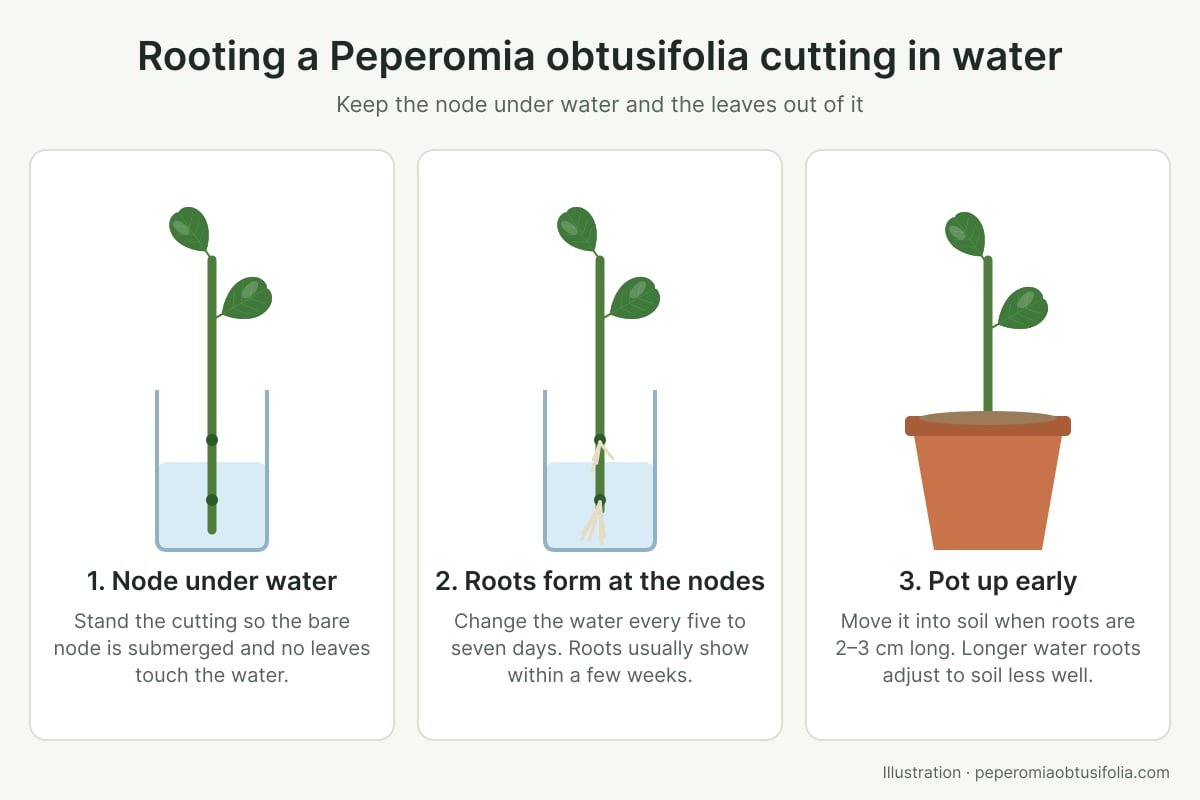
- Place the callused cutting in the chosen medium — the bottom 1-2 cm of stem submerged in water with leaves clear of the waterline, or the node buried just below the surface in a free-draining mix.
- Position in bright, indirect light, away from direct sun, which stresses a cutting that cannot yet replace lost water through active roots.
- Maintain the medium — change water every 5-7 days to keep it oxygenated, or keep substrate lightly moist without saturating it.
Rooting and New-Growth Signs
The first visible roots in water typically appear within two to four weeks, though timing varies with temperature and light — cooler rooms and marginal light both slow the process without necessarily preventing it. In substrate, roots are not visible directly, so a gentle, resistance-testing tug after three to four weeks is the usual check: resistance suggests roots have anchored, while the cutting lifting freely suggests more time is needed. The first new leaf is the most reliable overall confirmation that the cutting has established a functioning root system, since leaf expansion draws on resources a rootless cutting cannot sustain for long.
Transition and Aftercare
Once water-grown roots reach roughly 2-3 cm, pot the cutting into a standard free-draining mix — water roots are more fragile than soil-grown roots, so handle them gently during the move and expect a short adjustment period as the plant develops soil-adapted root hairs. Do not fertilise until a new leaf has fully expanded; a cutting still establishing its root system is particularly vulnerable to salt stress from feeding too early. Hold normal care thresholds from the complete care guide once the plant is settled, rather than treating it as a special case indefinitely.
Failure Diagnosis
| Symptom | Likely cause | Action |
|---|---|---|
| Stem turns soft, black, or foul-smelling | Wound wasn't callused before contact with moisture | See the cuttings rotting guide for rescue steps |
| Leaves wilt but stem stays firm | Hydraulic deficit while waiting on roots | Raise local humidity slightly, avoid direct sun, be patient |
| No roots after 4-6 weeks | Room too cool, or medium chronically wet | Confirm 18-24°C and that the medium is not waterlogged |
| Leaves yellow and drop one at a time | Normal resource reallocation during establishment | Monitor; concerning only if it continues past new-leaf emergence |
Water vs Soil: The Main Comparison
Water propagation offers the clearest visual monitoring and needs no special medium, but produces thinner roots with fewer root hairs, meaning a deliberate transition period once potted. Soil or perlite propagation produces roots already adapted to substrate, skipping that transition, at the cost of not being able to see progress directly. Neither is objectively superior — water suits a grower who wants to watch the process closely; perlite or soil suits one who would rather pot once and be done. For the full comparison across all four propagation methods this species tolerates, see the complete propagation guide.
Care FAQ
Where should I cut the stem for propagation?
Just below a node — the point where a leaf attaches to the stem. Nodes carry the concentrated meristematic tissue capable of forming new roots; a cut made mid-internode, away from any node, is far less likely to root and more likely to simply rot.
Do I need rooting hormone for Peperomia obtusifolia cuttings?
No. This species roots reliably from a healthy node-bearing cutting without hormone for routine propagation. Hormone can modestly speed root initiation but is not required the way it is for genuinely difficult-to-root woody species.
Is water or soil better for stem cuttings?
Both work; they produce different root types. Water-grown roots are thinner with fewer root hairs and need a gentler transition to soil; perlite or soil-grown roots develop more root hairs directly suited to substrate, easing that transition. Water suits easy visual monitoring; soil or perlite suits skipping the transplant step entirely.
Why is my stem cutting wilting before it roots?
A cutting without roots cannot replace water lost through the leaves, so any wilting before roots form is a hydraulic deficit, not a sign the cutting has failed. Raising local humidity slightly and keeping the cutting out of direct sun reduces water loss while it waits to root.