Peperomia Obtusifolia Identification Guide
Peperomia obtusifolia identification comes down to three checks that nursery labels frequently get wrong: leaf shape and vein pattern, the colour of sap from a nicked stem, and — where present — flower structure. No single trait is entirely diagnostic on its own, so confirming at least two of the three is the reliable approach, particularly given how often this species is mislabelled or confused with unrelated plants at the point of sale.
Quick Identification Reference
| Trait | Peperomia obtusifolia | Common mislabel it rules out |
|---|---|---|
| Leaf shape | Obovate, blunt rounded tip | Ficus elastica (tapering, pointed tip) |
| Leaf arrangement | Alternate, one per node | Hoya, Crassula (opposite pairs) |
| Sap when cut | Clear and watery | Ficus elastica (thick, milky latex) |
| Stem at maturity | Stays fleshy, never woody | Hoya, Crassula (become woody with age) |
| Stem cross-section | Rounded | P. magnoliifolia (more angular) |
| Flower structure | Leafless green-white spadix | Not shared by any of the above |
What This Species Actually Looks Like
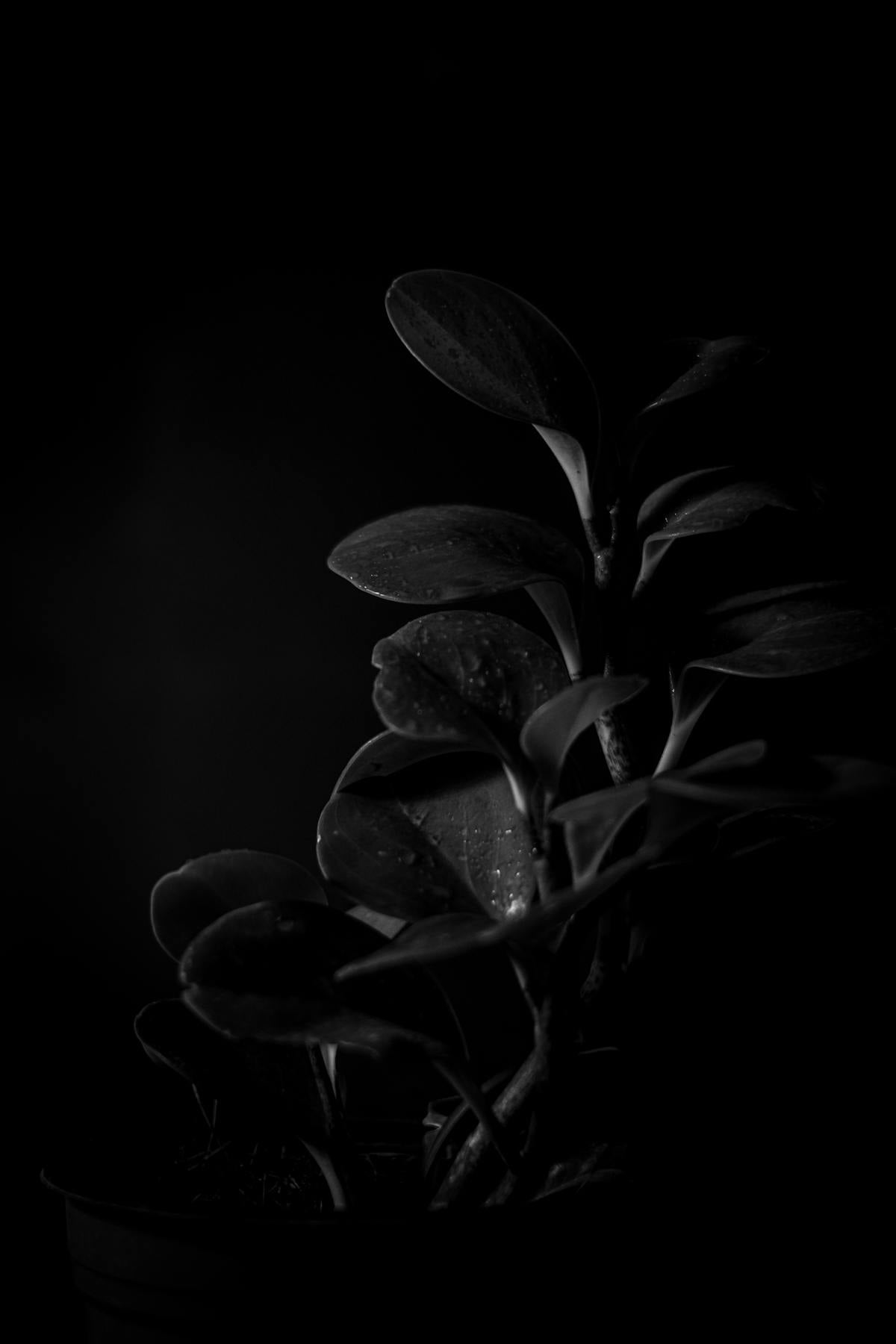
The specific epithet obtusifolia means "blunt-leaved," and that is the first and most useful visual cue. Leaves are obovate — wider toward the tip than at the base — with a rounded, blunt apex rather than the tapering point common on many other houseplant genera. Held up to bright light, the leaf shows 3-5 primary veins that curve from the base toward the tip without branching into a netted pattern, a venation style called curvinervous that is a hallmark of the genus. The surface itself is smooth, glossy, and covered in a thick waxy cuticle, giving it a cool, slightly rubbery feel rather than a papery or fuzzy texture.
The stem stays fleshy and succulent even on old, mature specimens — it never develops true bark or a woody trunk. Leaves attach in an alternate pattern, one per node, zigzagging up the stem rather than growing in opposite pairs. That permanently fleshy stem is also why a correctly identified specimen leans and bends toward light rather than holding a rigid, self-supporting shape — see the geotropism and gravity guide for the mechanism behind that growth response.
Causes of Misidentification, Ranked From Most to Least Likely
1. Confusion With Ficus elastica (the true rubber tree)
This is the most consequential mix-up, since the common name "Baby Rubber Plant" actively encourages it, and the two species carry different toxicity profiles.
Confirm it: Nick a leaf or stem and check the sap. P. obtusifolia produces a clear, watery fluid; F. elastica immediately leaks a thick, sticky, milky-white latex. The growth tip also differs — Ficus protects new leaves with a papery sheath (stipule) that peels away as the leaf expands, while Peperomia's growth tip has no such covering.
Why it matters beyond appearance: F. elastica latex is a skin and mucous-membrane irritant, and separate Ficus species are consistently listed as toxic to cats and dogs by the ASPCA, whereas P. obtusifolia — the ASPCA's own Baby Rubber Plant listing — is non-toxic to cats, dogs, and horses. Confirming the sap test is not a cosmetic detail if pets have access to the plant.
2. Confusion With Hoya Species
Both are sold as easy-care, glossy-leaved houseplants, and both are frequently marketed toward the same low-maintenance buyer.
Confirm it: Check leaf arrangement first — P. obtusifolia leaves are alternate; Hoya leaves are opposite, in pairs directly across from each other at each node. Mature Hoya stems also become distinctly woody and vining over time, which P. obtusifolia never does regardless of age. The full side-by-side comparison, including care differences, is in the Peperomia vs Hoya guide.
3. Confusion With a Different Peperomia Species — Most Often P. magnoliifolia
Retail labelling routinely applies "Peperomia obtusifolia" loosely across several visually similar species within the same genus.
Confirm it: Stem cross-section is the most reliable distinguishing trait — rounder in true P. obtusifolia, more angular in P. magnoliifolia — alongside subtle differences in leaf venation. Since both species require broadly similar care, a mix-up here has lower practical consequences than the Ficus or Hoya cases, but it matters for anyone specifically collecting or propagating the true species.
4. Confusion With Succulents Such as Crassula (Jade Plant)
Less common, but occurs when a young, compact P. obtusifolia is displayed alongside true succulents in a mixed "succulent" retail tray.
Confirm it: Leaf arrangement again settles this quickly — Crassula ovata has opposite leaf pairs, while P. obtusifolia is alternate. Crassula stems also become woody with age, unlike the permanently fleshy P. obtusifolia stem.
Why Succulence Alone Doesn't Confirm the Species
Nursery trays sometimes group a young, compact P. obtusifolia alongside genuine desert succulents under a generic "succulent" label, and the plant's own leaf tissue reinforces the mix-up: it stores water in the same hydrenchyma tissue desert succulents use, giving it a comparably firm, water-filled feel. But this is convergent adaptation, not shared lineage — P. obtusifolia is an epiphyte that evolved succulence to buffer short drought spells between rainfall in the tree canopy, not a desert plant. Two practical differences separate it from a true desert succulent like Crassula even before checking leaf arrangement: its light needs sit in the 2,000-4,000 lux optimum band typical of bright indirect indoor light, well below what Crassula and other desert succulents tolerate in direct sun, and it does best around 40-60% relative humidity rather than the very low humidity a cactus or Crassula shrugs off. Neither of these is a fast visual check on its own, so they support the leaf-arrangement and stem-woodiness tests above rather than replacing them — a semi-succulent feel narrows the possibilities but doesn't confirm the species by itself.
Confirming Flowering Specimens
If the plant is producing an inflorescence, identification becomes close to unambiguous. Peperomia species do not produce petalled flowers; instead they grow a spadix — a slender, erect, greenish-white spike, unscented, that looks like a solid rod to the naked eye but carries large numbers of microscopic fertile flowers along its length under magnification. This structure is a reliable signature of the Piperaceae family and is not produced by Ficus, Hoya, or Crassula.
Common Buying Mistakes
- Trusting a generic label such as "succulent mix" or "rubber plant" without checking the sap or leaf arrangement.
- Assuming glossy leaves alone confirm the species — glossiness is shared convergently with several unrelated genera and is not diagnostic by itself.
- Skipping the stem check on older specimens, where a woody, thickened stem should immediately rule out true P. obtusifolia and point toward Hoya or Crassula instead.
- Assuming a cultivar name on the tag is accurate — trade names for variegated and coloured forms are applied inconsistently across sellers, and the underlying species identity should still be confirmed independently using the checks above.
Identifying the Cultivar, Once the Species Is Confirmed
| Cultivar | Distinguishing trait |
|---|---|
| 'Variegata' | Stable cream-to-white leaf margins with a green centre |
| 'Albo-Marginata' | Similar white-margined variegation to 'Variegata'; naming is used somewhat interchangeably by some sellers |
| 'Marble' | Irregular, blotchy variegation scattered across the leaf rather than confined to the margin |
| 'Lemon Lime' | Yellow-to-lime variegation without a sharply defined white margin |
| 'Red Edge' | Reddish pigmentation concentrated at the leaf margin and stem |
Cultivar identity is a secondary check once the species itself is confirmed — a plant can be correctly identified as P. obtusifolia and still carry an inaccurate or inconsistently applied cultivar name, since trade names in this genus are not governed as strictly as the species-level binomial.
For the broader taxonomic and historical context behind the genus name, see the genus history guide. Readers interested in the plant's cultural associations rather than its biology should see the spiritual meaning and symbolism guide; those with questions about its inflorescence and pollen specifically should see the pollen and allergy guide, and the petiole anatomy underlying its structural growth habit is covered in the petiole guide.
Care FAQ
Is Peperomia obtusifolia the same as a Baby Rubber Plant?
'Baby Rubber Plant' is simply a common name for Peperomia obtusifolia, not a separate species. It is not related to the true rubber tree, Ficus elastica — the resemblance in leaf glossiness is convergent, not a sign of shared ancestry, and the sap test below tells the two apart in seconds.
How can I tell Peperomia obtusifolia from Hoya?
Check where the leaves attach to the stem. Peperomia obtusifolia leaves are alternate — one per node, arranged in a zigzag up the stem. Hoya leaves are opposite, growing in pairs directly across from each other. Mature Hoya stems also become distinctly woody and vining, which Peperomia obtusifolia never does.
What does the flower of a Peperomia obtusifolia look like?
A spadix — a slender, erect, greenish-white spike with no petals, often described as resembling a thin rat-tail. It carries large numbers of tiny fertile flowers along its length. This structure alone confirms placement in the Piperaceae family and is not shared with Ficus, Hoya, or true succulents like Crassula.
Why do nursery labels get Peperomia obtusifolia wrong so often?
Retail labelling frequently uses whichever common name is easiest to sell — "succulent mix," "rubber plant," or a cultivar name applied loosely to a related but distinct species such as Peperomia magnoliifolia. The label is a starting point, not a confirmation; the leaf, stem, and sap checks in this guide are what actually verify the identification.