Peperomia Leaf Anatomy: Why Succulence Prevents Rot
Peperomia leaf anatomy explains both the rubbery feel and the signature gloss of this species: a thick layer of water-storage parenchyma beneath the surface holds enough reserve that the plant tolerates real gaps between waterings, and a waxy cuticle over the epidermis limits water loss while also reflecting light. Both structures are the same underlying adaptation — a facultative epiphyte's answer to unpredictable water availability in the forest canopy — expressed in two different tissue layers.
Water-Storage Parenchyma: Why the Leaf Feels Rubbery
Slice a Peperomia obtusifolia leaf in half and the cross-section shows a thick layer of clear, largely colourless tissue distinct from the thinner green photosynthetic layer — this is the water-storage parenchyma, sometimes called hydrenchyma. This water-storage strategy is documented across many species in the roughly 1,500-species Peperomia genus, whose own naming history is a separate matter of taxonomic record covered in the genus history guide rather than a leaf-anatomy question. These cells carry little chlorophyll; their function is almost entirely water and mineral storage rather than energy production. When well hydrated, they hold water under real internal pressure — turgor — which pushes outward against the cell walls and gives the leaf its firm, taut, faintly rubbery feel. This is also why a healthy, well-hydrated leaf resists bending sharply and instead tends to crease or snap rather than fold smoothly: the pressurised cells have little give. A leaf that bends easily and feels soft rather than firm has partially emptied its water-storage tissue and is a genuine early sign of drought stress, distinguishable from turgor loss caused by root failure by checking the substrate alongside the leaf.
The Waxy Cuticle: Structure and Function
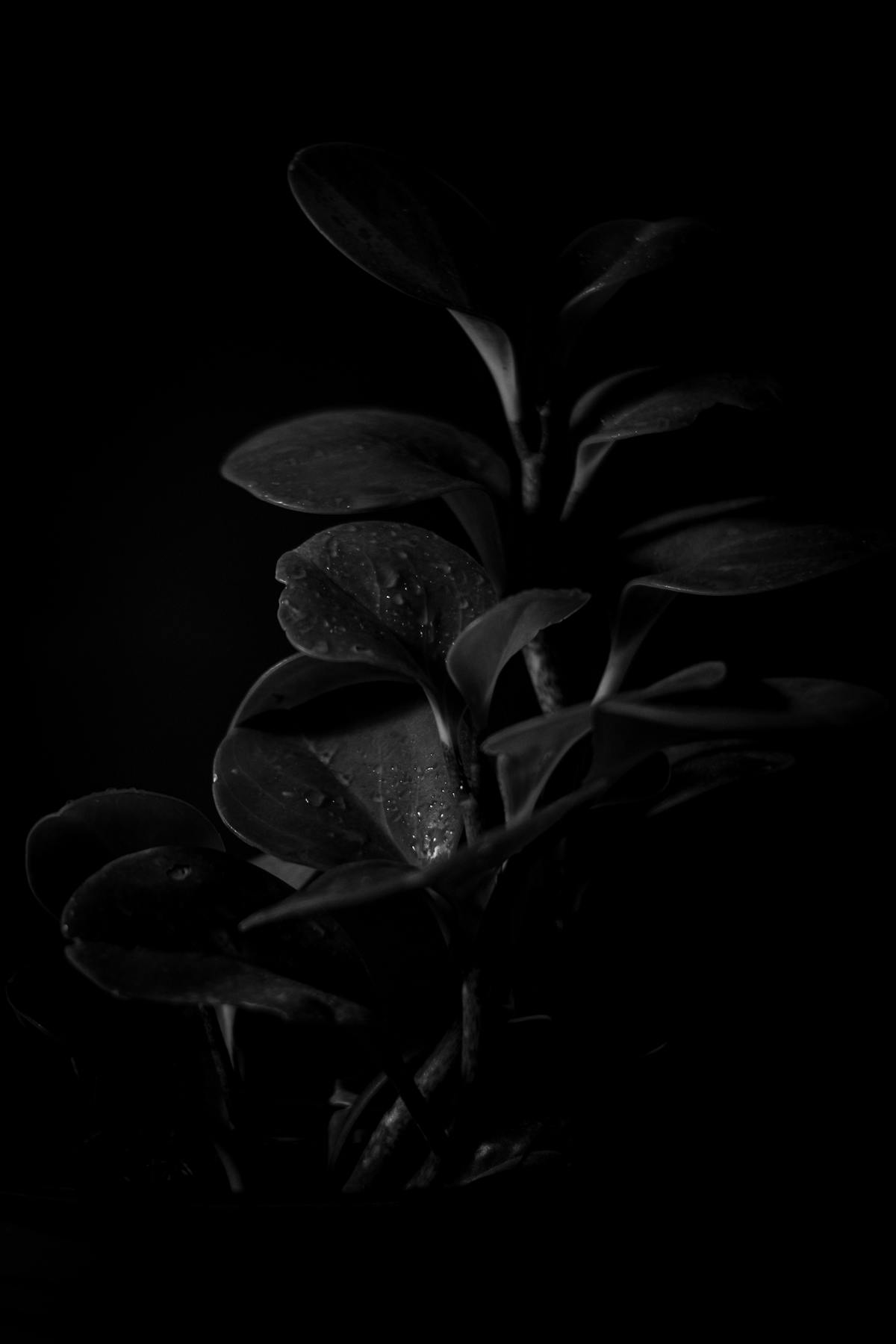
Covering the epidermis is a cuticle built primarily from cutin, a fatty-acid polymer the leaf's outer cells secrete and link together into a continuous, largely water-impermeable sheet. This barrier is substantially thicker on P. obtusifolia than on thinner-leaved tropical houseplants, and it is the main reason the species tolerates centrally heated rooms and irregular watering better than many other tropicals: most water the plant loses passes through the stomata under the plant's own control, not through the leaf surface generally. On top of the cutin layer, many specimens also carry a coating of epicuticular wax — microscopic wax crystals that scatter light rather than reflecting it as a sharp mirror image, which is part of why the leaf reads as a deep, saturated glossy green rather than a harsh shine. This wax layer is also strongly hydrophobic: water beading and rolling cleanly off the leaf surface, carrying dust and some surface spores with it, is a direct, visible consequence of this structure rather than a coincidence.
Why the Gloss Matters Beyond Appearance
A glossy leaf surface reflects a meaningful portion of incident light rather than absorbing all of it, which reduces how much the leaf heats up under strong indoor or filtered outdoor light — part of the reason this species tolerates brighter positions than its understorey origin might suggest. This reflectivity is also why misting and leaf-shine sprays are counterproductive rather than merely unnecessary: the cuticle is not a surface designed to take up water, so misting adds nothing the plant can use, and oil-based shine products risk sitting on top of the natural wax rather than enhancing it, potentially interfering with the light-scattering effect that gives the leaf its characteristic look in the first place. Newer leaves typically look less glossy than mature ones simply because the wax layer accumulates gradually as the leaf ages, not because anything is wrong.
Peperomia Stem Anatomy: Vascular Bundles and Lignification
The stem carries its own layer of water-storage parenchyma, functionally continuous with the leaf hydrenchyma described above — during a dry spell, this reserve draws down first, buffering the leaf and the apical meristem against a sudden shortfall before wilting becomes visible externally. A mature, well-hydrated stem feels firm and slightly rubbery under light pressure for the same turgor reasons as the leaf, and a stem that wrinkles or feels distinctly weak without any sign of lignification is showing the same turgor loss described above, not a separate stem-specific fault; check the substrate alongside it to rule out root failure before assuming drought.
A cross-section through a young stem shows a ring of vascular bundles running through the ground tissue rather than the single central column found in many woody dicots — an arrangement typical of Peperomia's placement within the magnoliid clade. Each bundle carries xylem, moving water and dissolved minerals upward, and phloem, moving sugars downward, sheathed in sclerenchyma fibres that give the bundle some mechanical resistance to bending. In a young, non-lignified stem, though, it is turgor pressure in the surrounding parenchyma — not these fibres — that does most of the work of holding the plant upright, which is why a stem that loses turgor also loses its rigidity.
As the stem ages, particularly near the base, it undergoes lignification — the deposition of lignin into the cell walls, which browns and stiffens the tissue. This marks a genuine shift in how that section of stem supports itself, from hydraulic support (turgor pressure in water-filled cells) toward structural support (a rigid cell wall that holds its shape regardless of hydration). The practical consequence is straightforward for propagation: a lignified, brown, hardened stem section roots far less reliably than a green, non-lignified section, since the same rigid walls that provide structural support also resist the cell division needed to initiate new roots. Take cutting material from the green growth nearer the tip rather than the hardened base for stem cutting propagation. A stem that has gone soft, dark, and foul-smelling rather than simply wrinkled is a different problem entirely — see the stem rot guide for that diagnosis.
Gas Exchange: A Stress-Conditional Adjustment, Not a Nightly Routine
Peperomia obtusifolia runs a modified C3 photosynthetic pathway under normal conditions — stomata open during the day for standard gas exchange, the same as most common houseplants. Under sustained water stress specifically, the species has been documented shifting toward CAM-cycling, temporarily adjusting stomatal timing to conserve water during drought. This is a stress response, not a routine nightly behaviour, and should not be described as the plant "breathing at night" as a matter of course. The practical relevance for care is narrower than the mechanism sounds: it means the plant has some physiological flexibility to survive a missed watering, not that its normal-condition gas exchange schedule differs from an ordinary daytime-active houseplant.
What This Does Not Prove
Semi-succulent leaf and stem anatomy explains real drought tolerance, but it does not make the plant drought-proof indefinitely, and it is not evidence the species is a true desert succulent like Crassula or Echeveria — it is a facultative epiphyte with a water-storage adaptation layered onto ordinary tropical-plant tissue, not a cactus-like physiology. It is also worth separating this kind of documented, mechanistic trait from the plant's more cultural associations — the spiritual symbolism attached to the species draws on its resilience, but that reading is folklore layered on top of the biology described here, not a description of it.
How This Anatomy Shapes Care Decisions
Skip misting. The cuticle described above is a water barrier, not a water-absorbing surface — misting does not meaningfully hydrate the plant and mainly adds standing moisture that raises fungal and bacterial risk in still air.
Judge hydration by leaf firmness alongside substrate moisture, not leaf firmness alone. A firm, taut leaf indicates full water-storage tissue; a softer, more flexible leaf suggests the reserve is depleted — but always confirm against the substrate, since a soft leaf on wet substrate points to root failure rather than drought, needing the opposite response.
Don't assume dull new growth is a problem. The wax layer builds gradually, and a less glossy newest leaf on an otherwise healthy plant is normal development, not a symptom.
Clean with plain water, not oil-based products. A soft, damp cloth restores the natural gloss by removing dust without risking interference with the epicuticular wax structure itself.
For the general watering and light thresholds this anatomy sits underneath, see the complete care guide; for the stomatal mechanics referenced above in more depth, see the humidity guide; and if turgor loss has progressed to visible wilting, the wilting guide covers distinguishing dehydration from root failure in more detail.
Care FAQ
Why do Peperomia leaves feel rubbery rather than papery?
Beneath the surface, the leaf carries a thick layer of water-storage parenchyma — large, largely colourless cells whose only function is holding water. When these cells are full, internal pressure (turgor) pushes outward against the cell walls, giving the leaf its firm, rubbery feel. A leaf that bends easily rather than feeling taut is a sign those cells have partly emptied.
Are Peperomia obtusifolia true succulents?
They are usually described as semi-succulent. The species doesn't grow in a desert, but it evolved the same water-storage strategy as true succulents to survive as a facultative epiphyte where soil moisture in the forest canopy and leaf litter is unpredictable.
What is the waxy cuticle, and why does it matter for care?
It is a layer of cutin and epicuticular wax coating the leaf surface, acting as a near-total water barrier. It is why misting does essentially nothing for this species — the leaf cannot absorb water through a surface built specifically to keep water out — and why "leaf shine" products, which are often oil-based, risk interfering with a barrier that already works well on its own.
Why does new growth look less glossy than older leaves?
The wax layer builds up gradually as a leaf matures rather than being fully present from the moment the leaf unfurls. A duller newer leaf is not a symptom of anything wrong — it typically develops its full gloss over the following weeks.