Peperomia vs Jade Plant (Crassula): Best Care Compared
Peperomia obtusifolia and the Jade Plant (Crassula ovata) are frequently confused because both have thick, glossy, jade-green leaves, but they belong to unrelated families and run on different internal chemistry. Choose Crassula if you have a genuinely bright, direct-sun spot and want a slow-growing, drought-tolerant succulent; choose Peperomia if your brightest spot is indirect light, or if there are cats or dogs in the house, since Crassula is toxic to both and Peperomia is not.
Side-by-Side Comparison
| Factor | Peperomia obtusifolia | Jade Plant (Crassula ovata) |
|---|---|---|
| Family | Piperaceae | Crassulaceae |
| Leaf arrangement | Alternate — one leaf per node | Opposite — two leaves per node |
| Photosynthetic pathway | C3, with CAM-cycling under drought stress only | Obligate CAM |
| Light need | 2,000-4,000 lux, bright indirect | Several hours of direct or near-direct sun |
| Watering trigger | Top 2-3 cm of substrate dry | Substrate fully dry, tolerates longer gaps |
| Mature growth habit | Compact, semi-succulent, stays soft-stemmed longer | Develops a thick, woody trunk with age |
| Toxicity to cats/dogs | Non-toxic (ASPCA) | Toxic (ASPCA) |
How to Tell Them Apart
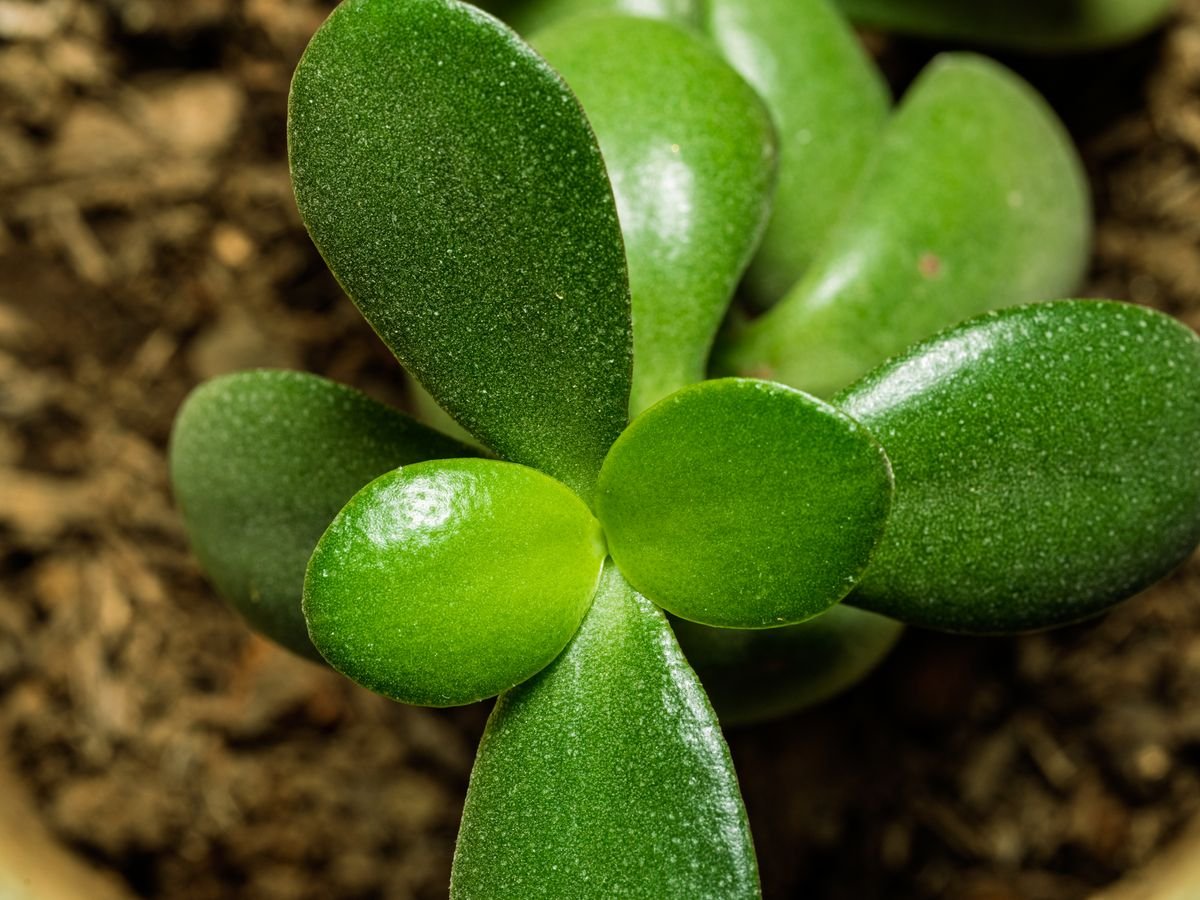
The single most reliable check is leaf arrangement, not colour or shape, since both plants can look almost identical in low light at a garden centre. On Crassula ovata, leaves grow in opposite pairs — two leaves directly across from each other at every node. On P. obtusifolia, leaves are alternate, growing one at a time in a spiral up the stem, one per node. This phyllotaxy difference holds regardless of cultivar, pot size, or growing conditions, which makes it a more dependable test than leaf thickness or gloss. The identification guide covers this and several other confirming checks — sap colour and stem texture among them — in more depth for anyone verifying a specimen bought under a vague "succulent mix" label.
A second, slower-developing clue is the stem. Young plants of both species can look similarly soft and fleshy, but Crassula ovata develops a genuinely woody, thickened trunk as it matures, while P. obtusifolia's stem stays fleshy and succulent even on old specimens and never truly turns to wood.
Care Differences That Actually Change Outcomes
The two species diverge most sharply on light and, as a direct consequence, on watering rhythm. Crassula ovata is an obligate CAM plant: its stomata stay closed during the day to conserve water and open only at night to take in CO₂, an adaptation suited to genuinely sun-drenched, arid conditions. Kept in anything less than several hours of direct or near-direct sun, it stretches toward the light with weak, elongated growth rather than staying compact. P. obtusifolia runs an ordinary C3 pathway under normal conditions, shifting toward CAM-cycling only as a temporary drought response, which is why it tolerates the 2,000-4,000 lux bright-indirect range comfortably without needing direct sun at all — a light budget suited to an ordinary living-room window rather than a south-facing sill.
Both plants share the same broad instruction — let the substrate dry between waterings — but Crassula's CAM strategy gives it a longer safe margin for missed waterings, while Peperomia's water-storage tissue, covered in the leaf anatomy guide, gives it real but comparatively shorter drought tolerance. Neither plant should sit in a self-watering pot or continuously moist mix; both fail toward root rot in the same way most semi-succulents and succulents do.
Which Is Easier for a Specific Home
A genuinely bright, south- or west-facing windowsill with several hours of direct sun favours Crassula, which will stay compact and eventually develop the thick, characterful trunk collectors want. A typical indirect-light room — an east-facing window, or a spot a metre or two back from a south window — favours Peperomia, since Crassula in that same spot etiolates quickly while Peperomia holds its compact form. Households with cats or dogs should default to Peperomia regardless of light, given the toxicity difference below.
Common Misidentification and Buying Mistakes
Retail labelling is the most common source of confusion — generic "succulent" or "jade" signage at big-box retailers sometimes covers both species interchangeably, and neither common name ("Jade Plant," "Baby Rubber Plant") reliably indicates which family a given pot actually belongs to. This is not a unique problem to this pairing: the same convergent-leaf-shape confusion shows up between Peperomia and Hoya, and separately between P. obtusifolia and the true rubber tree, Ficus elastica — in all three cases, a shared common name or a superficial leaf resemblance masks two unrelated plants with different care needs and, in the Ficus and Crassula cases, different toxicity profiles. Marketing claims are a second, separate confusion to watch for: some sellers promote either plant using unsupported "air-purifying" claims traceable to a badly misapplied NASA study, covered in the air-purification myth guide — neither species does anything unusual for indoor air quality beyond ordinary plant respiration.
Final Decision Guide
Choose Crassula ovata if you have a genuinely sun-drenched windowsill, want a slow-growing specimen that eventually develops a thick trunk, and do not have cats or dogs with access to the plant. Choose Peperomia obtusifolia if your brightest available spot is indirect light rather than direct sun, if you want a plant that tolerates centrally heated rooms and irregular watering without direct sun, or if pet safety is a factor in the household.
Sources
Toxicity and native-habitat references: ASPCA Animal Poison Control (Crassula ovata listing) and the ASPCA baby rubber plant listing for P. obtusifolia. Metabolic pathway background: Crassulacean acid metabolism and C3 carbon fixation.
Care FAQ
Is Peperomia obtusifolia a type of Jade plant?
No. The resemblance is convergent evolution, not shared ancestry — Peperomia obtusifolia sits in Piperaceae (the pepper family) while the Jade Plant, Crassula ovata, sits in Crassulaceae. Both independently evolved thick, water-storing leaves, but they are not related.
Do Peperomia and Jade need the same care?
No. Crassula ovata runs obligate CAM metabolism and needs several hours of direct or near-direct sun to stay compact; in lower light it stretches quickly. Peperomia obtusifolia runs a C3 pathway with only stress-triggered CAM-cycling, and does well in the 2,000-4,000 lux bright-indirect range without direct sun.
Which one is safer to keep around cats and dogs?
Peperomia obtusifolia, by a clear margin. It is non-toxic to cats, dogs, and horses (ASPCA). Crassula ovata is listed as toxic to cats and dogs, with ingestion associated with vomiting, depression, and incoordination.
What is the fastest way to tell them apart without a label?
Check where the leaves attach to the stem. Crassula ovata leaves grow in opposite pairs, two per node, directly across from each other. Peperomia obtusifolia leaves are alternate — one per node, zigzagging up the stem. This single check is more reliable than leaf colour or shape.