Peperomia vs Pilea: Best Care & Phyllotaxy Compared
Peperomia obtusifolia and Pilea peperomioides are frequently mistaken for each other thanks to their shared round, glossy leaves, but they are unrelated plants from different families with genuinely different care needs. Peperomia is the more drought-tolerant of the two thanks to thick, water-storing leaves; Pilea is the faster-growing, pup-producing option that wilts more dramatically and recovers less gracefully when watering is missed.
Side-by-Side Comparison
| Factor | Peperomia obtusifolia | Pilea peperomioides |
|---|---|---|
| Family | Piperaceae (pepper family) | Urticaceae (nettle family) |
| Leaf attachment | Alternate, spiralling up the stem | Peltate — petiole attaches to the leaf's centre, umbrella-style |
| Leaf texture | Thick, semi-succulent, rubbery | Thinner, more herbaceous |
| Watering | Top 2-3 cm dry before rewatering | Top half of substrate dry before rewatering |
| Drought tolerance | High — water-storing leaf tissue buffers missed waterings | Moderate — wilts visibly when dry, recovers once watered |
| Propagation | Stem or leaf cuttings; no pups | Offset "pups" from the base or roots, plus stem cuttings |
| Growth rate | Slow, 2-5 cm per year | Faster, fills out noticeably within a season |
| Toxicity | Non-toxic (ASPCA) | Commonly listed non-toxic |
How to Tell Them Apart
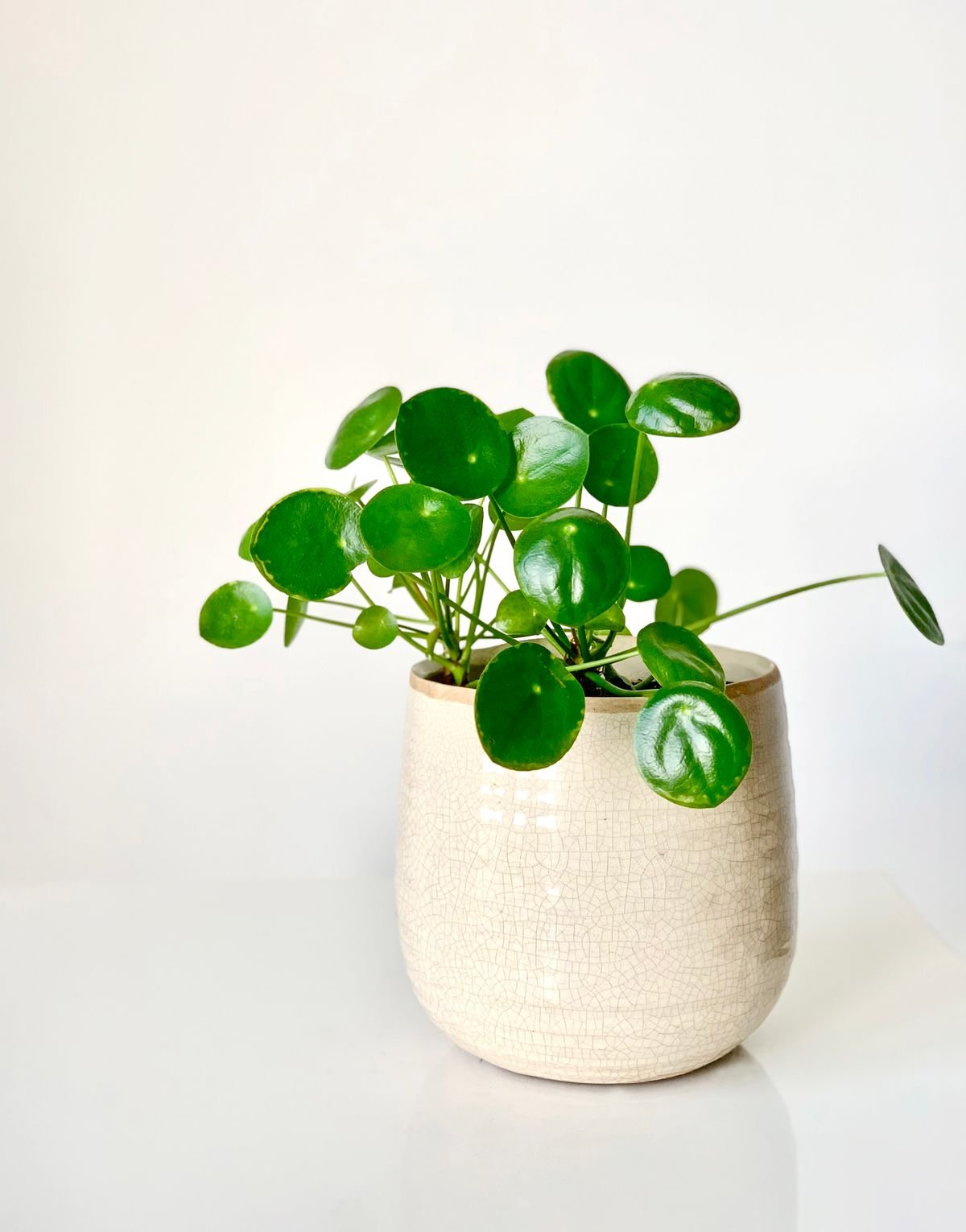
The most reliable check is where the petiole meets the leaf. On Peperomia obtusifolia, the leaf is attached at its base in the ordinary way, and leaves emerge one at a time in a spiral pattern up a thick, upright stem. On Pilea, the petiole attaches to the centre of the underside of the leaf — a peltate arrangement, the same structural pattern as a lily pad or an umbrella — and leaves radiate outward from a central stem on long, thin petioles. Leaf texture is the second confirming check: Peperomia leaves feel notably thick and firm, almost rubbery, while Pilea leaves are thinner and more flexible. If a specimen has ever produced small plantlets sprouting from the base or nearby soil, it is Pilea — Peperomia obtusifolia does not reproduce this way.
Care Differences That Change the Outcome
Watering tolerance is the biggest practical difference. Peperomia's thick water-storage tissue means it comfortably handles the top 2-3 cm of substrate drying out between waterings, and it tolerates being forgotten for a while better than most houseplants. Pilea's thinner leaves hold less of a reserve, so it wilts more visibly and sooner when the substrate dries too far — though it also recovers fully within hours of a good watering once that happens, since the wilting is a straightforward hydraulic response rather than damage.
Growth rate and repotting frequency differ meaningfully. Pilea grows noticeably faster and needs more frequent repotting and pup management as it spreads; Peperomia's slow growth means a pot upsize is needed only every couple of years.
Propagation logic is completely different. Peperomia is propagated from stem or leaf cuttings rooted separately, since it doesn't produce offsets. Pilea's signature trait is producing its own baby plantlets around the base, which can simply be separated and potted once they have a few roots of their own — a much lower-effort propagation path if a Pilea is already producing pups.
Light Needs Compared
Both plants do best in bright, indirect light, but they fail differently when light runs short. Peperomia obtusifolia tolerates the lower end of that range for longer, since its slower metabolism and water-storage tissue mean a dim spell shows up as slowed growth rather than immediate visible distress. Pilea peperomioides is more light-hungry in practice: too little light produces a leggy, sparse-looking plant fairly quickly, and an uneven light source produces the species' well-known tendency to lean and curl its leaves toward the brightest point, requiring more frequent rotation to keep growth even. Neither plant wants direct midday sun on the leaf surface for extended periods, since both can scorch, but Pilea's thinner leaf tissue shows scorch damage sooner than Peperomia's thicker, more light-reflective leaves do.
Which Is Easier for a Specific Home
- A household that travels often or waters inconsistently: Peperomia is the more forgiving choice, given its genuine drought buffer.
- A grower who wants visible, steady growth and enjoys propagating and sharing plants: Pilea's faster growth and pup production make it the more rewarding option for that specific goal.
- A lower-light room: neither is a true low-light plant, but Peperomia's slower metabolism means it stalls more gracefully under marginal light than it fails outright, while Pilea tends to stretch and lean toward the light source more noticeably if light is uneven.
- A household with pets: both are commonly regarded as safe, though confirming the current listing for either species directly is worth doing if a pet has actually ingested a meaningful amount, rather than relying on general reputation alone.
Common Misidentification and Buying Mistakes
- Assuming the "peperomioides" in Pilea's name means it's a Peperomia relative — it describes a resemblance, not a taxonomic relationship; the two are in entirely different plant families.
- Watering a Pilea on a Peperomia-style dry-down schedule — Pilea's thinner leaves don't hold the same reserve, and an overly long dry spell causes more visible stress than it would in Peperomia.
- Ignoring pups on a Pilea and letting the pot get overcrowded — regularly separating offsets keeps the parent plant healthier and produces free additional plants.
- Buying a "Peperomia" at a nursery that turns out to be mislabelled — checking leaf attachment (spiral vs peltate) settles the identification faster than relying on a retail tag alone; the same visual-confirmation habit matters across houseplant shopping generally, similar to distinguishing Peperomia from a true rubber tree or Peperomia from Hoya.
Final Decision Guide
Choose Peperomia obtusifolia if you want a slow-growing, forgiving plant that tolerates inconsistent watering and doesn't need frequent repotting or pup management. Choose Pilea peperomioides if you want faster, more visible growth and enjoy the ongoing propagation project of separating and sharing pups. Both are commonly cited as low-effort, pet-friendly options, and the choice mostly comes down to growth pace and watering tolerance rather than either being objectively easier.
For a fuller identification reference on P. obtusifolia specifically, see the identification guide. If air-purification claims are part of why either plant is being considered, see the air purification myth guide before treating either species as a meaningful air-quality intervention.
Care FAQ
Is Pilea peperomioides a type of Peperomia?
No, despite the name. Pilea peperomioides translates roughly to "the Pilea that resembles a Peperomia," but it belongs to Urticaceae, the nettle family, while Peperomia obtusifolia belongs to Piperaceae, the pepper family. The resemblance is convergent evolution toward a similar round-leaved form, not shared ancestry.
Which is easier to grow, Peperomia obtusifolia or Pilea peperomioides?
Peperomia obtusifolia is generally more forgiving of missed waterings, since its thick, water-storing leaves and waxy cuticle give it a real drought buffer that Pilea, with thinner, more herbaceous leaves, does not have to the same degree. Pilea is not difficult, but it wilts more visibly and recovers less gracefully from a skipped watering.
Do Peperomia and Pilea both produce baby plants (pups)?
Only Pilea does, reliably. Pilea peperomioides is well known for producing offset plantlets from its base or roots that can be potted up separately. Peperomia obtusifolia does not produce pups this way — new plants come from stem or leaf cuttings instead.
Are Peperomia obtusifolia and Pilea peperomioides both safe for pets?
Both are commonly listed as non-toxic to cats and dogs. Peperomia obtusifolia's non-toxic status is specifically documented by the ASPCA; check the current listing for either species directly if a pet has ingested a significant amount, since general reputation is not a substitute for confirming an individual case.