
Peperomia vs Snake Plant: Best CAM Care Compared
Peperomia obtusifolia and the snake plant are both marketed as nearly indestructible houseplants, but they hold themselves upright through completely different mechanisms, tolerate different light ranges, and differ sharply on pet safety. Choose snake plant for a genuinely dim room and a household with no pets at risk; choose Peperomia for a pet-safe plant that still wants reasonably bright light to grow well rather than just survive.
Side-by-Side Comparison
| Factor | Peperomia obtusifolia | Snake Plant (Sansevieria / Dracaena trifasciata) |
|---|---|---|
| Structural support | Turgor pressure (internal water) | Fibrous, reinforced leaf tissue |
| Metabolism | Modified C3 with CAM-cycling under water stress | Full-time CAM |
| Light for active growth | 2,000-4,000 lux | Tolerates considerably lower light without decline |
| Drought behaviour | Wilts visibly when dehydrated | Stays upright even when substrate is very dry |
| Toxicity (ASPCA) | Non-toxic to cats, dogs, horses | Toxic to cats and dogs (saponins) |
| Growth rate | Slow (2-5 cm/year) | Very slow |
| Substrate | Free-draining coir/perlite/bark mix | Free-draining, gritty mix; similar principle |
How to Tell Them Apart
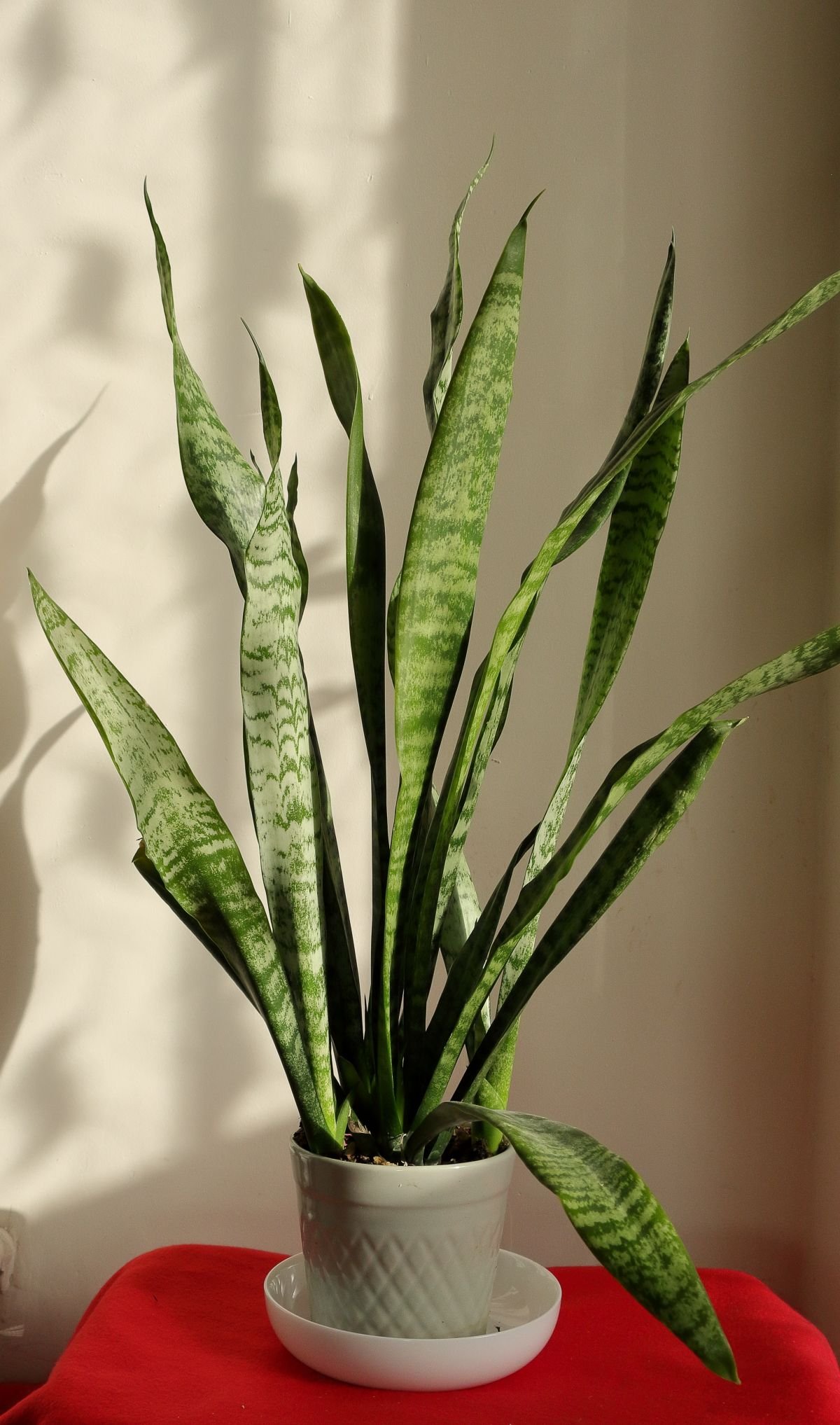
There is no real risk of confusing these two at a glance — the comparison is about care logic, not identification — but the structural difference is worth understanding directly. Snake plant leaves are tall, rigid, sword-shaped, and stand upright on their own regardless of hydration state, because they are reinforced with substantial fibrous tissue rather than relying on water pressure for shape. P. obtusifolia leaves are simple, glossy, and obovate, arranged on soft, semi-succulent stems that hold their shape through internal turgor pressure alone — press a leaf and it yields slightly; the plant's entire structural strategy depends on the water inside it.
Care Differences That Actually Change the Outcome
- What "drought-tolerant" means for each is different. Snake plant's full-time CAM metabolism keeps its stomata closed during the day and open only at night, minimising water loss continuously rather than only under stress — this is why it tolerates going weeks longer between waterings than P. obtusifolia, and why overwatering, not underwatering, is its dominant failure mode. P. obtusifolia runs a more typical daytime gas-exchange cycle and shifts toward CAM-like behaviour only under water stress, so it needs a more conventional dry-down-and-rewater rhythm on a
10-14day summer interval rather than an extended drought cycle. - Light tolerance diverges sharply. Snake plant persists in genuinely low light for extended periods without visible decline, which is why it's the more realistic pick for an interior room with no direct window access. P. obtusifolia needs
2,000-4,000 luxto grow actively and etiolates — producing thin, stretched growth — below roughly800 luxsustained for several weeks. - Failure mode when neglected in the wrong direction. A dehydrated snake plant stays structurally upright far longer than a dehydrated Peperomia, which wilts visibly and relatively quickly once its water reserve depletes — a useful diagnostic if you're trying to tell which plant is actually thirsty versus just naturally rigid.
- Toxicity. This is the difference with the clearest practical stakes for a household with pets. Snake plant is ASPCA-listed as toxic to cats and dogs due to saponins, causing nausea, vomiting, and diarrhoea on ingestion. P. obtusifolia carries no comparable toxic compounds.
Which Is Easier for a Specific Home
- A dim interior room or office with no direct window access: snake plant tolerates this considerably better and is the more realistic long-term choice.
- Households with pets or young children who chew houseplants: P. obtusifolia is the meaningfully safer option given snake plant's documented saponin toxicity.
- Frequent travel or inconsistent watering: snake plant's full-time CAM metabolism gives it a longer buffer against neglect than Peperomia's more conventional water-use pattern.
- A grower prone to overwatering: neither plant tolerates constantly wet substrate well, but snake plant rot from overwatering tends to be more severe and less recoverable than Peperomia's — err toward underwatering with snake plant specifically.
- Wanting a plant that grows visibly over a season: P. obtusifolia has the faster growth rate of the two, even though both are slow by houseplant standards generally.
Common Misidentification and Buying Mistakes
- Assuming both plants share a watering schedule because both are called "hard to kill" — snake plant's tolerance for neglect is structurally different from Peperomia's, and applying one plant's interval to the other risks either underwatering the Peperomia or overwatering the snake plant.
- Placing a Peperomia in a snake-plant-appropriate dark corner, expecting similar low-light tolerance — it will etiolate rather than simply persisting the way a snake plant would.
- Keeping a snake plant within chewing range of a pet on the assumption that a tough, rigid leaf is also a safe one — structural toughness and toxicity are unrelated properties.
- Judging thirst by leaf firmness alone — a firm snake plant leaf can still be sitting in overly wet substrate, since its rigidity doesn't depend on hydration the way Peperomia's does.
Final Decision Guide
Choose Peperomia obtusifolia if you have pets or young children with plant access, a reasonably bright spot (2,000+ lux), and want a plant with a faster, more visible growth pattern.
Choose snake plant if the room is genuinely dim, no pets or young children will have access to it, and you want a plant that tolerates extended neglect without active monitoring.
For the general care specification behind Peperomia's own thresholds referenced throughout this comparison, see the complete care guide. If you're not certain you actually have P. obtusifolia to begin with, confirm against the identification guide — the same care logic here doesn't necessarily transfer to a misidentified Hoya or Ficus elastica sold under similar "easy houseplant" branding, and for marketing claims that don't hold up under scrutiny for either plant in this comparison, see the air purification myths guide.
Care FAQ
Which is harder to kill, Peperomia or snake plant?
Both are unusually resilient, but through different mechanisms. Snake plant uses full-time Crassulacean acid metabolism (CAM) to minimise water loss and tolerates very low light and extended drought. Peperomia obtusifolia is more metabolically flexible day to day but has a narrower light range it actually needs to grow well, rather than merely survive.
Can either one grow in a dark corner?
Neither grows actively without light, but snake plant tolerates dim conditions for far longer without visible decline. Peperomia obtusifolia held in the same low-light spot will survive for a period but etiolates — producing thin, elongated growth — well before a snake plant shows comparable stress.
Is snake plant safe for cats and dogs?
No. The ASPCA lists snake plant as toxic to cats and dogs, with saponins as the toxic principle, causing nausea, vomiting, and diarrhoea if chewed or ingested. Peperomia obtusifolia carries no such compounds and is listed as non-toxic to cats, dogs, and horses.
Why does a snake plant stay upright even when very dry?
Its leaves are reinforced with substantial fibrous tissue that provides structural rigidity independent of water content, so a dehydrated snake plant leaf still stands upright rather than drooping. Peperomia obtusifolia has no comparable fibre reinforcement — its rigidity comes from internal water pressure, so a dehydrated specimen visibly wilts rather than staying upright.