Yellow Peperomia Leaves: Causes and Recovery
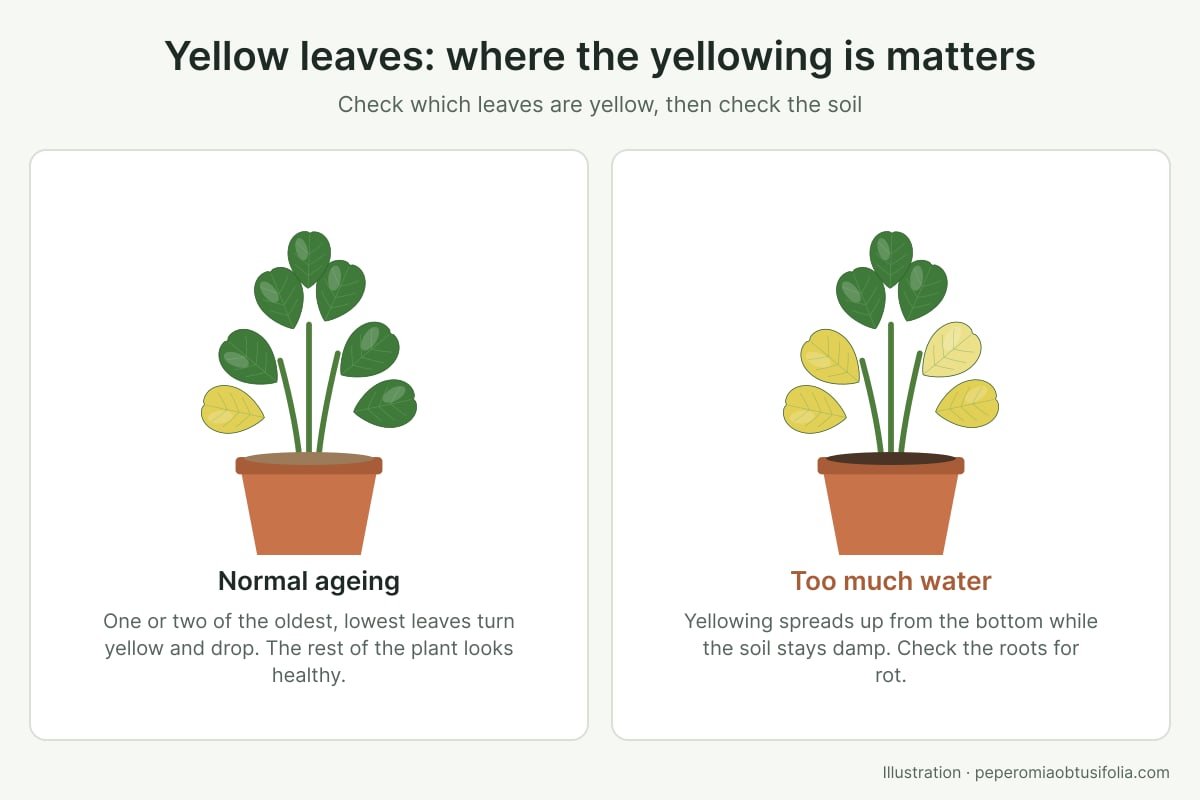
Yellow leaves on Peperomia obtusifolia are a chlorophyll-breakdown signal, not a diagnosis on their own. The pattern tells you which of several very different causes you're dealing with: bottom-up and firm points to nutrient remobilisation; top-down with green veins points to a pH-driven mineral lockout; soft, mushy, and whole-plant points to root anoxia — the single most common cause, and the one case where the reflex to add fertiliser actively makes things worse.
Quick Diagnosis Table
| Pattern | Location | Texture / Substrate | Most Likely Cause |
|---|---|---|---|
| Uniform yellow | Older leaves first, progressing upward | Firm; substrate at normal moisture | Nitrogen/magnesium remobilisation |
| Uniform yellow | Older leaves first | Soft, mushy; substrate wet, possibly sour-smelling | Root anoxia / root rot |
| Interveinal (green veins, yellow tissue) | New growth | Firm; often follows long unfiltered tap water use | Iron lockout from alkaline pH |
| Splotchy, irregular | Random leaves | Check undersides for pests | Pest damage |
| Bleached, papery | Sun-facing leaves only | — | Sunburn |
| Bottom 1-3 leaves only | New specimen, recently acquired | New growth stays green | Acclimation — usually resolves on its own |
What This Symptom Looks Like
Yellowing is the visible result of the plant enzymatically dismantling chlorophyll and exposing the yellow-orange carotenoid pigments that were always present underneath — the same biochemistry behind autumn leaf colour. The reason for that breakdown is what differs, and it maps to two questions: is a mobile nutrient being deliberately withdrawn, or has something stopped a nutrient reaching the leaf at all? Nitrogen and magnesium are mobile — the plant can reclaim them from an older leaf and ship them to new growth, which is why deficiency of either shows up bottom-up on otherwise firm leaves. Iron is immobile — once placed in a leaf it stays there, so a shortfall shows up only in the newest growth, with a sharp yellow-tissue-green-vein pattern because the veins were already built before the iron ran short. Root failure is different again: it cuts off delivery of everything at once, producing uniform yellowing with a soft, failing texture rather than a clean nutrient-specific pattern.
Causes Ranked from Most to Least Likely
1. Root anoxia from overwatering
The single most common cause. Substrate that stays wet for long periods damages this species' fine, drought-adapted roots and leads to root rot (NC State Extension), and the resulting root failure means the plant can no longer transport any mineral — not just nitrogen — to the leaves, regardless of how much fertiliser is in the substrate. Confirm: check the substrate — wet, possibly sour-smelling, with soft yellow leaves and sometimes wilting despite the moisture, confirms this over a nutrient cause. Unpotting reveals black or soft roots rather than firm pale ones.
2. Iron lockout from alkaline substrate pH
Iron is required to synthesise chlorophyll but precipitates out of solution above roughly pH 7.0, becoming chemically inaccessible to the roots even when physically present in the substrate. This happens gradually as calcium and bicarbonate from hard tap water accumulate over months, pushing pH upward — see the tap water guide for the accumulation mechanism. Confirm: the signature is interveinal yellowing — yellow tissue with sharply defined green veins — appearing on new growth specifically, on a plant with otherwise normal substrate moisture and a long history of unfiltered tap water.
3. Genuine nutrient shortfall
Less common than the two causes above, but a real possibility on a plant that has gone a long stretch without feeding during its active growing season. Confirm: bottom-up, uniform, firm yellowing on a plant with healthy roots and normal substrate moisture, with no green-vein pattern — a straightforward mobile-nutrient case rather than a lockout or a rot.
4. Acclimation on a newly acquired plant
Nurseries run higher light, higher humidity, and more frequent feeding than a typical home provides. A new plant often sheds its lowest one to three leaves over the first few weeks as it rebalances its canopy to the lower-input environment it has moved into. Confirm: limited strictly to the bottom of the plant, with all new growth emerging green and healthy — this is self-correcting and needs no intervention.
5. Light deficit
Below the tolerated minimum, the plant cannot photosynthesise enough to maintain its full canopy and sheds lower, shaded leaves to reduce its own maintenance cost — a pattern that looks like nutrient remobilisation but is driven by light instead. Confirm: measure lux at the leaf with a meter or phone app rather than assuming; a reading below about 800 lux points here.
6. Pest damage
Sap-feeding pests drain chlorophyll-containing cell contents directly, producing a splotchy or stippled pattern that doesn't follow the clean bottom-up or interveinal patterns of the causes above. Confirm: inspect leaf undersides closely for insects, webbing, or stippling before assuming a nutritional cause.
Step-by-Step Recovery Plan
- Diagnose by pattern before doing anything else — the wrong first move actively worsens the two most common causes. Fertilising a plant with root rot adds osmotic stress to an already-failing root system; withholding water from a plant with a genuine nutrient shortfall does nothing to fix it.
- For root anoxia: unpot, rinse the root mass, prune all soft or black roots back to firm tissue with sterilised scissors, and repot into fresh, free-draining substrate. Resume watering only once the top 2-3 cm is fully dry. The full sequence is in the overwatering rescue guide.
- For pH lockout: flush the substrate with two to three pot-volumes of low-mineral water to leach accumulated calcium and bicarbonate, then apply a chelated iron product at label rate — chelation keeps iron available to the roots even at a substrate pH that would otherwise lock it out.
- For a genuine nutrient shortfall: resume a balanced liquid feed at half strength, monthly, during the active growing season only.
- For acclimation, light deficit, or pests: address the specific cause directly — wait it out, relocate to better light, or treat the pest — rather than reaching for fertiliser as a default response.
- Prune only once new growth confirms the cause is resolved. Existing yellow leaves do not recover; removing them at the petiole base with sterilised scissors is a tidiness step, not a treatment.
Recovery Signs and Realistic Timeline
Existing yellow tissue does not regain its colour regardless of cause — recovery is judged entirely by what new growth looks like, not by any change in the leaves already affected. For root rot, expect several weeks before new growth confirms the rescue has worked, provided watering afterward stays on a genuine dry-down check rather than reverting to the schedule that caused the problem. For pH lockout, new leaves emerging with normal, even colour over the following weeks confirm the chelated iron and flush have resolved the lockout. If new growth continues to show the same pattern well after the corrective step, re-examine whether the diagnosis was actually correct rather than assuming more time will fix it.
How to Prevent Recurrence
Water on a dry-down check rather than a fixed schedule — this single habit prevents the most common cause outright. Flush the substrate periodically with low-mineral water to stop the slow pH drift that drives iron lockout, and consider switching to filtered or rainwater for routine watering if local tap water is notably hard. Feed on a modest, season-appropriate schedule rather than either neglecting it entirely or over-applying it. For the general thresholds this all sits on top of, see the complete care guide, and for a broader symptom-first view across issues beyond yellowing, see the problems guide.
FAQ
See the frontmatter FAQ block above for direct answers on cause, recovery, and distinguishing root rot from nutrient chlorosis. For related symptoms that sometimes accompany or get confused with yellowing, see sudden leaf drop, downward curling, and wrinkled, soft leaves — several share the same underlying causes as yellowing and are worth checking together.
Care FAQ
Why are my Peperomia obtusifolia leaves turning yellow?
The pattern identifies the cause. Bottom-up uniform yellowing with firm leaves usually means the plant is remobilising nitrogen from older leaves, either from a genuine nutrient shortfall or as part of normal acclimation. Top-down interveinal yellowing (yellow tissue, green veins) on new growth points to iron lockout from alkaline substrate pH. Whole-plant yellowing with soft, mushy leaves and wet substrate points to root anoxia — the single most common cause overall.
Can yellow Peperomia leaves turn green again?
Rarely, and only in early-stage cases. Once chlorophyll has been broken down and chloroplast structure has collapsed, that leaf does not regain its colour. Judge recovery by new growth emerging clean, not by any change in the leaves already affected.
Does overwatering cause yellow leaves on Peperomia?
Yes, and it is the single most common cause. Soil that stays wet for long periods damages the root system and leads to root rot (NC State Extension), and the resulting root failure means the plant cannot transport nitrogen or any other mineral to the canopy — producing yellowing even though the substrate is visibly wet. Adding more water at that point makes it worse.
What is the difference between nutrient chlorosis and root-rot yellowing?
Chlorosis from a nutrient or pH cause leaves the tissue firm, often shows a sharp green-vein pattern, and occurs with normal substrate moisture. Root-rot yellowing is soft and mushy, uniform across the whole leaf, occurs with wet or sour-smelling substrate, and often comes with wilting despite the wet mix. The two need opposite responses, so confusing them worsens the outcome either way.