How to Propagate Peperomia: 4 Reliable Methods
To propagate Peperomia obtusifolia, the method you pick determines how fast roots appear. The speed difference between propagation methods is not arbitrary — it is determined by the presence or absence of meristematic tissue: the clusters of undifferentiated, actively dividing cells from which all new plant structures emerge. A stem tip cutting retains the apical meristem and axillary meristems at each node — the biological machinery for producing roots, leaves, and new stems is already present and operational. A leaf cutting carries none of this. It must first trigger callus formation, dedifferentiate existing cells back toward a meristematic state, and only then begin constructing a new shoot from scratch. This single biological fact explains why stem tip cuttings usually root within a few weeks while leaf cuttings take much longer.
Understanding which method suits your situation — and why the apparent shortcuts often produce slower or weaker results — determines propagation success before you make the first cut.
The direct answer: Peperomia obtusifolia propagates reliably by four methods: stem tip cuttings in substrate (usually rooted within a few weeks in warm conditions), water propagation followed by substrate transfer (quick water roots, then a further re-rooting period after transfer), leaf cuttings with petiole (much slower, and fewer succeed), and division (immediate — no rooting period required). Stem tip cuttings in substrate are the recommended method for most situations. Propagate in spring at 22–25°C under 70–80% relative humidity.
For full care context, see the complete care guide.
Propagate Peperomia Obtusifolia: Methods at a Glance
| Method | Roots | First Shoot | Best For |
|---|---|---|---|
| Stem tip cutting (substrate) | Usually within a few weeks | Soon after rooting | Most situations; strongest roots |
| Water propagation | Often within a few weeks (water-adapted) | After substrate transfer | Visual observation of root development |
| Leaf cutting with petiole | Much slower than stem cuttings | Often a couple of months or more | Maximising plants from limited material |
| Division | Immediate | Already present | Multi-stemmed plants at repotting time |
Rough expectations, not measured figures. Conditions: 22–25°C, 70–80% RH, bright indirect light (roughly 2,000–4,000 lux as a working target), 50% perlite + 50% fine bark substrate
Method 1: Stem Tip Cuttings in Substrate
Why this works: The stem tip carries both the apical meristem and the node axillary meristems — the points from which adventitious roots will emerge. When placed in a well-aerated substrate, the cut node responds to the absence of root-derived cytokinin signals by activating root initiation genes. The process is rapid because no cellular reprogramming is required: root-producing cells are already present and differentiated.
What you need:
- Sharp scissors or a blade sterilised in 70% isopropyl alcohol
- Propagation substrate: 50% perlite + 50% fine bark (not standard potting compost — it retains too much moisture and increases rotting risk)
- A small pot (8–10 cm diameter) with drainage holes
- A clear plastic bag or humidity dome
The procedure:
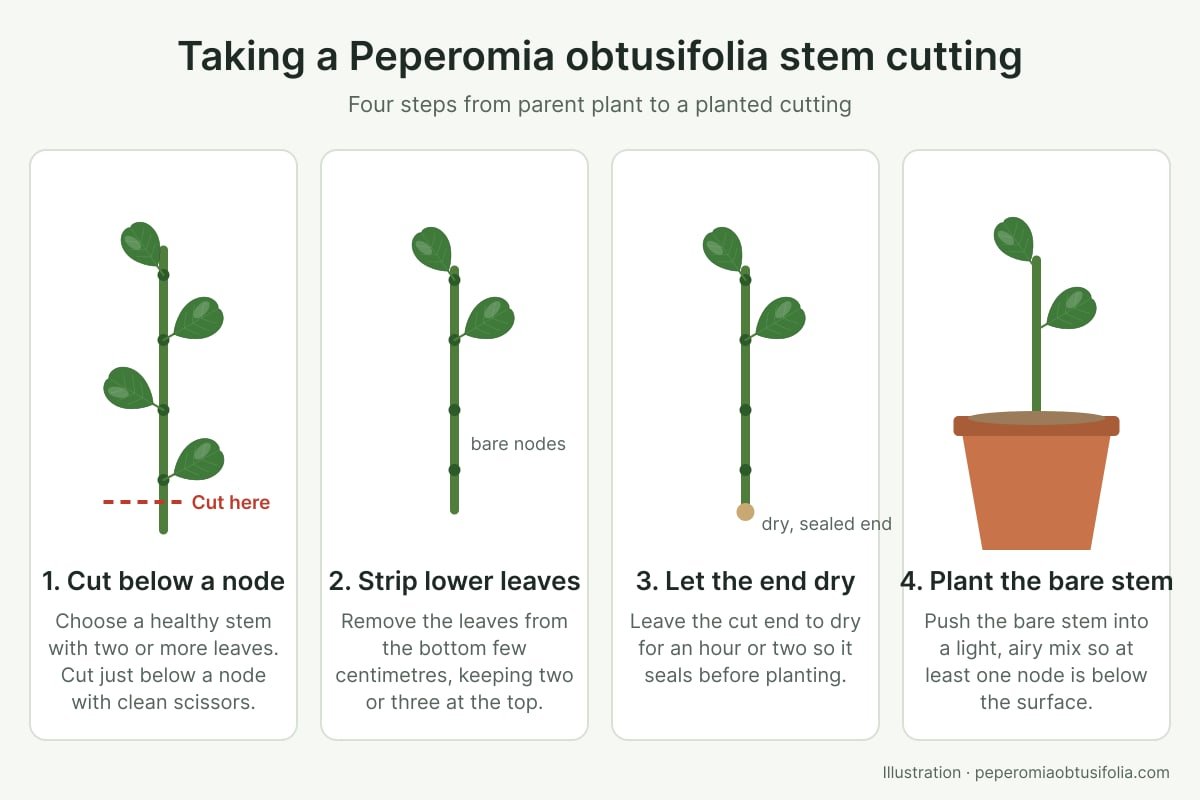
- Select a healthy stem with at least two nodes and two to three leaves. Cut just below the lowest node, leaving 5–8 cm of stem.
- Remove all leaves from the lower 3–4 cm of stem, leaving two to three leaves at the apex.
- Allow the cut end to air-dry for one to two hours until a visible callus (dry, slightly hardened surface) forms over the wound. This prevents bacterial entry before root-protective tissue develops.
- Insert the bare stem section 3–4 cm into lightly moistened propagation substrate. The substrate should hold its shape when squeezed but release no water.
- Cover with a clear plastic bag or humidity dome to maintain 70–80% relative humidity around the cutting.
- Place in bright indirect light (roughly 2,000–4,000 lux) at 22–25°C. Avoid direct sun — the cutting has no roots to replace moisture lost through the leaves.
- Lift the cover briefly every two to three days to exchange air and prevent fungal buildup.
Expected timeline: In warm conditions you will usually feel slight resistance when the cutting is gently tugged after a few weeks. New leaf growth follows some weeks later. Transfer to standard growing substrate once the first new leaf has fully expanded.
Pruning and propagation: Every stem removed during routine pruning is a viable cutting. A stem with one node and one leaf is sufficient — stem length is less important than the presence of meristematic tissue at the node.
Method 2: Water Propagation
Why this works — and why it is slower than it appears: Water propagation initiates root development rapidly: roots often appear within a few weeks. The complication is morphological. Roots that develop in water are structurally adapted to an aquatic, low-oxygen environment — they are thinner, carry fewer root hairs, and lack the root hair density required to navigate air gaps in substrate. When transferred to substrate, these water-adapted roots cannot function in the new medium. They die back entirely within one to two weeks of transfer, and the cutting must initiate a completely new root system from scratch. The full step-by-step protocol, including water maintenance and the wet-to-dry transition, lives in the water propagation guide.
The net result: water propagation often takes longer to produce an established plant than direct substrate propagation, despite the faster initial root appearance.
When water propagation is appropriate: When observing root development is the primary goal — for learning, for monitoring health, or for educational purposes. The visual feedback is genuine value; the method is simply not faster.
The procedure:
- Prepare the cutting exactly as in Method 1 (sterilised cut below a node, remove lower leaves, one to two hours callusing).
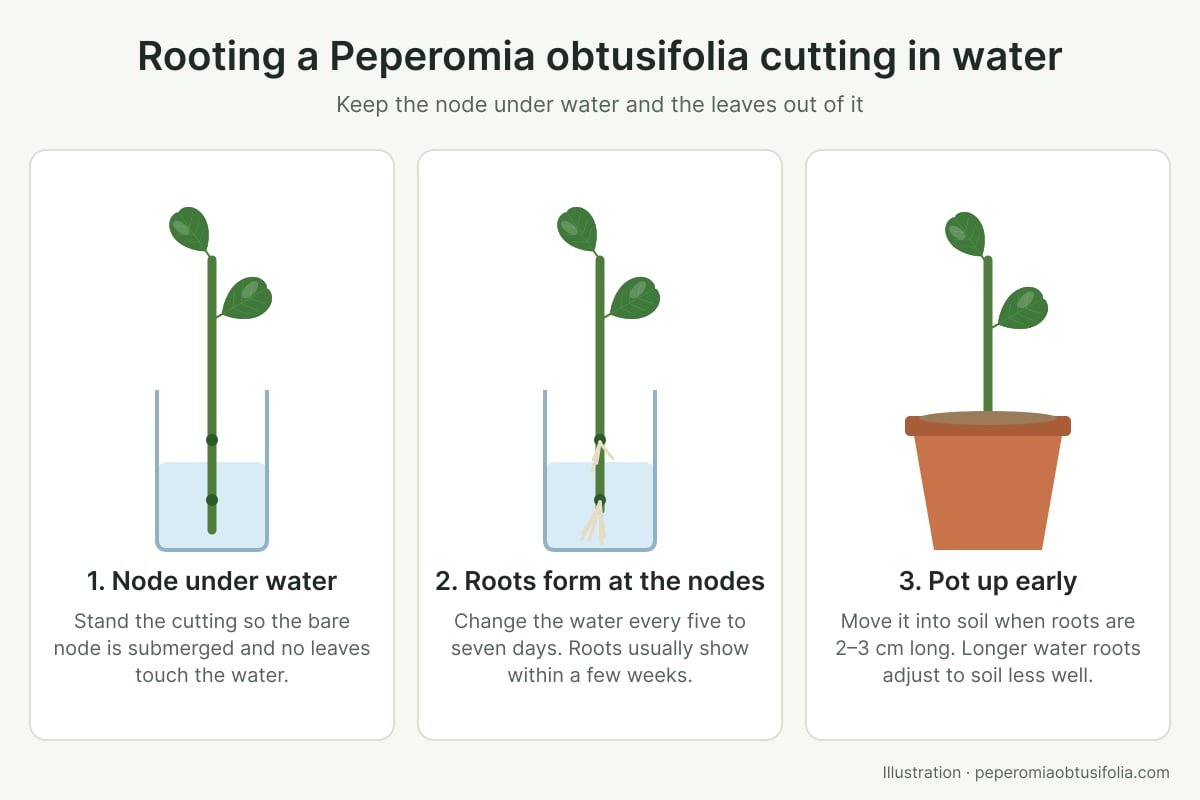
- Place in a clean glass or jar with the bottom 3–4 cm of bare stem submerged. No leaves should touch the water.
- Change the water every five to seven days to prevent bacterial buildup.
- Roots usually appear within a few weeks at 20–25°C.
- Transfer to substrate when roots are 2–3 cm long — not longer. The longer water roots become, the more morphologically specialised they are, and the harder the transition.
- After transfer, keep the substrate slightly more moist than normal for the first ten days to reduce desiccation stress on the transitional root system. Expect a growth pause of several weeks before new leaf production resumes.
Method 3: Leaf Cuttings with Petiole
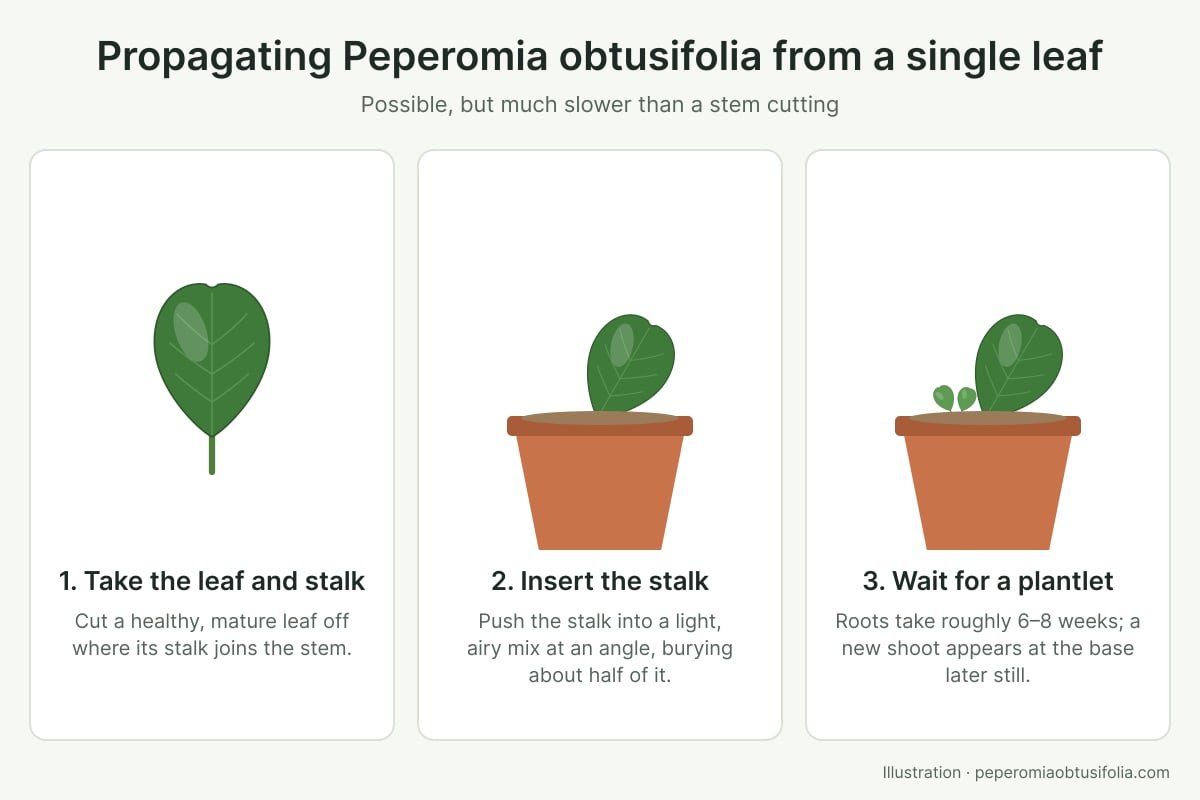
Why this is slower: A leaf cutting carries no meristematic tissue. The process begins with wound-response callus formation at the cut petiole base. Callus cells must then dedifferentiate — essentially reset their identity — before they can redifferentiate as root-initiation cells. Only then can root and shoot development begin. This cellular reprogramming is why leaf cuttings are much slower than stem cuttings at every stage of development.
Leaf cuttings are the correct choice when stem material is limited — for rare cultivars, when the parent plant cannot be pruned, or when maximising plant count from a single specimen. Where stem cuttings are available, they are faster, more reliable, and produce structurally stronger plants.
The procedure:
- Select a healthy, fully mature leaf. Immature or very old leaves are less likely to root.
- Remove the leaf cleanly at the base of the petiole (the short stalk connecting leaf to stem), cutting as close to the main stem as possible.
- Allow the cut end to callus for three to four hours — longer than for stem cuttings, because the petiole base has a larger cut surface relative to its mass.
- Insert the petiole into propagation substrate (50% perlite + 50% fine bark) at a 45° angle, burying approximately half the petiole length.
- Cover with a humidity dome. The leaf has no root system to replace transpired moisture; without high humidity (70–80% RH), the leaf will desiccate before plantlets emerge.
- Maintain at 22–25°C. Do not water the substrate — mist the surface lightly if it begins to look pale and dry.
- Be patient: roots and the first plantlet take much longer than on a stem cutting, often a couple of months or more.
Variegation note: Leaf cuttings from variegated cultivars usually produce all-green plants. UF/IFAS notes that variegated chimeral Peperomia propagated from leaf cuttings lose their variegation. This is a limit of the method, not a care failure. Use stem cuttings or division to keep the variegation.
Method 4: Division
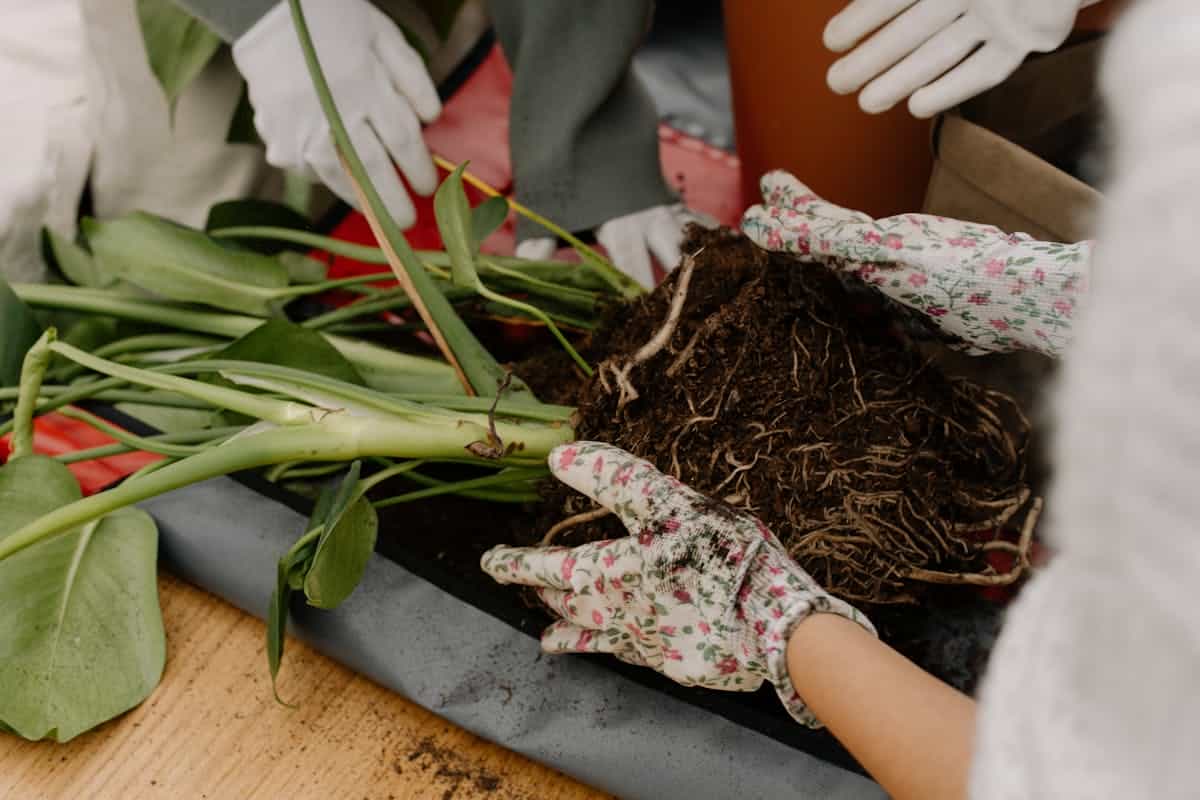
Why this is the most reliable method: Division bypasses the rooting stage entirely. Each divided section carries an established root system, functioning vascular tissue, and existing above-ground growth. There is no leafless, rootless vulnerable period. The plant experiences mild transplant stress — typically one to two weeks of reduced growth — before resuming normal development.
Division is only possible on multi-stemmed specimens where the root ball can be separated without leaving either section with an inadequate root-to-shoot ratio. The natural separation point is the distinction between individual stem clusters at the root ball level. Forcing a division between sections that share a single root mass creates two stressed, under-rooted cuttings rather than two plants.
The procedure:
- Water the plant thoroughly 24 hours before dividing. A well-hydrated root system is more flexible and less prone to tearing.
- Remove the plant from its pot and gently remove loose substrate from the root ball until the individual stem bases and their root attachments are visible.
- Identify natural separation points — locations where individual stems or clusters of stems arise from distinct root sections. Do not force separation along a single fused root mass.
- Tease the root ball apart along the natural separation lines using fingers. Where roots are tightly interwoven, use sterilised scissors to cut, minimising root loss.
- Each divided section must have an intact set of roots proportional to its above-ground growth. A section with two stems and minimal roots will struggle; a section with one stem and a full root system will establish rapidly.
- Pot each section into its own container — only 2–3 cm larger in diameter than the root ball. Place in bright indirect light and water lightly. Full recovery typically takes one to two weeks.
Timing: Division is most efficiently performed at repotting time in early spring (March–April in the northern hemisphere), combining two maintenance tasks. The full separation and aftercare protocol lives in the division guide.
The Propagation Substrate: Why Medium Composition Matters
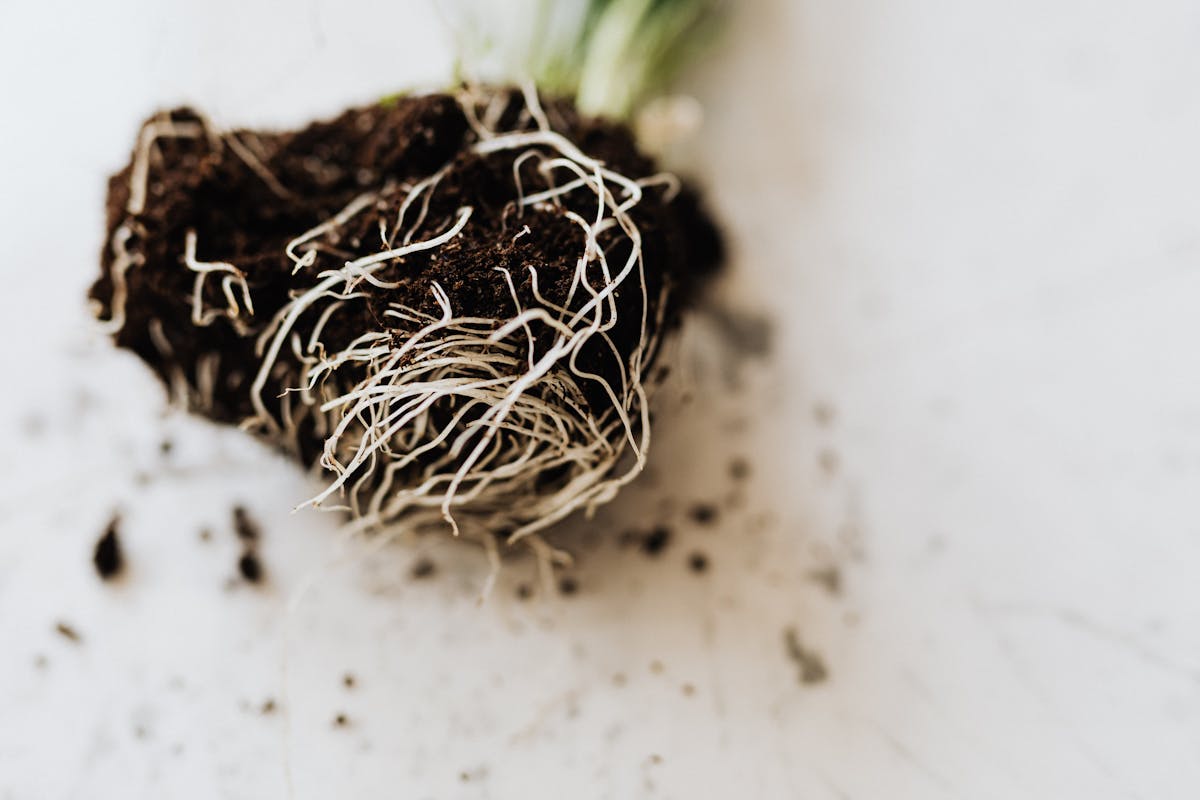
The propagation medium for stem and leaf cuttings must be fundamentally different from the growing substrate used for established plants. An unrooted cutting has no roots to regulate its internal moisture balance — it relies entirely on the substrate environment to protect the developing wound site from bacterial colonisation while providing just enough moisture to maintain cell turgor in the cutting tissue.
Standard potting compost is unsuitable for propagation. It retains moisture at levels that keep the unprotected wound site wet for extended periods, creating the bacterial environment that causes rot. Perlite alone drains too fast and holds insufficient moisture to maintain cutting hydration.
The optimal propagation substrate is 50% perlite + 50% fine bark:
- Perlite provides air pockets and rapid drainage, preventing anaerobic conditions at the wound site
- Fine bark retains just enough moisture to maintain cutting turgor without creating wet conditions at the cut surface
Moisten the mix before use until it holds its shape when squeezed but releases no water when squeezed firmly. After inserting the cutting, do not water again until the substrate surface begins to pale — the humidity dome supplies the moisture the cutting needs without creating wet substrate conditions around the wound.
Once rooted and producing its first new leaf, transfer to the standard growing substrate: 50% peat-free compost, 30% perlite, 20% fine bark.
Coco coir as a substrate alternative. Where fine bark is unavailable, a 50% coco coir + 50% perlite mix is a workable substitute for the propagation stages above. Coir wets more evenly than peat-based media — it does not develop the hydrophobic surface crust that peat forms after fully drying out — and sits close to neutral, which suits this species. Buy washed or pre-buffered coir specifically: unbuffered coir can carry residual sodium and potassium salts from processing that are harmful to a cutting's unprotected wound site. The rooting timeline and callusing requirements are unchanged from the perlite-and-bark method above — coir is a substrate swap, not a different protocol.
Coarse sand as a substrate alternative. Coarse horticultural sand (sold as "sharp sand" or "builder's sand") is a workable niche option for thick, top-heavy stem cuttings that need physical support while rooting — the weight of the sand holds a heavy cutting upright better than a lighter perlite-bark mix does. Sand grains are non-porous, so water drains around them rather than being absorbed, which keeps the wound site well-aerated provided the sand stays lightly moist rather than saturated. The critical distinction is grain size: fine "play sand" compacts when wet into a dense, airless layer that suffocates a cutting, while coarse, irregular horticultural sand grains cannot pack tightly and stay aerated. Sand carries no nutrients at all, so transfer the rooted cutting to standard growing substrate as soon as roots reach a few centimetres, the same as any other propagation medium here. This method suits thick stem cuttings specifically — the abrasive grain texture is more likely to damage a delicate leaf petiole than the softer perlite-bark mix or sphagnum moss.
Hydrogel water beads as a niche medium. Superabsorbent polymer beads (sold as water beads or under brand names like Orbeez) are sometimes used as a visually striking alternative to plain water propagation. Soaked and fully expanded, the beads hold a large reserve of water while leaving air gaps between spheres that a cutting's submerged node can access, which is the main advantage over standing water alone. The beads provide no nutrients whatsoever, so — exactly as with sand — a rooted cutting needs transferring to a proper growing substrate once roots are established, typically within the same few-week window as other methods here. Treat this as a novelty option for the visual appeal rather than a genuine upgrade over standard water or substrate propagation, since the claimed root-strengthening benefit of beads over plain water is not well established.
Universal Propagation Rules
These five conditions determine success regardless of method:
1. Timing: Propagate in spring (March–May) or early summer. Meristematic activity peaks as the plant enters its active growth phase. Cuttings taken in winter root significantly more slowly due to suppressed hormonal activity and reduced light for photosynthesis.
2. Sterile tools: Use scissors sterilised with 70% isopropyl alcohol before every cut. Bacterial introduction through a contaminated blade is the most direct cause of cutting rot. Wipe the blade between cuts when working with multiple cuttings.
3. Callusing: Allow the cut surface to air-dry before placing in substrate or water. The dried callus surface prevents bacterial entry at the wound site; exact timing by cutting thickness is covered in the callus timing guide. Do not skip this step — it is the single most common cause of a cutting rotting instead of rooting, covered in full in the cuttings rotting guide.
4. Temperature: Maintain 22–25°C at the root zone. Below 18°C, root initiation slows dramatically. Below 15°C, it may not occur at all. If ambient temperature is low, a heated propagation mat under the pot provides targeted warmth without overheating the cutting.
5. Moisture balance: The substrate should be barely moist — not wet. An unrooted cutting cannot regulate moisture loss through its leaves the way an established plant can; wet substrate around the wound site creates bacterial conditions before protective tissue has formed.
Choosing the Right Method
For most situations: Stem tip cuttings in substrate. Fastest to an established plant, the most reliable, and produces structurally strong soil-adapted roots from the start.
To observe root development: Water propagation. Provides visual feedback during the rooting phase, but requires anticipating the transition period and accepting a longer total timeline to an established plant.
When stem material is unavailable: Leaf cuttings with petiole. Slower and less reliable, but viable for rare cultivars or specimens that cannot be pruned.
For immediate results from a large plant: Division at repotting. No rooting period; each section is a functional plant from day one.
To rescue a failing plant: Take two to three stem tip cuttings from any surviving healthy growth and propagate immediately. Each cutting is an independent insurance plant.
A cutting that has produced its first new leaf has successfully rooted — that new leaf could not have formed without a functional root system supplying water and minerals. At that point, transfer to standard growing substrate and treat as an established plant.
Care FAQ
What is the easiest way to propagate Peperomia obtusifolia?
Division is structurally the easiest — each section retains a complete root system, so there is no rooting period and no vulnerable leafless stage. For creating new plants from a single-stemmed specimen without dividing the parent, stem tip cuttings in substrate are the most reliable method, usually rooting within a few weeks at 22–25°C.
Do I need rooting hormone to propagate Peperomia obtusifolia?
No. Peperomia obtusifolia roots readily without it, and stem cuttings usually root in water or a free-draining mix without any help. IBA-based hormone may shorten the wait slightly on soil-rooted cuttings, but it is not required.
Why do my Peperomia cuttings keep rotting?
The three most common causes: cutting placed directly into wet substrate without a callusing period (the unprotected wound site absorbs bacteria before any protective tissue forms); propagation medium that retains too much moisture (pure potting compost is unsuitable — use 50% perlite + 50% fine bark); and temperatures below 18°C, which suppress root initiation and leave the cutting in a vulnerable unrooted state for too long. See the cuttings rotting guide for the full rescue protocol.
Can you propagate Peperomia obtusifolia from a single leaf?
Yes, but leaf cuttings are substantially slower than stem cuttings. A single leaf with its petiole must generate entirely new meristematic tissue, so roots and especially the first shoot take much longer to appear, and fewer leaf cuttings succeed. For variegated plants, use stem cuttings instead: UF/IFAS notes that leaf cuttings of variegated Peperomia produce all-green plants.
How long does Peperomia obtusifolia take to root?
Stem tip cuttings in substrate usually root within a few weeks at 22–25°C under 70–80% humidity. Leaf cuttings with petiole are much slower, often taking a couple of months or more to produce the first shoot. Water-rooted cuttings often show roots within a few weeks, but the water-adapted roots typically die back when transferred to substrate, adding a further re-rooting period — see the water propagation guide for the full transition protocol.