Peperomia Obtusifolia Care: Complete Indoor Guide
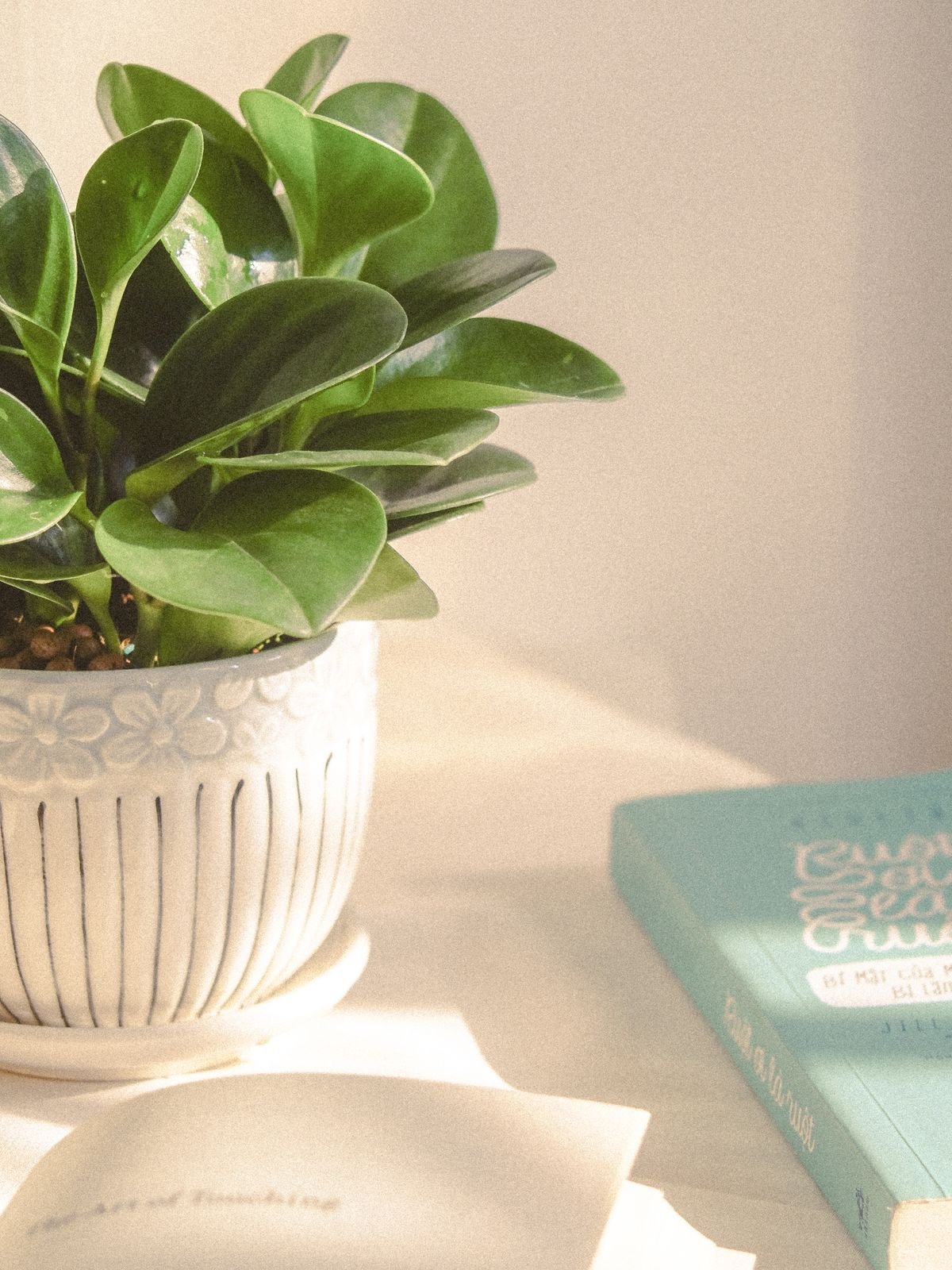
Peperomia obtusifolia care rests on one principle: this is a semi-succulent, not a moisture-loving tropical. Peperomia obtusifolia (L.) A.Dietr. — the Baby Rubber Plant — belongs to the family Piperaceae and is native to the forest understoreys of Venezuela, Colombia, Ecuador, Mexico, and southern Florida (NC State Extension; RHS). It is a facultative epiphyte: a plant that grows both terrestrially on forest floors and epiphytically on the surfaces of trees, with a root system adapted to free-draining, oxygen-rich substrate and intermittent drought.
That ecological origin resolves most care questions on its own: the standard tropical-houseplant advice to "keep the soil consistently moist" is precisely wrong for a species built for seasonally dry forest floors and bark.
The short answer: Peperomia obtusifolia requires bright indirect light (roughly 2,000–4,000 lux as a working target), watering only when the top 2–3 cm of substrate is fully dry, a free-draining mix with at least 30% perlite, temperatures of 18–24°C, and fertiliser at half-strength monthly during spring and summer only. Its most common cause of failure is overwatering, not underwatering.
Quick Care Reference
| Factor | Optimal Range | Risk Threshold |
|---|---|---|
| Light | Roughly 2,000–4,000 lux (bright indirect; working target) | Below about 800 lux: little or no growth, legginess |
| Watering trigger | Top 2–3 cm of substrate dry; pot has lost weight | Soil that stays wet for long periods: root rot |
| Summer interval | Every 10–14 days (12 cm pot, standard conditions) | — |
| Winter interval | Every 21–28 days | — |
| Substrate | 50% peat-free compost, 30% perlite, 20% bark | No moisture-control or peat-only mixes |
| Temperature | 18–24°C day / 15–18°C night | Below 10°C: cellular damage |
| Humidity | 40–60% RH | Below 30% RH: leaf edge desiccation |
| Fertiliser | Balanced NPK 20-20-20 at 50% rate, monthly | Spring–summer only; none in dormancy |
| Repotting | 2–3 cm larger than root ball | Never into an oversized pot |
| Toxicity | Non-toxic (ASPCA) | Safe for cats, dogs, and horses |
1. Light: The Understory Biology
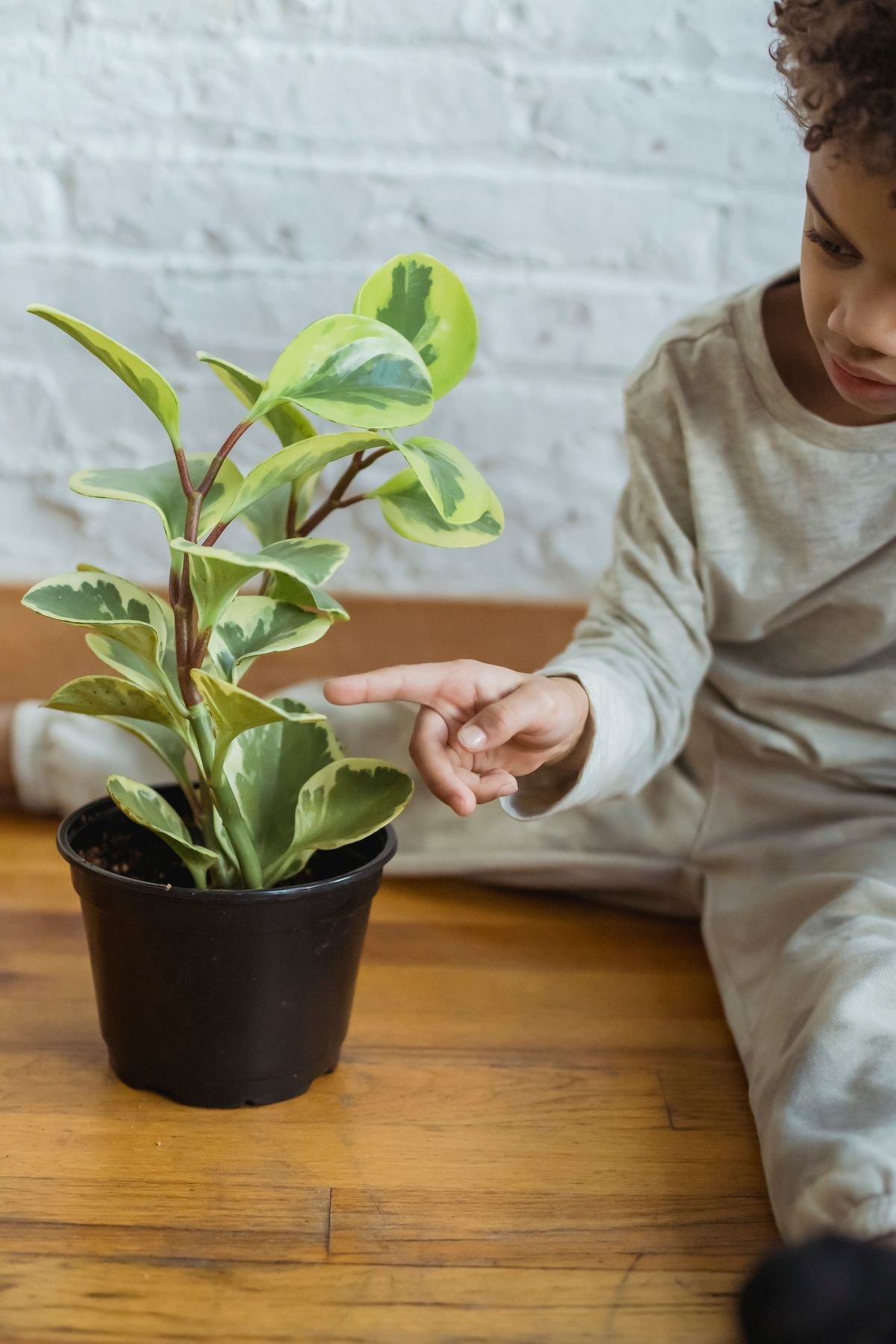
In its native range, Peperomia obtusifolia grows beneath a forest canopy — bright but mostly diffuse light, rarely direct. Under drought stress, the species also shows documented CAM-cycling: it recycles respiratory CO₂ through daily organic-acid swings without taking in CO₂ at night (Hanscom & Ting 1978; Holthe, Patel & Ting 1992), a modest water-saving trait consistent with a shaded, intermittently dry forest-floor origin rather than constant bright sun.
Practical implication: place the plant within 1–2 m of a bright window with diffuse, not direct, light. East-facing morning sun is ideal; south or west-facing windows work behind a sheer curtain to filter midday intensity; north-facing positions fall short for most of the year.
Working light figures (approximate, based on UGA Extension's indoor light categories rather than measurements on this species):
- Roughly 2,000–4,000 lux: Good growth. Compact internodes, full leaf colour, active growth.
- Around 800 lux: Tolerated minimum. The plant survives but does not grow — it draws down stored energy reserves.
- Below about 800 lux: Etiolation begins. Internodes stretch as the plant directs growth toward the light source. This structural response cannot be reversed in existing tissue; the standard correction is to move the plant to adequate light and prune back to a compact node, letting new growth resume at the correct internode spacing (see the pruning guide).
- Strong unfiltered direct sun: Scorch (RHS and MBG both advise avoiding direct sun). Pale bleached patches form on the leaf surface and turn papery.
Variegated cultivars ('Variegata', 'Alba', 'Albo-Marginata') need brighter light than the all-green species — the white or cream leaf sections contain no functional chlorophyll, so less of each leaf can photosynthesise. A position that sustains the green form will cause progressive reversion to all-green growth in variegated cultivars.
A practical field test: hold your hand 30 cm above a white surface in the chosen position. A sharp, well-defined shadow indicates adequate light. A diffuse or absent shadow indicates the position is below the tolerance threshold.
2. Watering: Reading the Semi-Succulent
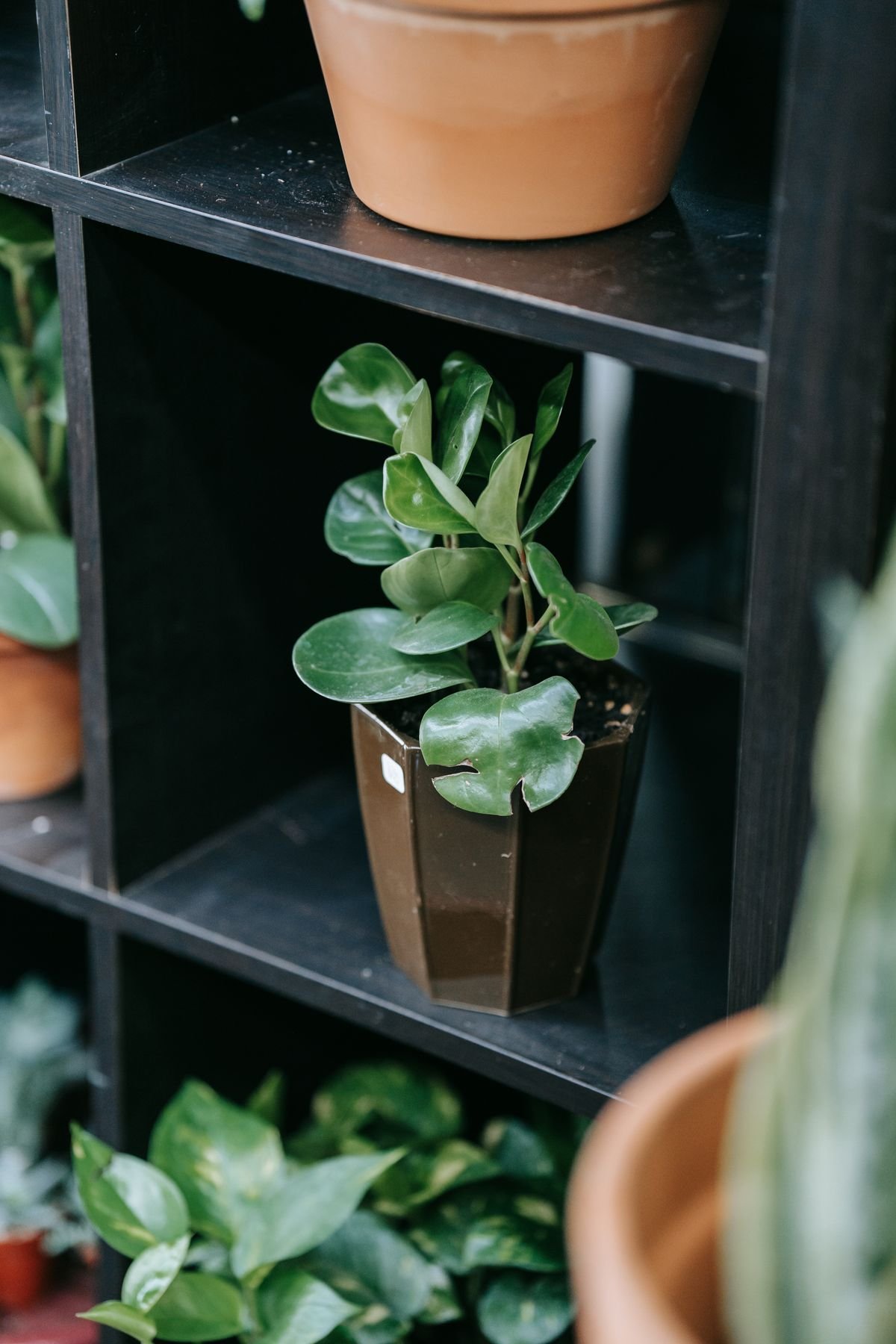
Overwatering is the primary cause of decline in container-grown Peperomia obtusifolia. The species stores water in its thick, semi-succulent leaves — an adaptation to dry spells in its native range — and its fine, shallow root system is not built for prolonged substrate saturation. Generic tropical-houseplant advice to "keep the soil consistently moist" describes a moisture-loving aroid, not this species: applied here, it keeps the soil wet for long periods, which starves the fine roots of oxygen and leads to root and stem rot (NC State Extension).
The correct watering protocol:
- Check substrate moisture by pressing a finger 2–3 cm into the surface. The watering trigger is when this layer is completely dry to the touch and the pot has lost perceptible weight compared to just after the last watering.
- Water thoroughly at substrate level, not over the foliage. Moisture on the leaf surface in low-airflow conditions is the primary germination environment for fungal pathogens.
- Allow all excess to drain completely from the drainage holes. Empty the saucer within 30 minutes.
Seasonal intervals (12 cm container, 50/30/20 mix, 18–22°C, 40–60% humidity):
- Spring and summer: every 10–14 days
- Autumn and winter: every 21–28 days
These are calibration starting points, not fixed schedules. The plant's leaf firmness is the definitive guide: firm and glossy indicates adequate hydration; slightly soft and matte indicates deficit.
Terracotta versus plastic: unglazed terracotta lets moisture evaporate through its walls, so it dries noticeably faster than plastic and shortens the safe interval. Moving from a plastic nursery pot to terracotta on the same unchanged schedule is a common, avoidable route to root rot — not from watering more, but from the old interval now overshooting a faster-drying pot.
For a full treatment of bottom-watering technique and water quality, see the complete overwatering rescue guide.
3. Substrate: Oxygen at the Root Zone
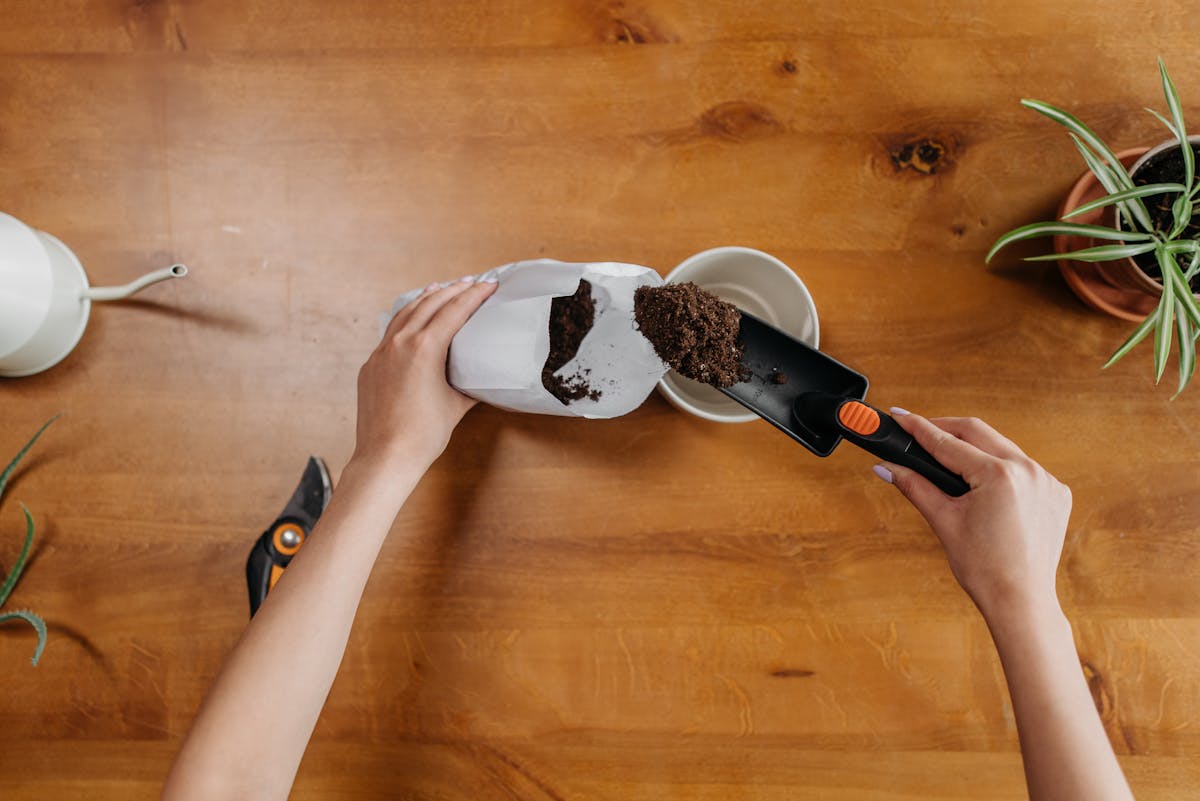
The root system of Peperomia obtusifolia respires aerobically — it consumes oxygen and releases carbon dioxide. In its native habitat, roots grow in leaf litter, bark, and rocky outcrops: free-draining, structurally open materials that hold oxygen in air pockets between particles. Standard all-purpose potting compost, used alone, compacts over time, displacing oxygen and retaining moisture at levels that exceed this root system's tolerance.
The recommended substrate:
| Component | Proportion | Function |
|---|---|---|
| Peat-free compost | 50% | Nutrient retention, structure |
| Perlite | 30% | Drainage, permanent air pockets |
| Fine bark | 20% | Structural chunkiness, simulates epiphytic root environment |
Keep the inorganic fraction (perlite, pumice, or horticultural grit) at 30% or above — below that, saturation risk rises regardless of watering frequency, which is why moisture-control or water-retaining compost formulations are unsuitable here.
Pot material affects drying rate directly: unglazed terracotta evaporates through the wall as a passive safeguard against overwatering, while plastic holds moisture longer, trading disciplined watering for more forgiveness in hot, dry spells. Growers who want to remove substrate moisture management from the equation entirely sometimes move to semi-hydroponic LECA, which replaces the dry-down cycle above with continuous capillary wicking from a reservoir — a different system, not just a different mix.
For a detailed soil mix recipe with alternative inorganic components, see the soil mix recipe guide.
4. Temperature and Humidity
Peperomia obtusifolia performs best in warm, steady conditions; the RHS gives 18–30°C as its ideal range. The practical indoor parameters:
Temperature:
- Optimal daytime: 18–24°C
- Tolerated range: 15–30°C
- Critical threshold: Keep it above 10°C (RHS). Colder conditions cause chilling damage, and affected leaves do not recover.
- Cold draft risk: Temperatures below 15°C at leaf level damage stomatal function even without visible symptoms. Plants positioned against north-facing glass in winter can have leaves noticeably colder than the room air.
Keep the plant away from forced-air heating and air conditioning vents, which combine rapid temperature swings with drying airflow that accelerates transpiration beyond what the root system can sustain.
Humidity: unlike many tropical houseplants, this species tolerates ordinary household air without a humidifier — 40–60% RH, the typical range in most temperate homes, is sufficient (see the full humidity guide for the cuticle-and-stomata mechanism behind this tolerance). Two risk thresholds:
- Below 30% RH (common in winter near radiators): The atmospheric vapour pressure deficit pulls moisture out of leaf margins faster than the roots can replace it, causing crispy brown edges.
- Above 75% RH in stagnant air: Elevated fungal and bacterial leaf-spot risk.
5. Fertiliser: Calibrating for a Light Feeder
In its native habitat, Peperomia obtusifolia grows in leaf litter and bark substrates that are low in soluble nutrients and drain rapidly after rain. It evolved as a light feeder — its root system is not adapted to the high nutrient concentrations that benefit fast-growing tropical species.
Over-fertilising is a frequent error. Excess soluble nitrogen and potassium accumulate in the substrate as salt deposits, raising the electrical conductivity of the soil solution. When soil conductivity exceeds root-cell membrane tolerance, water moves osmotically out of the roots rather than into them — producing leaf tip and margin burn that is often misdiagnosed as underwatering.
The correct fertiliser protocol:
- Formulation: Balanced NPK (20-20-20 or equivalent). No specialist formulations are required.
- Concentration: 50% of the labelled rate. This species does not benefit from full-strength applications.
- Frequency: Once monthly during the growing season (spring through summer).
- Dormancy: No fertiliser from autumn through winter. The plant's reduced photosynthetic rate means nutrients it cannot use accumulate as the salt deposits that cause damage.
- Flush schedule: Run clean water through the substrate at three to four times the pot volume every three to four months to dissolve and remove accumulated salts.
Leaf tip burn beginning at the margins — distinct from the central-leaf damage caused by root rot — is the first sign of salt accumulation; see the fertiliser burn guide for the full flush protocol. Full product-type comparisons and situational adjustments (LECA, variegated cultivars, travel) are covered in the fertiliser guide.
6. Repotting: Container Volume and Root Zone Management
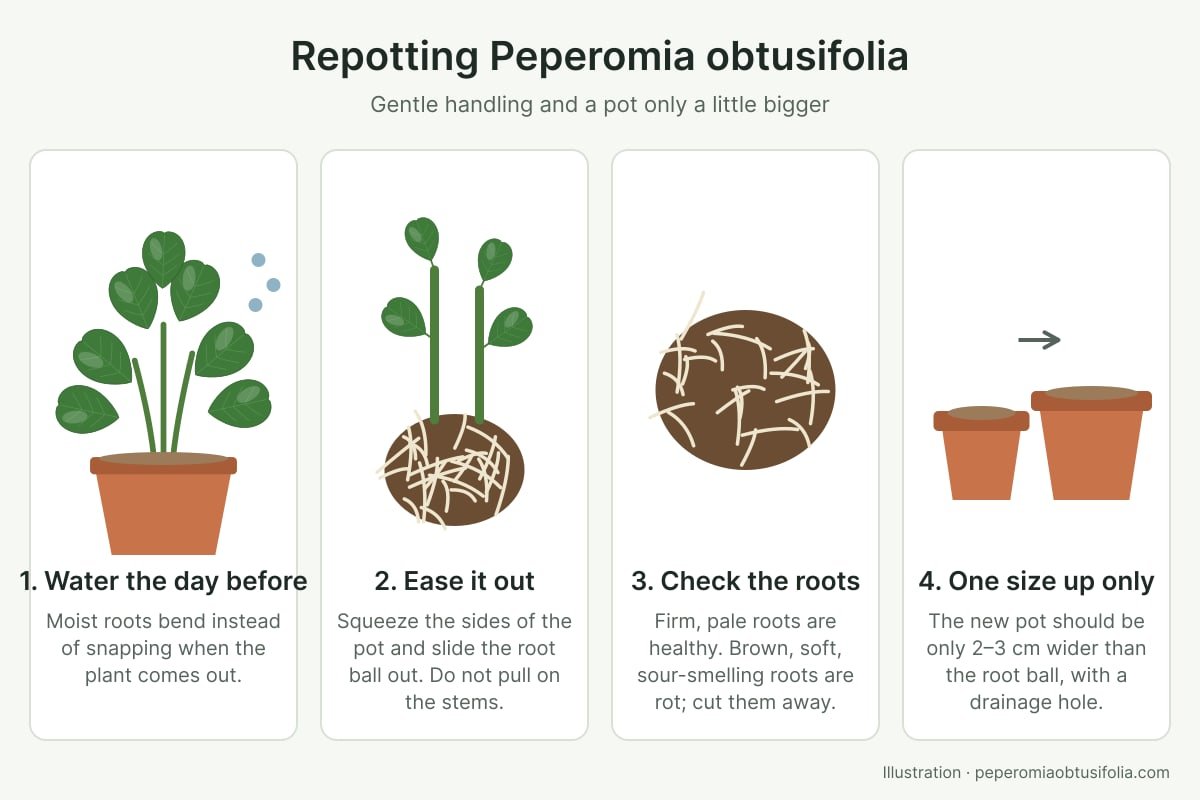
Peperomia obtusifolia has a compact, shallow root system. The most common repotting error is selecting a container significantly larger than the current root ball — often with the intention of "giving the plant room to grow." This is structurally counterproductive.
A root system cannot regulate moisture across a substrate volume significantly larger than its own spread. The area beyond the root zone retains water without any biological mechanism to draw it down. A typical case: a 12 cm root ball moved into a 20 cm pot of standard compost, on an unchanged watering schedule, tends to stall and then yellow at the lower leaves, because the outer compost stays wet for long stretches between waterings and the roots there run short of oxygen. Moving it instead into a 14 cm pot with a free-draining mix usually lets it recover, though slowly.
The repotting protocol:
- When to repot: Roots emerging visibly from drainage holes, or the plant showing drought stress symptoms within three to four days of watering (indicating the root ball has consumed all available substrate moisture and requires more volume).
- New pot size: 2–3 cm larger in diameter than the current root ball. No more.
- Season: Early spring (March–April in the northern hemisphere), as new growth begins.
- Post-repotting: Wait two to four weeks before resuming the normal fertiliser schedule. The disturbed root system needs time to reestablish contact with the new substrate before it can process nutrient inputs.
7. Propagation
Peperomia obtusifolia propagates by stem cuttings, leaf cuttings and division (RHS), with meaningfully different timelines. Stem tip cuttings are faster: a cutting with the growing tip and two to three nodes usually roots in substrate within a few weeks in warm, humid conditions, and is the more dependable of the two. Leaf cuttings with petiole work but are much slower, since a single leaf must generate entirely new growing tissue before a plantlet can emerge, and they fail more often. Leaf cuttings of variegated forms also tend to come back all green (UF/IFAS), so take stem cuttings from those. Division gives you an established plant straight away.
Root in substrate rather than water where possible. Water-initiated roots are morphologically adapted to low-oxygen aquatic conditions — thinner, with lower root hair density — and often die back and get replaced by a new root system on transfer to substrate, which adds weeks to the total timeline. Rooting directly in a 50% perlite, 50% fine bark mix avoids that transition delay entirely.
8. Common Pests
Peperomia obtusifolia is relatively resistant to pest pressure when environmental conditions are correct. Most infestations follow periods of stress — particularly overwatering or low humidity.
The primary pests to identify:
- Fungus gnats (Bradysia spp.): Small flies hovering around the substrate. Adults are harmless; the larvae feed on fine root hairs in wet substrate. The primary prevention is allowing the substrate surface to dry between waterings — larvae cannot survive in dry top layers.
- Mealybugs (Pseudococcus spp.): White, cottony deposits at leaf axils and stem joints. Remove manually with 70% isopropyl alcohol on a cotton swab; apply neem oil solution as a preventive.
- Spider mites (indoors, usually the common two-spotted spider mite, Tetranychus urticae): Stippled, pale dots on the leaf surface, often with fine webbing on the undersides. Thrive in hot, dry conditions. Raise humidity to 40–60% RH and apply a miticide or insecticidal soap.
- Scale insects: Brown, immobile shell-like bumps on stems. Remove with isopropyl alcohol; persistent infestations require systemic insecticide.
Isolate any infested plant immediately to prevent transfer to adjacent specimens. Inspect new plants in quarantine for a minimum of two weeks before introducing them to an established collection.
9. Flowering
Peperomia obtusifolia produces flowers, though they are botanically modest — small, cream-coloured spikes (spadix-like inflorescences) emerging from the stem. The RHS describes flowering as erratic, mainly in late summer. The flowers produce no significant fragrance and do not affect the plant's care requirements.
Flowering in an indoor specimen is a reliable indicator of adequate care conditions: the plant only allocates resources to reproduction when its core metabolic needs (light, water, temperature) are consistently met. A plant that has not flowered after two to three years of cultivation is likely performing below its photosynthetic optimum — most commonly due to insufficient light.
10. Toxicity and Pet Safety
The ASPCA classifies Peperomia obtusifolia as non-toxic to cats, dogs, and horses, with no compounds known to produce toxic effects in companion animals or humans — one of a small number of houseplants safe to place around pets and small children without ingestion risk.
11. Troubleshooting Reference
| Symptom | Biological Cause | First Action |
|---|---|---|
| Yellowing lower leaves | Root anoxia from overwatering | Unpot; inspect roots |
| Soft, mushy stem base | Stem rot (Pythium spp.) | Remove affected tissue; repot |
| Black spots, hard and corky | Cellular oedema — pressure rupture | Adjust watering interval; improve drainage |
| Black spots, soft and sunken | Fungal or bacterial leaf spot | Isolate; remove affected leaves; improve airflow |
| Internode elongation | Light deficit (below about 800 lux) | Reposition or add supplemental lighting |
| Brown, crispy leaf margins | Humidity below 30% RH or salt burn | Flush substrate; raise humidity |
| Pale bleached patches | Strong direct sun | Filter or diffuse light source |
| Sudden leaf drop (green leaves) | Cold shock below 10°C or root anoxia | Check temperature and root condition |
For full diagnostic protocols across all symptom types, see the complete problems guide.
12. The Spring Reset: Ending Winter Dormancy
As day length increases in early spring, P. obtusifolia shifts out of the reduced-metabolism state it holds through winter. Phytochromes — light-sensing pigments in the growing tip — track the shortening period of darkness, and once it drops below a threshold, hormonal signalling shifts from maintenance toward new-leaf production. This is why growth resumes in spring on its own, without any change to care: the trigger is day length, not the calendar date, and it is the same photoperiodic mechanism underlying the growth pause described in the winter care guide.
The adjustments below apply once new growth is visibly under way — a swelling growth tip or a newly unfurling leaf — not on a fixed date:
- Resume fertilising at the half-strength monthly rate described in the fertiliser section above. Feeding before new growth appears wastes nutrients as salt accumulation rather than plant use.
- This is the best window for repotting, since active root growth heals transplant disturbance faster than at any other point in the year — see the repotting section above for sizing.
- Spring is also the right time for structural pruning. Cutting back leggy or lopsided winter growth breaks apical dominance and activates dormant buds lower on the stem, producing a fuller, bushier habit — see the pruning guide for technique.
- A substrate flush — running three to four times the pot volume of clean water through the mix — clears salt or mineral buildup accumulated during winter's slower watering pace before the growing season's faster uptake begins.
Conclusion
Every decision in this guide traces back to the same origin: P. obtusifolia is a semi-succulent forest-floor and bark specialist, not a moisture-loving tropical, and treating it like one is the most common route to failure. Get the light and watering interval right and the rest — substrate, fertiliser, repotting — mostly follows as a matter of degree rather than a separate set of rules. Once the plant is healthy and compact, the two remaining decisions are cosmetic rather than biological: the pruning guide covers shaping it into a fuller, bushier form, and the feng shui placement guide covers where to put it for the rounded, glossy display value most growers choose this species for in the first place.
Care FAQ
How often should I water Peperomia obtusifolia?
Never water on a fixed schedule. The plant is semi-succulent and stores water in its leaves. Water only when the top 2–3 cm of the substrate has dried completely. In summer this typically means every 10–14 days; in winter, every 21–28 days depending on your home temperature and light levels.
Is Peperomia obtusifolia a low-light plant?
It tolerates low light, but it does not perform well there. Below about 800 lux it survives but barely grows. For good growth, aim for roughly 2,000–4,000 lux at leaf level, a working target based on UGA Extension's indoor light categories. Variegated cultivars need brighter light than the green form because they have less green tissue.
What is the most common way Peperomia obtusifolia is killed?
Overwatering. Soil that stays wet for long periods fills the air spaces around the roots, the roots run short of oxygen, and root rots such as Pythium or Phytophthora take hold (NC State Extension; University of Illinois RPD 653). The plant then wilts in wet substrate, which is often misread as thirst and answered with more water.
Is Peperomia obtusifolia safe for pets?
Yes. The ASPCA classifies Peperomia obtusifolia as non-toxic to cats, dogs, and horses. It is one of the few houseplants that presents no ingestion risk to household pets.