Fix Leggy Peperomia Obtusifolia: Etiolation, Pruning & The Lux Reset

A leggy Peperomia obtusifolia is not growing fast — it is in etiolation, the plant's shade-avoidance response to chronic light deficit. Internodes stretch from the species' typical 1–2 cm to 4–6 cm. Leaves emerge smaller, paler, and at extreme angles to capture stray photons. The stem eventually leans toward the light source, and the structural integrity of the plant collapses under the weight of its own canopy.
The short answer: Fixing a leggy P. obtusifolia requires both interventions, not one. Prune the elongated stem back to the last compact node to break apical dominance and unlock dormant lateral buds — and relocate to 2,000–4,000 lux measured at the leaf surface to prevent re-etiolation in the new growth. Pruning alone produces fresh stems that stretch again under the same light. Relocation alone leaves the existing leggy architecture permanent. The combined protocol is the only path to compact, bushy form.
For the foundational light and watering framework, see the complete care guide.
Diagnostic Table: Reading the Signs of Etiolation
| Symptom | Quantitative Threshold | Diagnostic Meaning |
|---|---|---|
| Internode length | >3 cm between leaves | Light below 1,000 lux sustained |
| Leaf colour | Pale or lime-green, lacking chlorophyll | Chloroplast under-development; etiolation |
| Stem orientation | Leaning toward light source | Phototropism — uneven auxin distribution |
| New leaf size | Smaller than mature older leaves | Energy redirected to stem elongation |
| Stem strength | Collapses under canopy weight | Cell-wall weakening from gibberellin signalling |
| Bare lower stem | Gaps with no axillary growth | Apical dominance suppressing lateral buds |
1. The Etiolation Mechanism: Why the Stem Stretches
In a forest understorey, when P. obtusifolia is overshaded by competing vegetation, the spectral composition of the incoming light shifts. The upper canopy absorbs disproportionately more red light (660 nm) than far-red (730 nm); the light that reaches the shaded plant has a depressed red-to-far-red ratio. The plant's phytochrome photoreceptors detect this shift and interpret it as a signal of overcrowding.
The hormonal response is immediate. The plant increases gibberellin production at the meristem, which softens cell walls in the developing stem and triggers rapid cell elongation. Energy is reallocated from chloroplast development and leaf production toward vertical extension. The plant gambles its structural integrity for the chance of reaching brighter light above the canopy.
Indoors, the same response is triggered by sustained light below the species' tolerated minimum of 800–1,000 lux — a typical position 2–3 m from a window in a fluorescent-lit office, or any corner where unmeasured "bright indirect light" turns out, on measurement, to deliver only 300–600 lux at the leaf surface.
This is the position that the houseplant literature most reliably gets wrong: "Bright indirect light" is meaningless without a lux number. The phrase describes a range from ~300 lux (shaded north-facing room, well below tolerated minimum) to ~10,000 lux (south-facing window with sheer curtain, well within optimum). Until a number is attached, the advice is unactionable. P. obtusifolia's standard is 2,000–4,000 lux measured at the leaf surface — by phone app or dedicated meter, not by feel.
2. Apical Dominance and the Auxin–Cytokinin Tug-of-War
Even after relocation, a leggy P. obtusifolia will not branch out on its own. Two opposing hormones govern whether dormant lateral buds along the stem activate or remain suppressed:
- Auxin — produced at the apical meristem (the growing tip). Flows downward through the stem and chemically suppresses every lateral bud below it. As long as the tip is intact, no lateral growth occurs.
- Cytokinin — produced in the roots. Travels upward and activates lateral buds — but is overridden by descending auxin under normal conditions.
The two hormones sit in dynamic balance. Removing the apical bud eliminates the descending auxin signal within hours; cytokinins reach the lateral buds without interference; within 10–14 days under adequate light, 2–3 lateral branches emerge from the nodes below the cut. This is why every "make it bushy" intervention requires cutting the tip — there is no chemical or environmental substitute for breaking apical dominance.
3. The Pruning Protocol
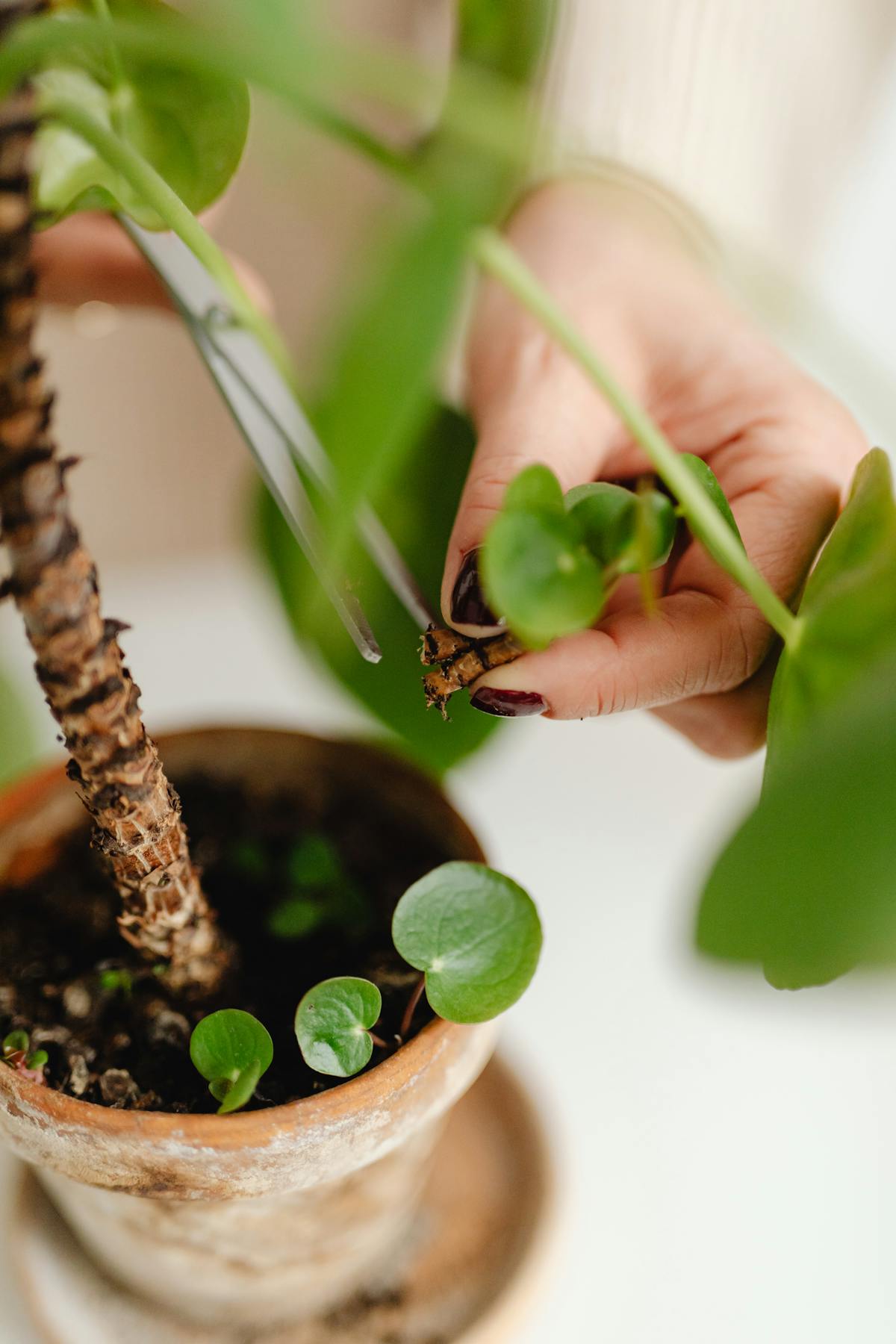
The mechanics are simple, but the cut location is decisive.
- Identify the last compact node — the highest point on the stem where internodes were still under
2 cm. New growth will emerge from this region. - Sterilise the scissors with 70% isopropyl alcohol before every cut and between plants. P. obtusifolia is susceptible to bacterial leaf spot through fresh wounds.
- Cut horizontally
0.5 cmabove a healthy node. Cutting flush with the node damages the meristem; cutting more than 1 cm above leaves a stub that dies back and invites pathogens. - Be willing to hard-prune. A 30 cm leggy stem can be cut to 5–10 cm without harm. P. obtusifolia is exceptionally resilient to severe pruning provided the root system is healthy and the stem base remains firm and green.
- Time the prune for early spring — when daylength is increasing and the plant is entering active growth. Lateral bud activation typically produces visible growth within 14 days under
2,000–4,000 lux. Winter pruning delays the same response to 6–8 weeks. - Do not fertilise for 4 weeks post-prune. Cut tissue is sensitive to osmotic stress; resume balanced NPK
20-20-20at50%of label rate monthly only after the first new lateral leaves have hardened off.
4. The Etiolated Office Specimen — A Recurring Case
A frequent diagnostic scenario in reader correspondence: a P. obtusifolia has been kept 2–3 m from the nearest window in a fluorescent-lit office for two or more years. Internodes have elongated from the species' typical 1–2 cm to 4–6 cm. The plant leans toward the window. New leaves are smaller than older ones. The stem can no longer support the canopy and has begun to flop.
The mechanism is sustained sub-1,000 lux light triggering shade-avoidance. Auxin redistribution to one side of the stem (the side away from the window) produces phototropic curvature; gibberellin-mediated internode elongation accounts for the overall reach toward the light source. Existing elongation is structurally permanent — the cells are committed to their stretched form.
The corrective intervention combines both halves: a hard prune back to the lowest 2–3 compact nodes, and immediate relocation to a position reading at least 2,000 lux at the leaf surface — typically 30–60 cm from a bright east- or west-facing window, or under a supplemental LED grow light positioned 30–40 cm above the canopy. Lateral buds become visible at the remaining nodes within 14 days; full canopy regeneration to a bushy form takes 6–10 weeks.
5. Post-Pruning Light: Preventing Re-Etiolation
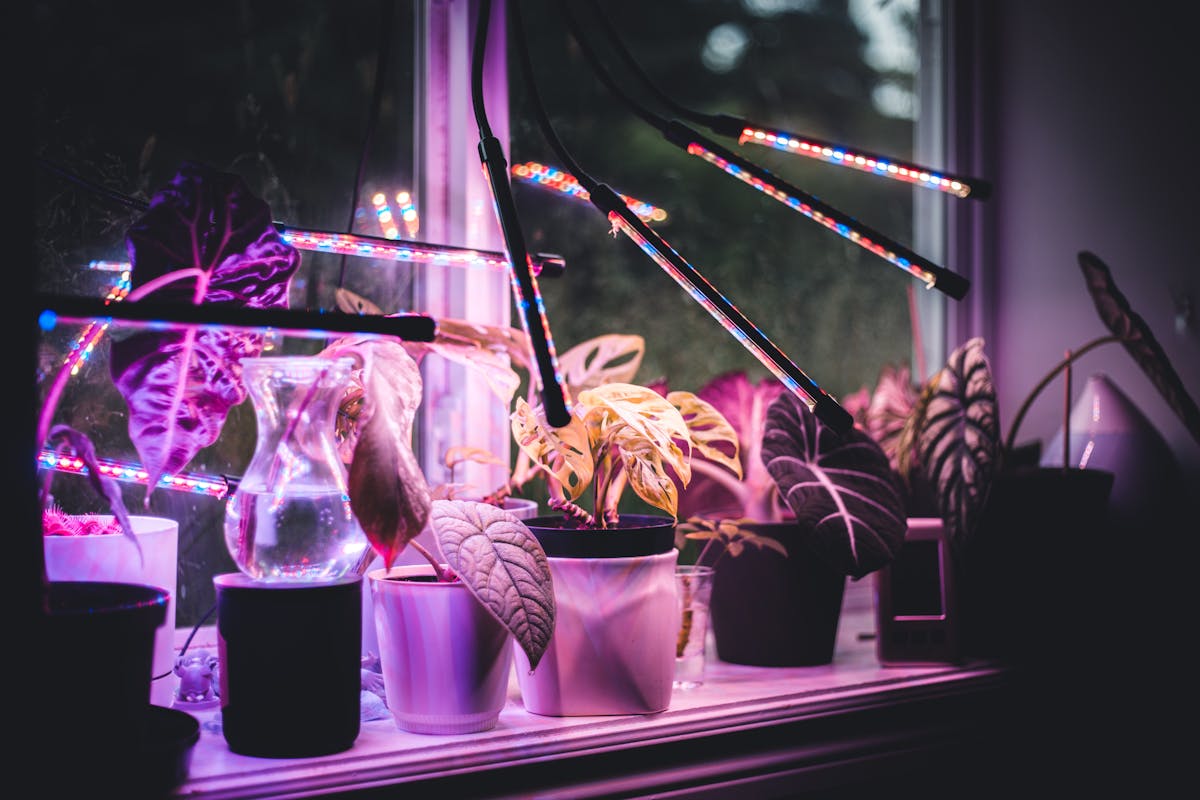
Pruning resets architecture. Light maintains it. If the plant returns to the same position after the cut, the new lateral growth elongates under the same sub-threshold lux and the work is wasted.
- Target
2,000–4,000 luxmeasured at the leaf surface, not at the window glass. Light intensity drops with the square of distance — a window reading 10,000 lux delivers roughly 2,500 lux at 1 m and 1,000 lux at 2 m. - Rotate the pot 90° every 7–10 days. This redistributes auxin around the stem and prevents the phototropic lean that drives one-sided architecture and structural collapse.
- In winter, supplement with LED. Ambient light commonly drops by 70–80% between October and February in temperate climates. A
15–20 WLED grow light positioned30–40 cmabove the canopy maintains2,000–4,000 luxthrough the low-ambient months. - For variegated cultivars — 'Variegata', 'Albo-Marginata', 'Alba' — target
2,800–5,000 lux. Their tissue carries 30–40% less functional chlorophyll, so the same lux delivers proportionally less usable energy.
6. The Salvage: Propagating the Leggy Tops
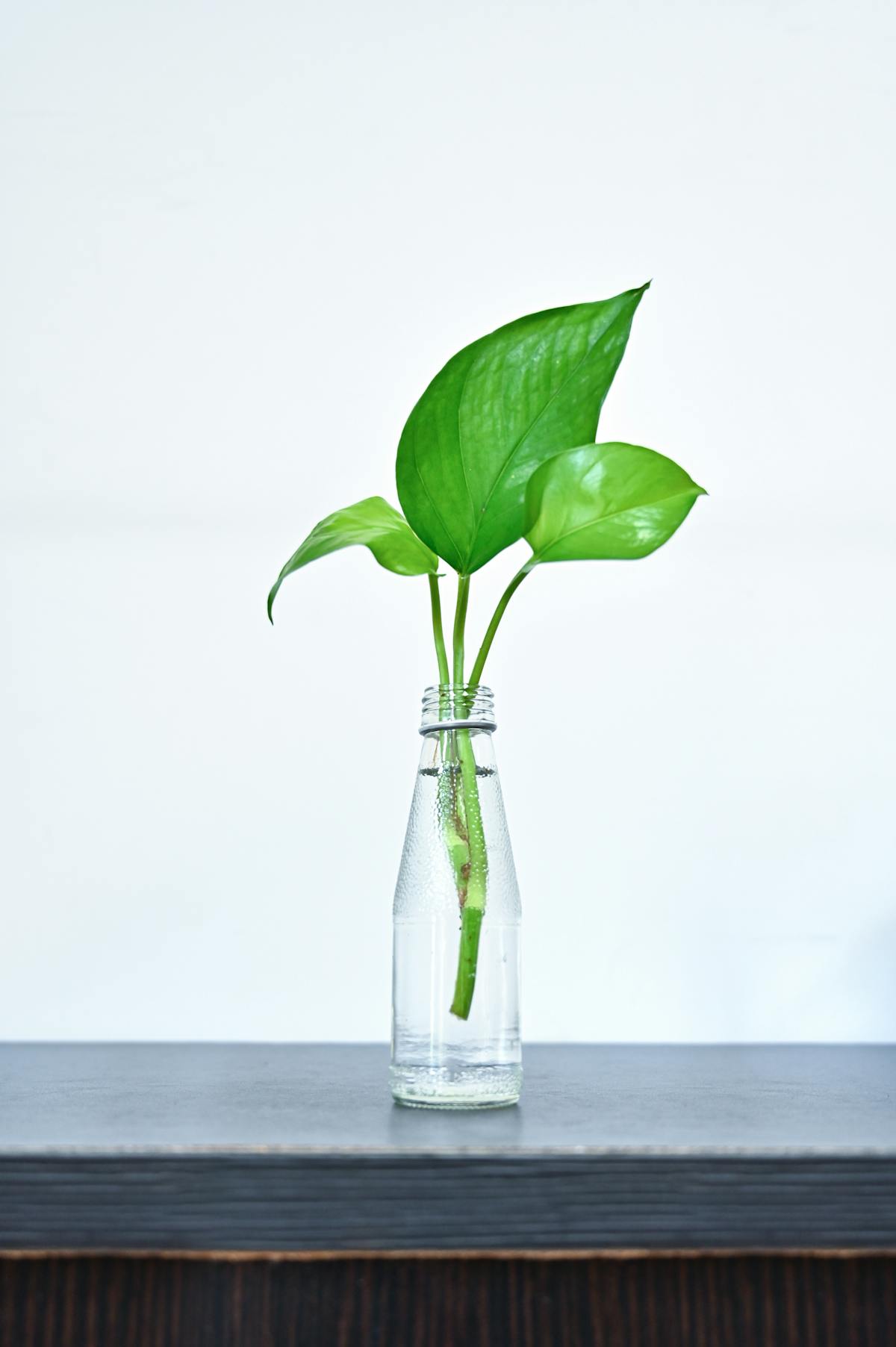
The pruned tops are not waste material — they are propagation stock. Stem cuttings of 5–10 cm taken with at least one node root readily in water (14–28 days to first roots, 80–95% success) or in moist perlite (21–42 days, 85–95% success). The new plants emerge compact under correct light, while the parent rebuilds a bushy canopy from its lower nodes.
A specific caveat for variegated specimens: leaf cuttings regenerate from L2/L3 cell-layer tissue, which is genetically all-green; plantlets from variegated leaf cuttings revert to green in >95% of cases. To preserve variegation, propagate from stem cuttings with at least one variegated node — and accept that even nodal propagation produces some reversion.
For the full propagation procedure, see the stem-cutting propagation guide.
Recommended Products
- Sterile pruning snips — sharp, narrow blades for the precise
0.5 cm-above-node cut. Disinfect with 70% isopropyl between cuts. - Digital lux meter — the only honest way to confirm the leaf surface receives the
2,000–4,000 luxthat prevents re-etiolation. - LED grow light, 15–20 W full-spectrum — supplemental light for winter and dim rooms. Position 30–40 cm above the canopy.
Sources and Related Reading
- Wikipedia — Etiolation (mechanism reference for shade-avoidance, internode lengthening, and chloroplast under-development)
- Wikipedia — Apical dominance (mechanism reference for auxin–cytokinin balance and pruning response)
- NC State Extension — Peperomia obtusifolia (species profile and indoor cultivation reference)
Internal mechanism references on this site:
- Peperomia obtusifolia care guide — parent reference for thresholds.
- Peperomia obtusifolia grow lights — supplemental lighting protocol for the
2,000–4,000 luxtarget. - Light meters: lux, foot-candles, PPFD — measurement methodology.
- Peperomia obtusifolia growth rate — what to expect from new lateral growth post-prune.
- How to propagate long Peperomia vines — converting the pruned leggy tops into new compact specimens.
- Peperomia obtusifolia curling leaves — sibling diagnostic for the curling that often co-occurs with etiolation.
Care FAQ
Why is my Peperomia obtusifolia getting so tall and thin?
This is etiolation — the shade-avoidance response. Below 1,000 lux sustained for 4–6 weeks, the plant reallocates energy from leaf production to stem elongation, gambling structural integrity for the chance of reaching higher photon density. Internodes stretch from the species' typical 1–2 cm to 4–6 cm, leaves become smaller and paler, and the stem cannot support its own weight. The existing elongated tissue is permanent; the fix is corrective pruning combined with relocation to 2,000–4,000 lux.
How do I make my Peperomia bushy again?
Break apical dominance by removing the growing tip. The terminal bud produces auxin, which travels down the stem and chemically suppresses every lateral bud below it. Once the tip is cut, auxin flow stops, and cytokinins from the roots activate 2–3 lateral buds at nearby nodes. Each becomes a new branch. Without the prune, lateral buds remain dormant indefinitely.
Where exactly should I cut a leggy Peperomia stem?
Make a clean horizontal cut roughly 0.5 cm above a healthy node — the small swelling where a leaf or leaf scar meets the stem. New growth emerges from the next node below the cut within 10–14 days, provided ambient light is at least 2,000 lux. Sterilise the scissors with 70% isopropyl alcohol before each cut and between plants.
Can I fix a leggy Peperomia without pruning it?
No. Improving light prevents future legginess but does not restore architecture. Elongated stem tissue is permanently structured — the cells have committed to their stretched form and cannot un-elongate. Pruning is the only mechanical way to reset the plant's shape; the leggy tops can then be propagated as new compact plants.
What lux level prevents future legginess?
The optimum range for compact growth is 2,000–4,000 lux measured at the leaf surface with a meter or calibrated phone app — equivalent to a position 30–60 cm from a bright east- or west-facing window. The tolerated minimum is 800–1,000 lux, below which etiolation begins after 4–6 weeks. Variegated cultivars require 30–40% more light than the green form.
When is the best time to prune a leggy Peperomia?
Early spring, when daylength is increasing and the plant is entering active growth. Pruning in autumn or winter delays recovery because lateral bud activation requires photosynthetically usable light and warm root-zone temperature (18–24°C). A spring prune typically produces visible lateral growth within 14 days; a winter prune may take 6–8 weeks.
Can I propagate the leggy stems I cut off?
Yes — stem cuttings of 5–10 cm, taken with at least one node, root readily in water (14–28 days to first roots, 80–95% success) or in moist perlite. Variegated tops are best rooted from stem cuttings with at least one variegated node, as leaf cuttings regenerate from L2/L3 tissue and revert to all-green in over 95% of cases.