
Peperomia Winter Care: Light, Water and Temperature
Peperomia obtusifolia tolerates a typical indoor winter well, and the main limiting factor is not cold air generally but two specific, avoidable conditions: sustained proximity to cold window glass, and watering on a fixed schedule that ignores the season's slower substrate dry-down. Neither requires special equipment to manage — both come down to placement and a longer interval between waterings.
Quick Winter Suitability Checklist
| Factor | Winter condition | Peperomia obtusifolia tolerance |
|---|---|---|
| Light | Shorter days, lower-angle sun | Tolerates the seasonal dip; growth slows rather than fails |
| Temperature | 18-24°C typical heated room | Within optimum; risk is localised cold near glass, not room temperature |
| Airflow | Often reduced (windows shut) | Adequate if the plant isn't sealed in a still, unventilated corner |
| Humidity | Often <30% RH with forced-air heating | Tolerates moderate dryness; sustained heat plus low humidity is the main stress combination |
| Watering access | Substrate dries much more slowly | Requires an extended interval, not the summer schedule |
| Duration | Roughly November to February in temperate climates | Full season is manageable with the adjustments below |
Why Growth Slows or Stops in Winter
Peperomia obtusifolia does not enter a true deciduous dormancy, but it does undergo a real, measurable metabolic slowdown driven by day length rather than temperature alone. In summer, photosynthetic output exceeds the energy the plant spends on respiration, and that surplus funds new leaves. As day length and light intensity drop through autumn, output falls toward the compensation point — the level at which energy production only just offsets the cost of staying alive — and surplus for new growth disappears. This is why a healthy plant can show no new growth for several months without anything being wrong: the meristem isn't damaged, it simply has no energy budget to spend on expansion until light levels recover.
The practical sign that this is normal seasonal slowdown rather than a problem is that existing leaves stay firm and glossy while new growth simply pauses. A plant that is losing leaf turgor, yellowing, or dropping older leaves during this period is showing a different, unrelated problem — most often a watering interval that hasn't been adjusted for the slower metabolism described below.
The Main Risks, Ranked by Likelihood
1. Overwatering on an unchanged schedule. This is the most common cause of winter decline. Slower transpiration means the substrate that dried in 10-14 days over summer can take 21-28 days in winter, and watering on the old interval saturates substrate the roots are no longer using at the same rate, risking root anoxia within days.
2. Cold damage from window proximity. Leaves resting against or close to cold glass lose heat by radiation overnight, and the air layer right against the pane can run several degrees colder than the room reads on a thermostat — occasionally enough to cross the roughly 10°C threshold below which cell membranes begin sustaining real damage.
3. Low humidity from forced-air heating. Central heating routinely drops indoor relative humidity below 30%, well under this species' 40-60% optimum. On its own this is tolerated reasonably well, but combined with a nearby heat source it accelerates water loss through the leaf surface. See the humidity guide for the fuller mechanism and correction options.
4. Reduced light intensity. Lower-angle winter sun and shorter days reduce available light even in a previously adequate spot, which is rarely damaging on its own but compounds the other risks if the plant is also fighting cold or dehydration.
Best Placement and Setup for Winter
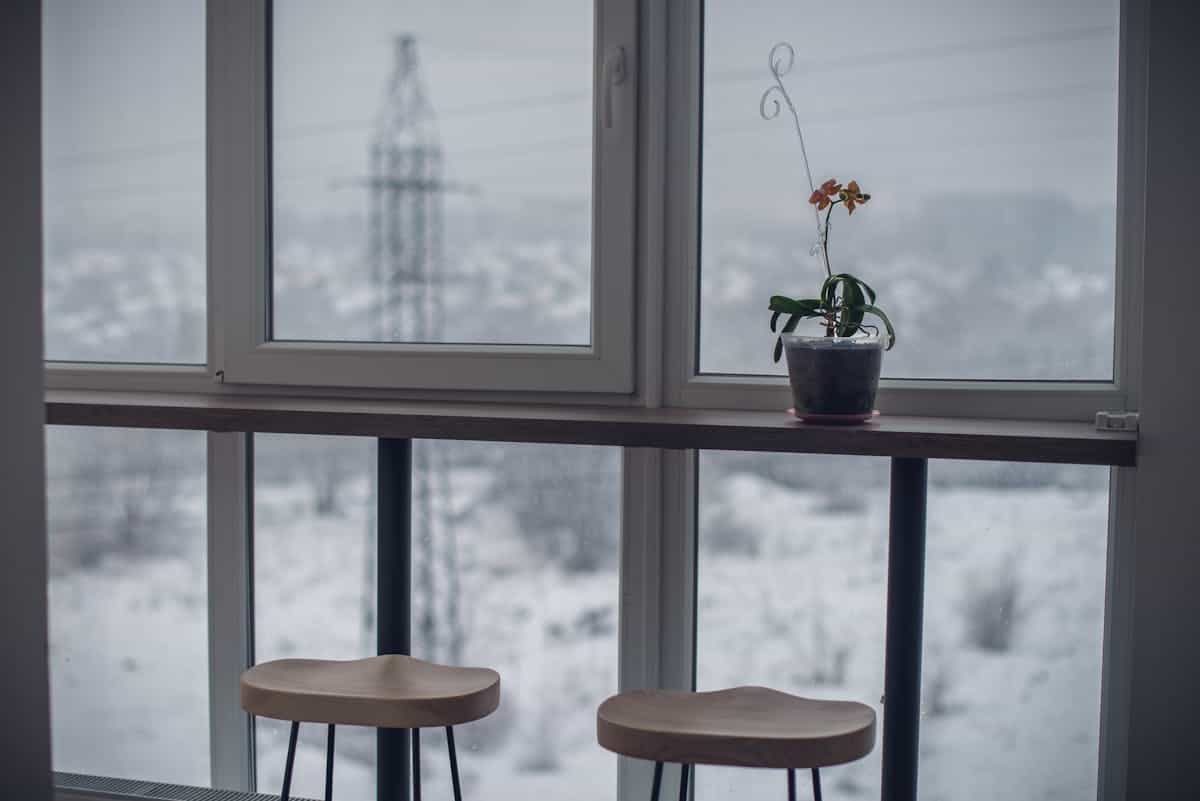
Keep the plant at least 30-60 cm back from any exterior window pane, since this is enough to avoid the localised cold microclimate that forms directly against cold glass overnight. A south- or west-facing window compensates partially for the season's reduced light intensity better than a north-facing one, so repositioning toward a brighter aspect for the winter months is worth doing if the layout allows it. Keep the plant a short distance from radiators or forced-air vents rather than directly in the airflow, since a direct blast of hot, dry air raises local water loss well beyond what the rest of the room experiences. Grouping several plants together modestly raises local humidity through their combined transpiration, though this is a marginal effect rather than a substitute for addressing a genuinely dry room.
How Watering and Light Must Change
Watering shifts from a roughly 10-14 day summer interval to roughly 21-28 days in winter, and the trigger should always be the top 2-3 cm of substrate testing dry, or the pot feeling noticeably lighter than when last watered — not a fixed number of days. A saturated pot becomes an anaerobic risk zone within days regardless of season, and that risk rises in winter because the roots are drawing down the reserve more slowly.
Fertilising should stop entirely from autumn through late winter. A plant that isn't actively growing doesn't take up the nutrients, and unused fertiliser salts accumulate in the substrate instead, risking root-hair damage; resume feeding once new growth resumes in spring.
Light cannot be increased outdoors in winter, but keeping leaves clean and free of dust improves the light actually captured at the leaf surface, and relocating to the brightest available spot — ideally within the 2,000-4,000 lux optimum range — offsets some of the season's natural light deficit. Where a room genuinely cannot provide adequate winter light, a full-spectrum grow light for several hours daily is a reasonable supplement, though it is rarely necessary for a plant already positioned in a reasonably bright room.
Warning Signs the Winter Setup Is Failing
- Yellowing lower leaves with wet substrate — points to overwatering on too short an interval, not seasonal dormancy.
- Mushy, translucent, or dark blistered patches, especially on the underside of lower leaves — indicates cold damage or oedema from a cold-glass-plus-recently-watered combination; move the plant away from the window immediately.
- Crisping, browning leaf edges near a radiator or vent — indicates heat-and-low-humidity stress rather than underwatering; relocate away from direct airflow before adjusting the watering routine.
- Soft, collapsed stem tissue at the base — indicates root rot from sustained overwatering and needs immediate substrate inspection, not more water.
- No new growth for several months with leaves remaining firm and glossy — this is the expected seasonal slowdown described above, not a warning sign.
Step-by-Step Winter Correction Plan
- Check current placement first. Measure the distance from the nearest window pane; relocate if leaves are within 30 cm of cold glass.
- Switch from a fixed watering schedule to a dryness check. Test the top 2-3 cm of substrate before every watering, and expect this to take roughly twice as long as the summer interval.
- Stop fertilising if not already stopped, and don't resume until new growth is visible.
- Assess humidity. If forced-air heating is running and the plant sits within its direct airflow, reposition it or introduce a room humidifier if leaf-edge crisping has already begun.
- Re-check weekly rather than daily. Winter changes are gradual; frequent watering "just in case" is the single most common way winter care goes wrong.
Seasonal Adjustments and FAQ
In consistently mild climates (USDA zones 10b-12) where indoor heating runs minimally, the winter slowdown is less pronounced and the watering interval extension can be smaller than the 21-28 day figure above — substrate dry-down time is the reliable guide regardless of climate zone. In colder regions with aggressive central heating, the low-humidity risk described above becomes the dominant concern rather than cold damage, since the room itself rarely drops below the species' comfort range even in deep winter.
For the general watering and light framework this seasonal adjustment sits within, see the complete care guide. For the reverse-season placement question, see the outdoor summer guide. A terrarium or enclosed cabinet setup buffers both cold draughts and low humidity simultaneously, which is part of why it suits winter-sensitive specimens particularly well — see the terrarium growing guide for setup details.
Care FAQ
Does Peperomia obtusifolia go dormant in winter?
Not in the true deciduous sense, but it does enter a pronounced metabolic slowdown. Shorter days and lower light intensity push photosynthesis below the point where the plant produces surplus energy for new growth, so growth largely pauses from around November to February and resumes once day length and light levels recover in spring.
Should I water my Peperomia less in winter?
Yes. Slower metabolism means slower water use, so the substrate stays wet far longer between waterings. The interval typically extends from every 10-14 days in summer to every 21-28 days in winter — always confirmed by checking that the top 2-3 cm of substrate is dry, not by the calendar.
Why are my Peperomia leaves dropping near a cold window in winter?
This is usually cold damage rather than dormancy. Glass radiates heat away overnight, and the air layer directly against cold glass can sit several degrees colder than the rest of the room, occasionally crossing the roughly 10°C threshold below which cellular damage begins. Moving the plant back from the glass resolves it.
Is it safe to keep my Peperomia near a radiator in winter?
It tolerates nearby heating better than many thinner-leaved tropicals, but forced-air heat lowers relative humidity substantially, and sustained low humidity combined with heat increases water loss through the leaves. Keeping the plant a short distance from a direct heat source and monitoring for crisping edges is the safer approach.