Peperomia Falling Over: Causes and Support Fixes
A Peperomia obtusifolia that leans, flops, or collapses is not malfunctioning — it is responding to a specific, identifiable cause. The three most common triggers are etiolation from insufficient light, the plant simply reaching its naturally top-heavy mature size, or root rot softening the stem base. The stem itself is the fastest diagnostic: thin and stretched points to light, a curve toward one window points to phototropism, and a soft or mushy base at the soil line points to rot.
Quick Diagnosis: Falling-Over Peperomia
| Stem Appearance | Direction of Fall | Base Firmness | Likely Cause |
|---|---|---|---|
| Thin, pale, stretched internodes | Leans generally, no single direction | Firm | Etiolation (low light) |
| Normal thickness, curved toward one window | Consistently toward the light source | Firm | Phototropism |
| Thick, well-developed, heavy canopy | Outward or downward under leaf weight | Firm | Natural top-heavy maturity |
| Normal or thinning | Sudden, collapses at soil line | Soft, mushy, or hollow | Root or stem rot |
What This Looks Like
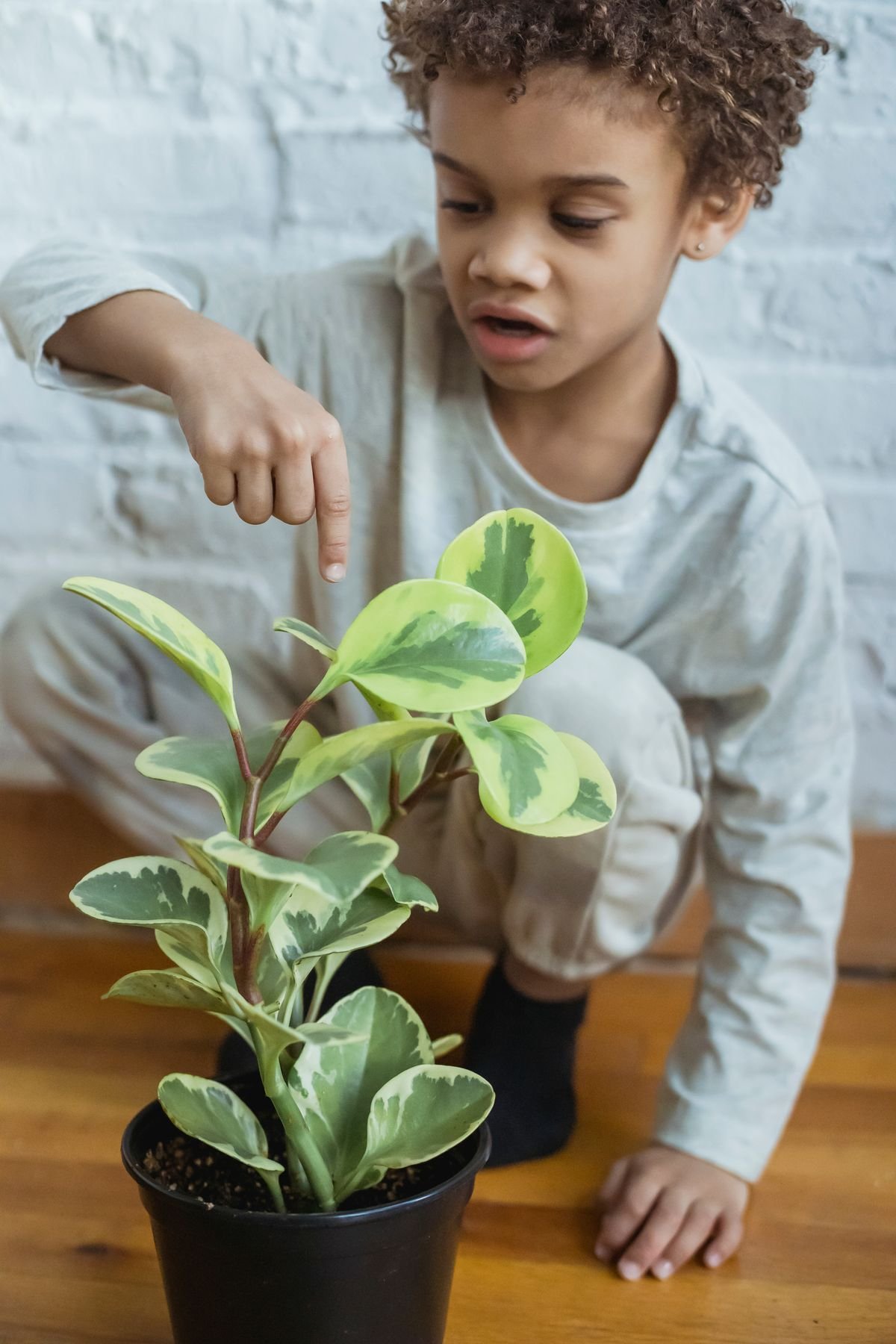
A structurally weak P. obtusifolia shows itself in one of two ways: the stem itself is too thin and elongated to hold its own canopy upright, or an otherwise normal, well-proportioned stem simply cannot support the accumulated weight of a large, mature plant, or leans toward a light source. A collapsed stem — soft, discoloured, or hollow at the point where it meets the soil — is a different problem entirely and is covered separately below, since the fix is not structural support but root and stem repair.
Causes Ranked From Most to Least Likely
1. Etiolation From Insufficient Light
This is the most common cause of weak stems in indoor-grown specimens. In sustained low light, the plant treats vertical reach toward a light source as more urgent than structural density. It produces elevated auxin levels that drive rapid cell elongation in the internodes — the segments of stem between leaves — producing long, thin, pale growth that lacks the lignin and cellulose density to support its own weight.
Confirm it: Internodes are visibly longer than on a healthy reference plant, new leaves are smaller and paler than older ones, and the stem is uniformly thin along its length rather than curved toward one side. Measure the light at the leaf surface with a light meter — a reading below about 800 lux makes this the likely cause. The site's working target for this species is roughly 2,000-4,000 lux.
Rule it out: A light reading already in the roughly 2,000-4,000 lux range and stems of normal thickness point elsewhere.
2. Phototropism — Leaning Toward One Light Source
If the plant is otherwise sturdy but consistently curves toward a single window, the mechanism is phototropic rather than etiolated. Auxin is broken down by light, so it accumulates on the shaded side of the stem. The shaded side elongates faster than the illuminated side, and the stem physically bends toward the light as a result.
Confirm it: The curve is consistent and directional — always toward the same window or light source — rather than a general floppy lean in no particular direction. Stem thickness is otherwise normal.
Rule it out: A lean with no consistent directional bias, or a uniformly thin stem all the way around, points back to Cause 1 instead.
3. Natural Top-Heavy Growth at Maturity
A mature P. obtusifolia accumulates a substantial amount of water in its thick, semi-succulent leaves, and a large, well-filled canopy can simply outweigh what an otherwise healthy stem was built to support. In its native range this species often grows as a facultative epiphyte or ground-scrambler rather than a rigidly upright plant, so a mature specimen leaning or trailing under its own canopy weight is closer to its natural growth habit than to a fault.
Confirm it: The stem is thick and firm, the plant has an established, leafy canopy, and the light level already measures in the roughly 2,000-4,000 lux range. There is no discolouration or softness at the base.
Rule it out: A young or recently propagated plant that has not yet built a substantial canopy is unlikely to be falling over for this reason — check Causes 1 and 4 instead.
4. Root or Stem Rot — Sudden Base Collapse
Unlike the first three causes, this one is pathological rather than structural, and it is the only cause where staking will not help. Soil that stays wet for long periods suffocates the roots and leads to rot (University of Illinois RPD 653); the anaerobic root zone is then colonised by opportunistic pathogens such as Pythium, and the resulting cell-wall-degrading enzymes travel upward into the base of the stem itself, softening the tissue that would otherwise hold the plant upright.
Confirm it: Gently squeeze the main stem at the soil line. Firm resistance rules this out. Soft, spongy, or hollow resistance, especially alongside a sour smell from the substrate, confirms it — see the stem rot guide for the full presentation.
Rule it out: A firm stem at the soil line, regardless of how badly the plant is leaning, rules out rot — the cause is one of the first three.
Step-by-Step Recovery Plan
- Squeeze the stem at the soil line first. This single check separates a structural problem (Causes 1-3, safe to address with light and support) from a pathological one (Cause 4, which needs root surgery, not staking).
- If the stem is firm and the cause is light-related: relocate to roughly
2,000-4,000 luxand prune the leggy growth back by about one-third, cutting just above a leaf node — this disrupts apical dominance and redirects energy into bushier, lower branching rather than further vertical stretch. The full method is in the pruning guide, and the etiolation-specific recovery steps are in the leggy Peperomia guide. - If the stem is firm and leaning toward a window: rotate the pot a quarter turn at each watering to keep auxin distribution even across the stem. An existing curve in mature growth will not straighten, but new growth will emerge vertically.
- If the stem is firm and the plant is simply mature and heavy: stake it. A bamboo stake or small trellis, with the main stems secured loosely at roughly 10 cm intervals using soft ties, is a standard fix — not a sign the plant has failed.
- If the stem is soft or hollow: stop watering immediately. Unpot and inspect the roots. If the rot has reached the stem base, cut back to firm, healthy tissue above the damage and propagate the salvageable upper growth as cuttings rather than trying to save the original base. A limited case confined to the roots may respond to the rescue steps in the hydrogen peroxide treatment guide.
Recovery Signs and Timeline
For light-driven weak stems, new growth at the correct light level should emerge visibly thicker and with shorter internodes within 4-6 weeks — the existing thin growth will not thicken retroactively, so the stem's overall appearance improves gradually as new, sturdier growth accumulates above the old. A phototropic curve in already-grown stem tissue is permanent; only the newest growth after correction will emerge straight. Staked, top-heavy plants show no recovery timeline as such, since there was no pathology to begin with — the stake is a permanent or long-term support, not a temporary bridge to independence. Root and stem rot recovery depends on how much tissue was salvaged: a plant reduced to rooted cuttings restarts on the timeline of a new propagation, usually rooting within a few weeks in warm conditions and standing independently within a couple of months.
How to Prevent Recurrence
- Check light levels with a meter, not by eye. Rooms that feel bright to the human eye frequently measure well below the working target at leaf height, especially more than a metre or two from a window.
- Rotate the pot a quarter turn at every watering to prevent a directional lean from developing in the first place.
- Prune proactively once or twice a year, in early spring, rather than waiting until the plant is visibly leggy — regular pinching keeps the growth habit compact and branching rather than tall and thin.
- Stake early on plants you know will get large, rather than waiting for a mature specimen to already be flopping — it is easier to train a stem while it is still developing than to correct an established lean.
- Confirm substrate moisture at depth before every watering to avoid the chronic overwatering that leads to root and stem rot in the first place.
Weak or falling-over stems are a light problem first, a maturity-and-support problem second, and a root-health problem only in the least common but most urgent case. If the presentation doesn't clearly match one of the three, the complete symptom guide covers the rest of what this species can show, including sudden leaf drop, downward-curling leaves, and wrinkled, soft leaves that often share the same underlying light or root-health causes.
Care FAQ
Why is my Peperomia obtusifolia falling over?
Three causes account for almost all cases: etiolation (thin, weak stems produced by insufficient light), the plant simply reaching a naturally top-heavy mature size, or root rot causing the stem base to soften and collapse. The stem itself tells you which — thin and stretched points to light, a curve toward one window points to phototropism, and a soft or mushy base points to rot.
How do I get my Peperomia to stand up straight again?
For light-driven weak stems, move the plant to roughly 2,000-4,000 lux and prune back the leggy growth to encourage denser branching. For a naturally top-heavy mature plant, a bamboo stake or small trellis is a standard, unremarkable fix, not a sign of failure. For root rot, staking will not help until the root system itself is repaired.
Why is my Peperomia leaning toward the window?
This is phototropism. Auxin, the hormone that drives cell elongation, accumulates on the shaded side of the stem, causing that side to grow faster than the light-facing side and bending the stem toward the light source. Rotating the pot a quarter turn at each watering keeps growth even and prevents a permanent lean from developing.
Can staking damage my Peperomia?
Not if done correctly. Use soft ties rather than wire or tight string, and secure the stem loosely enough to allow slight movement rather than clamping it rigidly - some flex helps the stem develop its own structural strength over time. Check ties every few weeks as the stem thickens, since a tie that was loose enough at installation can become tight enough to cut into growing tissue.