Why Peperomia Roots Are Small: Stunted Growth Fix
A small root ball on Peperomia obtusifolia is normal architecture, not stunted growth, because the species evolved as a facultative epiphyte with a compact, shallow, fibrous root system rather than a deep taproot. The distinction that actually matters is not size but condition: firm, white-to-tan roots are healthy at any size, while dark, mushy, or sheath-shedding roots indicate genuine root rot regardless of how much root mass is present.
Small but Healthy vs Genuinely Stunted: Side-by-Side
| Factor | Normal small root system | True stunted or rotted roots |
|---|---|---|
| Colour | White to light tan | Dark brown or black |
| Texture | Firm; snaps cleanly under gentle pressure | Mushy; squishes or the outer cortex slides off |
| Smell | None | Sour, rotten odour |
| Leaves | Firm, glossy, normal colour | Yellowing, wilting, or dropping |
| Growth pattern | Root mass stable once pot is filled; foliage keeps growing | No new growth anywhere on the plant |
| Cause | Genetic epiphytic adaptation | Continuous substrate saturation, compacted mix, or an oversized pot |
How to Tell Them Apart
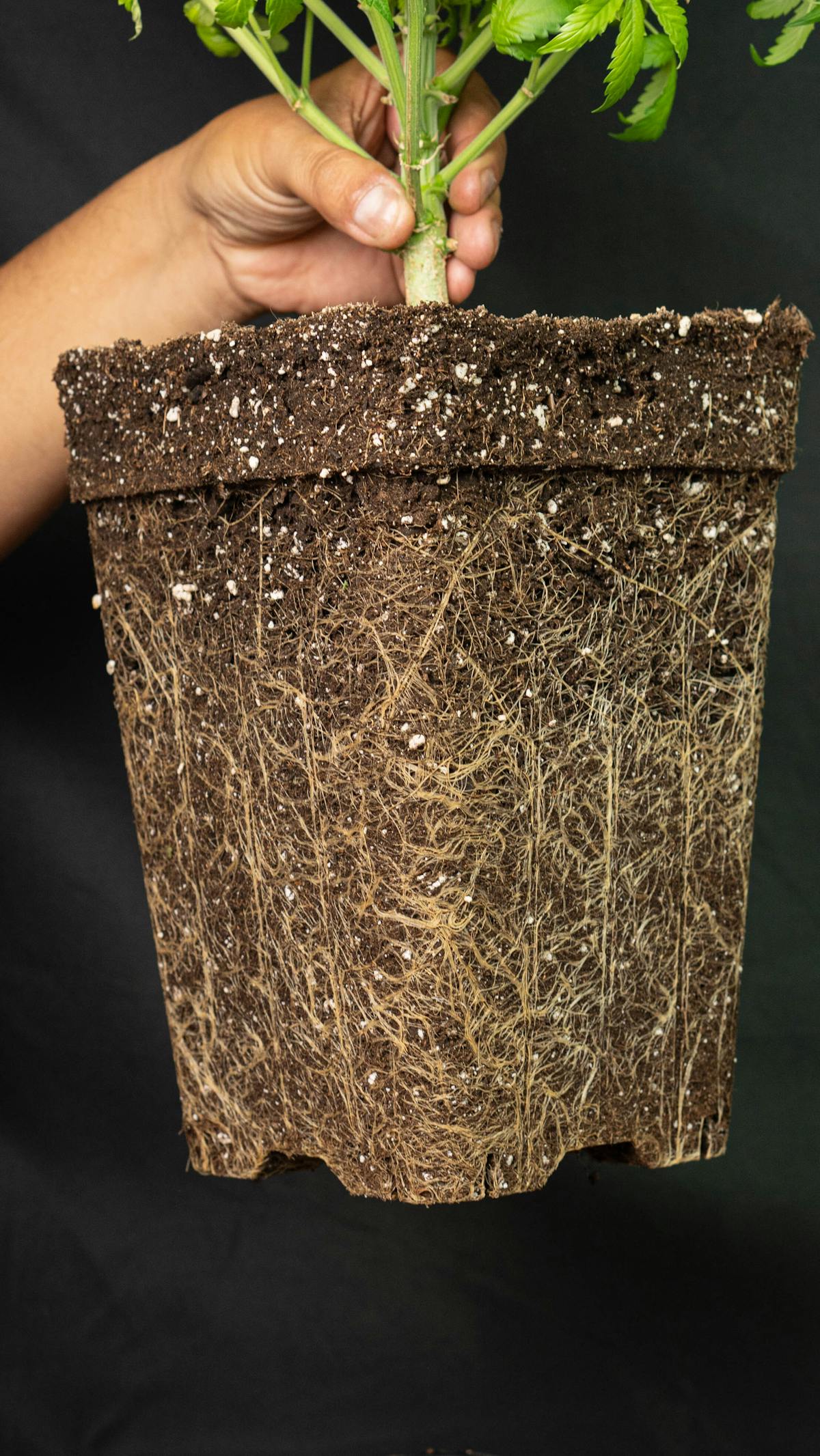
Unpot the plant and examine the roots directly rather than judging by root-ball size alone. Healthy P. obtusifolia roots are white to pale tan, feel firm between the fingers, and snap rather than squash when gently bent. A small but entirely healthy root system will still show this firm, intact texture even if it only fills a fraction of the pot. Genuine root rot looks and feels different regardless of quantity: roots turn dark brown to black, the outer root cortex slides off the inner core when lightly pulled, and there is often a sour smell from anaerobic decay. If the roots are firm and pale but simply modest in volume, nothing is wrong — that is the species' normal epiphytic architecture, not an early warning sign.
This modest root architecture is a direct consequence of how P. obtusifolia grows in the wild. As a facultative epiphyte, it roots into thin pockets of leaf litter, moss, and bark rather than deep soil, and it evolved a fine, fibrous root network built for rapidly absorbing moisture during rain events rather than anchoring into or foraging through a large soil volume. A Philodendron or Monstera, by contrast, is a terrestrial or semi-terrestrial climber with a fundamentally different root strategy, so comparing root-ball size across genera is not a meaningful health check for this species. The comparison that matters is P. obtusifolia against itself over time — the same plant's roots should stay firm and pale, whatever their overall volume.
Care Differences That Change the Outcome
For a genuinely small but healthy root system, the correct response is to leave it alone. Repotting into a larger container to "give the roots room" is counterproductive: a compact root system cannot regulate moisture across a substrate volume much larger than its own spread, so the extra substrate outside the root zone stays wet for days longer than the plant tolerates, raising the risk of root anoxia in exactly the area the roots would need to grow into. Size any new pot only 2-3 cm larger in diameter than the current root ball, and repot only when roots are visibly emerging from the drainage holes or the plant shows drought stress within three to four days of watering. A humic acid soil conditioner is sometimes marketed as a fix for a small root system specifically; treat any such effect as a plausible secondary bonus rather than a substitute for correct pot sizing and watering.
For roots showing genuine rot, the priority shifts entirely. Trim away dark, mushy tissue back to firm white root with clean scissors, let the cut surfaces air-dry briefly, and repot into fresh, free-draining substrate — a 50% peat-free compost, 30% perlite, 20% bark mix keeps oxygen available at the root zone. Adjust watering to the top-2-3cm-dry trigger going forward rather than a fixed schedule, since soil that stays wet for long periods is what caused the anoxia in the first place.
Which Situation Is More Likely for a Given Setup
- Recently repurchased or repotted plant, roots pale and firm, leaves healthy: almost certainly the species' normal small-root architecture — no action needed.
- Plant in a pot noticeably larger than its root ball, substrate staying wet for a week or more: watch closely; this setup is the classic precursor to root rot even if the roots currently look fine.
- Plant showing yellowing lower leaves or wilting despite moist substrate, combined with dark or mushy roots on inspection: genuine root rot — follow the trim-and-repot protocol above rather than adding more water.
- Plant that has held the same root mass for months but keeps producing new leaves: normal pot-equilibrium behaviour, not a growth problem — this is also the point at which shaping the plant with the pruning guide becomes worthwhile, since a stable root system supports the lateral branching pruning encourages.
- Grower who wants to stop guessing about pot size and moisture entirely: semi-hydroponic LECA replaces the substrate dry-down cycle with continuous reservoir wicking, which sidesteps the oversized-pot risk described above at the cost of a different setup and monitoring routine.
Common Mistakes When Assessing Root Health
- Judging health by root length or volume alone, when colour and firmness are the traits that actually indicate condition in this species.
- Upsizing the pot as a reflexive fix for a small root ball, which usually creates the overwatering conditions that cause the rot the grower was trying to prevent.
- Assuming a plateau in root growth means the plant has stopped developing, when foliage growth typically continues normally once the root system reaches pot-equilibrium.
- Treating "the roots didn't fill the new pot" as a failure a few weeks after repotting, when root establishment in a properly sized pot takes several weeks under normal conditions.
Final Guidance
If the roots are pale, firm, and the leaves are healthy, the small root ball is doing exactly what it evolved to do — resist the urge to upsize the pot or add fertiliser to "encourage" more root growth. If the roots are dark, mushy, or foul-smelling, treat it as root rot regardless of how much or how little root mass remains, trim back to healthy tissue, and correct the substrate and watering interval that most likely caused it. For the full substrate and watering framework this sits within, see the complete care guide; for pot-sizing specifics, see the pot size guide; and for the full root-rot recovery protocol including hydrogen peroxide use, see the root rot treatment guide. Once root health is confirmed, display placement is purely a design decision — see the feng shui placement guide for positioning that has no bearing on the plant's biology one way or the other.
Sources
The species' perennial and epiphytic habit is recorded by Kew's Plants of the World Online; general care guidance comes from the Missouri Botanical Garden Plant Finder and the RHS species profile. NC State Extension notes that wet soil causes root rot, and Phytophthora and Pythium diseases of Peperomia are described in University of Illinois RPD 653.
Care FAQ
Do Peperomia obtusifolia plants naturally have small roots?
Yes. As a facultative epiphyte adapted to growing on tree bark and in shallow leaf litter, the species evolved a compact, shallow, fibrous root system rather than a deep taproot. A mature specimen with a substantial canopy commonly has a root ball that looks disproportionately small compared to non-epiphytic houseplants of similar size.
How can I tell if small roots mean root rot instead of normal growth?
Check colour and texture, not size. Healthy roots are white to light tan and firm, snapping cleanly rather than squishing when gently pressed. Roots that are dark brown or black, mushy, or shed their outer layer when touched indicate root rot, regardless of how much root mass is present.
Will repotting into a bigger pot help my Peperomia grow more roots?
No, and it usually causes the opposite problem. A small root system cannot draw down moisture across a substrate volume much larger than its own spread, so the extra substrate stays wet for days longer than the plant tolerates, risking root anoxia. Size the new pot only 2-3 cm larger in diameter than the current root ball.
Why has my Peperomia not grown new roots in months even though the leaves look healthy?
Once the root system fills the available pot volume, growth typically shifts toward foliage rather than continued root expansion, and the plant tolerates being slightly root-bound well. Firm, glossy leaves and steady new growth are the signs to watch — root mass on its own is not a reliable health indicator for this species.