Best Grow Light for Peperomia: Setup and Distance
A grow light for Peperomia obtusifolia only needs to reproduce the 2,000–4,000 lux of diffuse light this species already tolerates well in a bright window — not the highest-output fixture available. The practical target, converted to the units grow lights are actually rated in, is roughly 30–60 µmol/m²/s of PPFD at leaf height, run for 12–14 hours daily. Appearance and marketing claims (high CRI, "full spectrum," Kelvin rating) matter far less than confirming the fixture actually delivers that photon flux at the distance you intend to use it.
| Factor | Target | Why |
|---|---|---|
| PPFD at leaf height | 30–60 µmol/m²/s | Converted equivalent of the 2,000–4,000 lux optimum for this species |
| Photoperiod | 12–14 hours | Matches typical indoor supplemental-lighting guidance; leaves a dark period for respiration |
| Distance | Fixture-specific — measure, do not assume | Governed by the inverse-square law; varies by wattage and beam angle |
| CRI | Useful for diagnosis, not growth | Human-vision metric; does not affect photosynthesis |
| Spectrum | Red and blue wavelengths do the photosynthetic work | Matches the chlorophyll absorption peaks in the PAR range |
1. Converting the Site's Lux Target to PPFD
Grow lights are specified in PPFD (photosynthetic photon flux density, µmol/m²/s), not lux, which measures visible brightness weighted for the human eye rather than photon count. For white LED sources, a widely used approximation is roughly 15 µmol/m²/s per 1,000 lux (equivalently, about 65–70 lux per µmol/m²/s), consistent with general PPFD/DLI guidance from Iowa State University Extension on supplemental lighting for indoor plants. Applying that conversion to this species' established 2,000–4,000 lux optimum gives a PPFD target of roughly 30–60 µmol/m²/s — the number to look for on a fixture's spec sheet or measure with a PAR meter, not a generic "grow light" marketing claim.
Over a 12–14 hour photoperiod, that PPFD range works out to a Daily Light Integral of roughly 1.3–3.0 mol/m²/day. Iowa State's general category for low-light foliage houseplants sits at 3–6 mol/m²/day, which places P. obtusifolia at or below the low end of that range — consistent with a species documented to tolerate 800–1,000 lux as a survival minimum, well below what most foliage houseplants need to do more than hold still.
Treat a manufacturer's PPFD claim as a starting estimate, not a guarantee. Consumer LED listings routinely quote output measured at the diode itself or at an unstated distance, rather than at the leaf surface where it actually matters, and low-cost fixtures in particular can overstate delivered PAR relative to their wattage. A cheap smartphone lux app, while not a substitute for a calibrated PAR meter, is enough to confirm whether a fixture is in the right order of magnitude once positioned — a reading nowhere near 2,000–4,000 lux at leaf height means the fixture, distance, or both need adjusting regardless of what the packaging claims.
2. Choosing a Fixture: Panel, Clip-On, or Spotlight
| Fixture type | Best for | Limitation |
|---|---|---|
| Broad LED panel (multiple diodes across a wide board) | Shelves or multiple plants; even coverage without hotspots | Larger footprint; higher upfront cost |
| Clip-on LED bulb or gooseneck lamp | A single specimen on a desk or shelf | Narrower coverage; needs repositioning as the plant grows |
| Concentrated spotlight (COB-style single-point LED) | Tall specimens needing canopy penetration from height | Produces a bright hotspot directly beneath it and a sharp drop-off at the edges — a poor match for this species' broad, flat leaves, which are better served by even coverage |
For a single Peperomia obtusifolia on a shelf or windowsill, a broad-panel fixture or a diffused clip-on light is the more forgiving choice: the plant's leaf structure is broad and roughly horizontal, so uneven light distribution reads as one leaf compensating while another etiolates, rather than a uniform response across the canopy.
Supplementing a window is a lighter task than replacing one. A plant already getting some natural light near a window only needs a fixture to top up the shortfall during the darkest months or on the dimmer side of the room, which a small clip-on light handles well. A plant with no meaningful natural light — an interior room, a windowless office — needs the fixture to supply the entire 2,000–4,000 lux target on its own for the full photoperiod, which favours a broader panel with a verified PPFD rating over a decorative or accent-style LED bulb.
Variegated cultivars such as 'Variegata' need roughly 30–40% more light than the green form to avoid reversion, since their white or cream tissue carries less functional chlorophyll. Under a grow light, this means aiming for the upper end of the 30–60 µmol/m²/s range (or supplementing with a second fixture) rather than assuming the same setup that suits a green-leaved specimen is automatically sufficient.
3. Spectrum and CRI: What Actually Reaches the Plant
Photosynthesis draws almost entirely on the red (approximately 600–700 nm) and blue (approximately 400–500 nm) wavelengths within the PAR range; a fixture advertised as "full spectrum" or in the 4000–6500K colour-temperature band is simply describing a white-light mix that includes those two bands alongside the green and yellow wavelengths humans see best.
High CRI is marketed as a plant-health specification. It is not one. CRI measures how accurately a light source renders colour for the human eye — it has no bearing on the red/blue photon flux a leaf actually uses for photosynthesis, and pushing CRI higher by adding more green and yellow output can come at the cost of the red and blue proportion that drives growth. The genuine reason to prefer a high-CRI fixture is diagnostic, not biological: under a low-CRI or heavily tinted light, early pest damage, chlorosis, or leaf-spot discolouration is harder to see accurately, which delays catching a real problem — not because the plant is growing any better under it.
4. Setup: Distance and the Inverse-Square Law
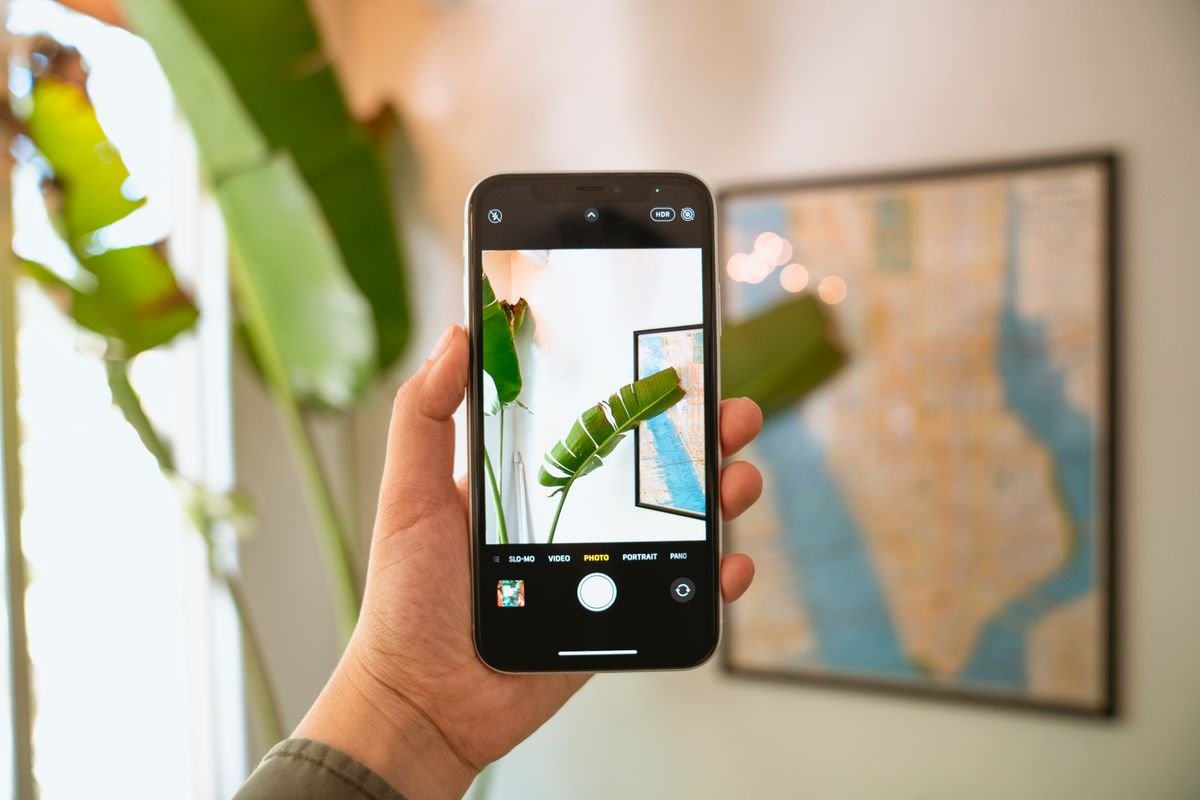
Light intensity from a point-like source falls off with the square of the distance from it — doubling the distance from a fixture to the leaf cuts delivered intensity to roughly a quarter, not half. This is why a specific mounting height from one fixture's manual does not transfer to a different wattage or beam angle: the only reliable method is to measure PPFD or lux at leaf height with the light in its intended position, using a dedicated meter or a calibrated smartphone lux app, and adjust height until the reading falls in the 2,000–4,000 lux (or 30–60 µmol/m²/s) range.
Where a shelf or grow rack limits how far a fixture can be raised, a matte white or light-coloured reflective backing behind the plants redirects some of the light that would otherwise be lost past the leaves back toward them, which is a genuine way to raise effective intensity without moving the fixture or increasing power draw.
A mounting distance that reads correctly on a meter can still be too close in practical terms if it puts leaf tissue within range of the fixture's heat output — LEDs run cooler than older grow-light technology but are not heat-free, and a leaf pressed directly against or very near the diode housing can show localised drying or scorch that has nothing to do with light intensity. Leave a small physical gap between the fixture and the nearest leaf even when the PPFD reading at that distance would otherwise be acceptable.
5. Photoperiod: Why More Hours Is Not Better
Run the fixture for 12–14 hours daily on a consistent schedule — a simple mechanical or digital timer removes the day-to-day variation that comes from turning lights on and off by memory. Do not run a grow light continuously to "grow the plant faster": during the dark period, the plant converts sugars produced during illumination into new tissue through cellular respiration, and removing that period does not add growth, it removes the phase in which growth is assembled.
6. Grow Light vs Sunlight: What Actually Differs
To the leaf, a photon from an LED and a photon from the sun are the same thing. The differences that matter are practical ones about how steady, how warm, and how controllable each source is.
- Consistency. Window light changes hour by hour, with cloud cover, and with the season. A plant on a north-facing sill in December may get a fraction of what the same spot delivers in June. A grow light on a timer delivers the same output every day, which is why plants under a correctly set fixture often grow more evenly than plants relying on a window alone.
- Glass. Window glass, and tinted or low-E glass in particular, cuts some light before it reaches the plant. A spot that looks bright to you can still read well under 2,000 lux at leaf height. Measuring is the only way to know.
- Heat. Direct sun carries a lot of infrared, which warms leaf tissue directly. That is how a plant in a sunny window can scorch even when the room is cool. LEDs produce far less radiant heat at the leaf, so they can sit closer to the plant than a sunny window could safely deliver the same intensity, though the small gap described in Section 4 still applies.
- Day length. In winter, natural daylight may only give a few usable hours. A grow light lets you run the full 12–14 hour photoperiod regardless of season, which makes it most useful as a winter supplement rather than a year-round replacement.
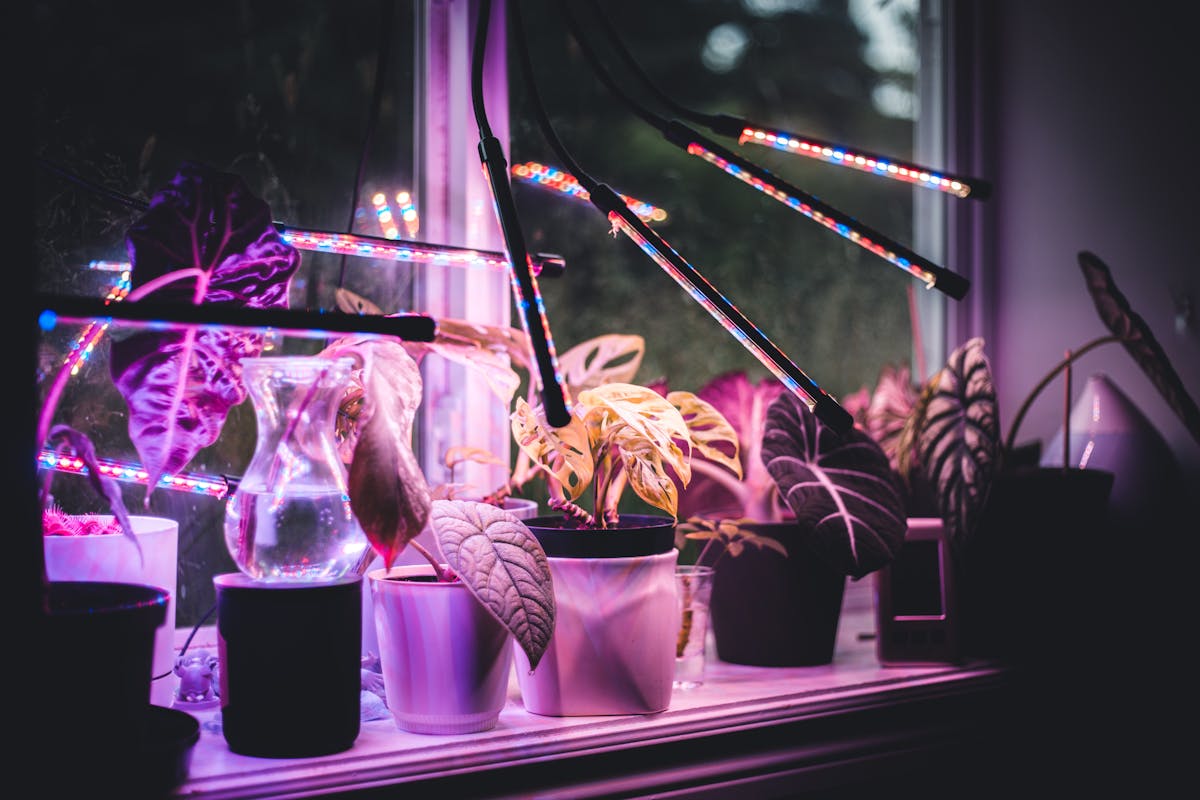
- Purple versus white fixtures. Purple ("blurple") LEDs emit mostly red and blue, the wavelengths photosynthesis uses most. They do grow plants, but they make it very hard to see the leaf's true colour, so early yellowing, pests, or leaf spot go unnoticed for longer. A white LED delivering the same PPFD is the more practical choice in a living space.
So a grow light can replace a window entirely, but for most homes the better use is topping up a window during the darker months.
7. Common Mistakes
- Buying based on wattage or "coverage area" claims alone, without checking the PPFD the fixture actually delivers at the height it will realistically be mounted.
- Copying a mounting distance from a review or manual written for a different fixture. Distance recommendations are specific to that light's output and beam angle; measure your own setup instead.
- Treating CRI or Kelvin rating as the primary spec, when PPFD at leaf height and photoperiod are what determine the plant's response.
- Running lights 24 hours a day on the assumption that more light always means more growth — see Section 5.
- Assuming a grow light fixes legginess on its own without also correcting the mounting distance and duration; a light present but positioned too far away, or run for too few hours, still under-delivers.
- Never rechecking the setup after the first successful reading. Diode output degrades gradually over years of use, and dust accumulation on the fixture reduces delivered light well before it is visually obvious; an annual re-measurement at leaf height catches this before growth quietly slows.
8. If the Setup Still Is Not Working
A grow light correctly specified for 2,000–4,000 lux (30–60 µmol/m²/s) over 12–14 hours should halt further etiolation within a few weeks and support new, more compact growth over the following months. If a plant under an apparently adequate light continues to stretch, measure the actual reading at leaf height rather than trusting the fixture's rated output — age, dust on the diodes, and distance all reduce delivered intensity below the spec-sheet number. Existing elongated internodes do not reverse under improved light; the standard correction is to prune back to a compact node once new growth resumes (see the fix leggy Peperomia guide). If leaves show bleaching or papery patches instead of etiolation, the fixture is likely mounted too close or set beyond the 40,000 lux unfiltered-sun-equivalent threshold; see the sunburn treatment guide for recovery.
Conclusion
A grow light for Peperomia obtusifolia is a solved problem once it is treated as a photon-delivery target rather than a product category: roughly 30–60 µmol/m²/s at leaf height for 12–14 hours, measured rather than assumed, from a fixture that spreads that light evenly rather than concentrating it into a hotspot. CRI, Kelvin rating, and wattage are secondary to that measurement, useful mainly for narrowing a shortlist before the meter confirms whether a given product actually delivers what its listing claims. For the full comparison between windows and supplemental lighting, see the light requirements guide; for window-specific placement, see the best window direction guide.
Care FAQ
What PPFD should a grow light deliver for Peperomia obtusifolia?
Roughly 30–60 µmol/m²/s at leaf height, run for 12–14 hours daily. This is the PPFD equivalent of the site's established 2,000–4,000 lux optimum for this species, using the standard ~15 µmol/m²/s per 1,000 lux conversion factor for white LED light.
Does a high CRI grow light actually help my Peperomia grow?
No. CRI (Color Rendering Index) measures how accurately a light source renders colour to the human eye — it has no photosynthetic relevance. A high-CRI light does not grow the plant faster or better than a lower-CRI light at the same PPFD and spectrum; it makes it easier for you to spot early pest damage or discolouration accurately.
Can a grow light fully replace a window for Peperomia obtusifolia?
Yes, provided it delivers 2,000–4,000 lux (or the PPFD equivalent) for 12–14 hours daily. The plant's photosynthetic response depends on photon flux and duration, not on the light's source; a correctly specified and positioned LED fixture is functionally equivalent to a bright window.
How close should a grow light be to a Peperomia?
This depends entirely on the fixture's output and follows the inverse-square law: intensity falls off with the square of distance, so small changes in height produce large changes in delivered light. There is no single correct distance across fixtures — measure the actual PPFD or lux at leaf height with the light in position, rather than copying a distance figure from a different product.
Do I need to run a grow light 24 hours a day for faster growth?
No. The plant requires a dark period for cellular respiration, when stored sugars produced during the light period are converted into new tissue. A photoperiod of 12–14 hours light and 10–12 hours uninterrupted darkness supports growth better than continuous illumination.