Peperomia Lemon Lime Care: Light, Water and Colour
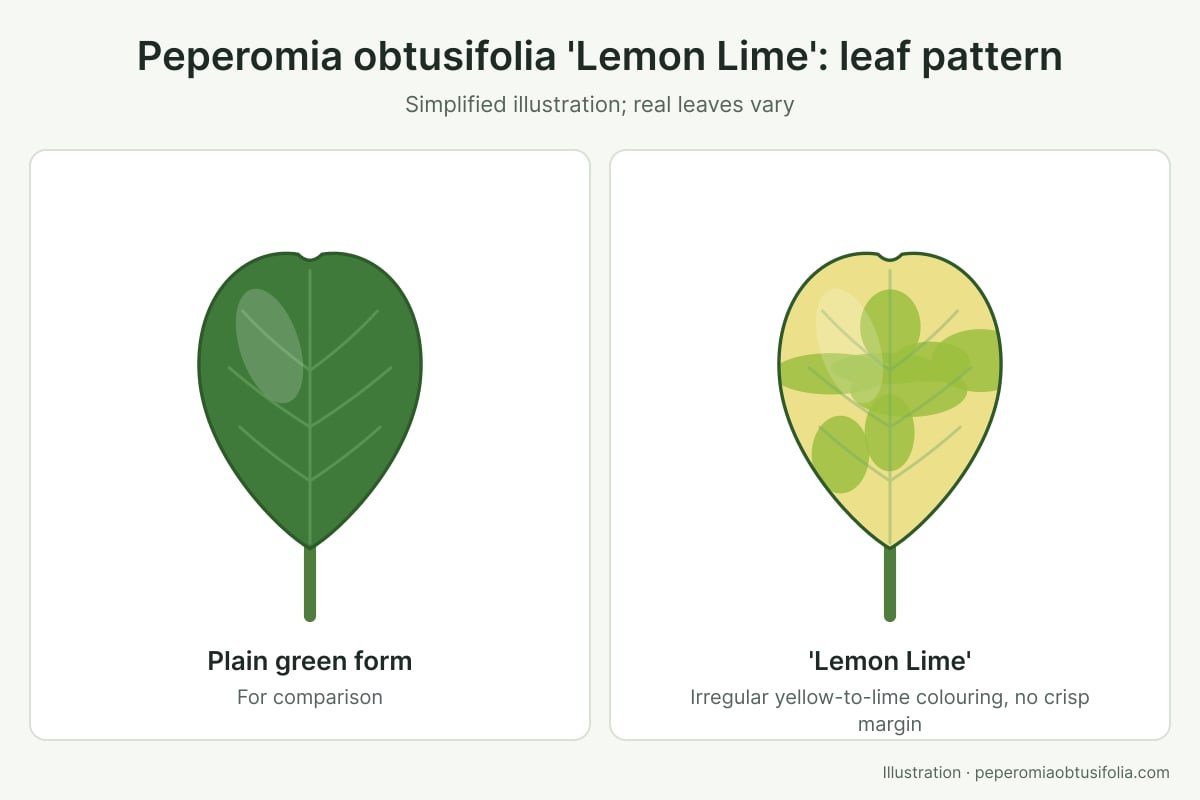
Peperomia obtusifolia 'Lemon Lime' is identified by its yellow-to-lime variegation — new leaves emerging pale yellow-green and maturing toward a deeper lime, without the sharply defined white or cream margins seen in cultivars like 'Albo-Marginata'. 'Lemon Lime' is a widely used nursery trade name rather than a formally trialled cultivar name, and its defining colour is directly dependent on light: below the species' optimum range, it reverts toward solid green rather than simply looking duller.
Is This Cultivar Name Verified?
'Lemon Lime' appears consistently across nursery and retail listings for a yellow-green variegated P. obtusifolia, and it is treated as an established trade name on this site alongside 'Variegata', 'Golden Gate', and 'Gold Coast'. It has not, however, undergone the same formal registration and trials process as some Peperomia selections — the RHS Award of Garden Merit is held by the species P. obtusifolia itself, with no AGM shown for 'Greengold' or 'Variegata', and that status should always be re-verified at the RHS site before citing it, since award lists are reviewed periodically. Treat 'Lemon Lime' as a reliable descriptive trade name for identification purposes, not as a synonym with the same formal standing as an AGM cultivar.
Identification Traits
- Leaf colour and pattern: irregular yellow-to-lime variegation across the lamina, without the crisp white margin of 'Albo-Marginata' or the marbled patches of 'Marble'. The proportion of yellow to green varies leaf to leaf on the same plant.
- New growth: emerges paler and more yellow than mature leaves, which deepen toward lime green as they harden off — the opposite trajectory to reversion, where new leaves emerge progressively more green over successive flushes.
- Stem colour: typically green to pale green, without the reddish pigmentation seen in 'Red Edge'.
- Growth habit: the same compact, upright, semi-succulent habit as the green form — variegation affects pigment, not structure.
- Reversion in progress: a branch producing leaves that are solid, uniform green with no yellow patterning at all is reverted tissue, not a healthy variation of the pattern.
Quick Care Table
| Factor | Guidance |
|---|---|
| Light | Brighter than the green form's working target of roughly 2,000-4,000 lux |
| Watering trigger | Top 2-3 cm of substrate fully dry; confirm at depth, not just the surface |
| Soil | Free-draining mix, at least 30% inorganic content (perlite, pumice, or bark) |
| Temperature | 18-30°C (RHS); keep above 10°C |
| Fertiliser | Balanced NPK 20-20-20 at 50% label rate, monthly, spring and summer only |
| Mature size | Comparable to the green form — compact and upright, without invented precision beyond that |
Every figure in that table matches the green-form baseline except light, which is the one input this cultivar's pigment is directly sensitive to. That single difference is also why 'Lemon Lime' problems are disproportionately light-related rather than reflecting any special fragility in watering, temperature, or feeding — treat those four as identical to the green form and reserve extra attention for the light reading specifically.
Light and Colour Stability
The mechanism behind 'Lemon Lime's colour is straightforward: yellow tissue carries less functional chlorophyll than green tissue, so it captures less light energy per unit area. To compensate, the plant needs brighter light than the green form, whose working target on this site is roughly 2,000-4,000 lux at leaf level. In poor light, all-green shoots have the advantage, since green tissue photosynthesises more efficiently when light is limited, and reverted growth tends to spread. This is reversion, not fading, and it is not reversible in the leaves that have already grown — only new growth reflects a corrected light level.
The failure mode in the other direction is sunburn: strong direct sun can scorch the leaves (RHS, MBG), causing chloroplast damage and bleached, papery patches regardless of cultivar. The safest way to deliver the higher light this cultivar needs without crossing into direct-sun damage is bright filtered light — an east-facing window with a few hours of gentle morning sun, or a full-spectrum LED grow light positioned to measure the correct lux at the leaf surface rather than relying on the fixture's wattage or marketing claims. Confirm the actual reading with a light meter rather than judging by eye — a spot that looks bright to a person standing in the room frequently measures well under the plant's requirement.
Watering, Soil, and Pot Choice
The watering mechanics for 'Lemon Lime' are identical to the green form — the same dry-down trigger, the same bottom-watering method, the same periodic top-flush to clear mineral salts. The one practical difference worth naming: a specimen kept in lower light than it needs has a slower metabolism and lower water demand, and watering it on the same interval as a correctly lit plant is a common route to root rot. If the plant sits in suboptimal light for any reason, extend the watering interval and confirm dryness at depth — with a chopstick test — rather than watering on the usual schedule regardless. For the general watering framework and seasonal intervals, see the complete watering guide.
Soil and pot requirements are also unchanged from the species baseline: the standard 50/30/20 substrate and a pot no more than one inch larger than the current root ball. Terracotta suits growers prone to overwatering; the full trade-offs are in the best pots guide.
Reversion, Propagation, and Pruning
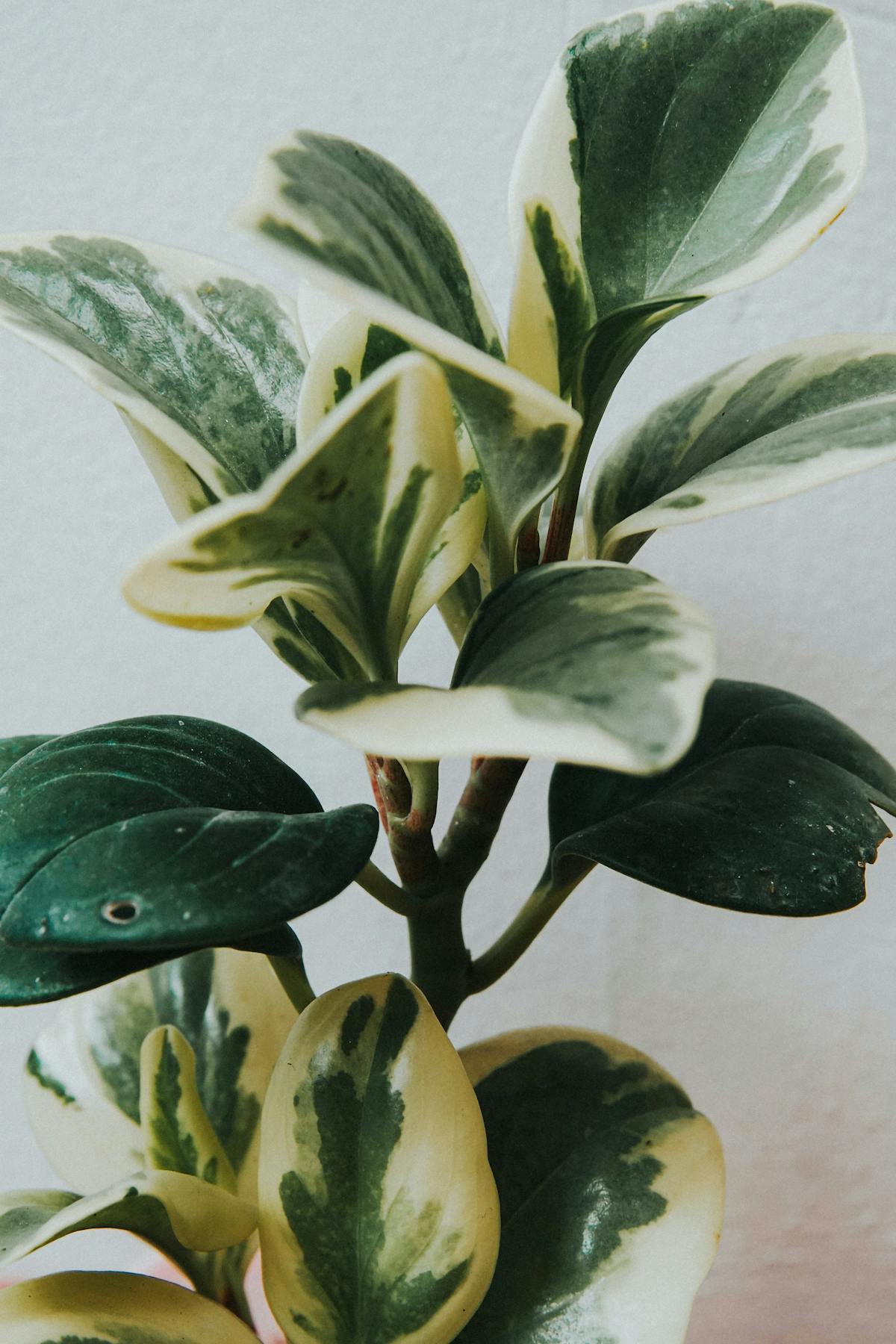
Variegation in 'Lemon Lime' is held in the outer cell layer of the meristem, the same chimeric arrangement documented for 'Variegata' and 'Albo-Marginata'. Leaf cuttings regenerate from the inner, genetically all-green layers, so a leaf cutting from this cultivar grows into an all-green plant (UF/IFAS notes this for variegated chimeral Peperomia) — propagating by leaf is not a reliable way to preserve the pattern. To keep the colour, propagate by stem cutting, and specifically choose a cutting that includes at least one node still showing yellow-green variegation rather than one that has already reverted. Even nodal cuttings can still produce some reverted growth over time, since the underlying instability is genetic, not purely environmental.
When reversion appears on an established plant — a stem producing leaves with no yellow patterning at all — prune it back to the last node still showing the pattern, using shears sterilised with 70% isopropyl alcohol. All-green tissue carries more functional chlorophyll and grows more vigorously than variegated tissue under the same light, so an unpruned reverted branch can gradually take over the plant's canopy. For general pruning technique beyond reversion management, see the pruning guide; for a broader look at encouraging and preserving variegation across cultivars, see the variegation guide.
Common Problems and Lookalike Cultivars
Beyond reversion, 'Lemon Lime' is subject to the same problem set as the green form — black spots, oedema, and root rot all present identically, since none of those mechanisms are colour-dependent. One pattern worth naming specifically for this cultivar: a grower who sees yellow leaf tissue and assumes chlorosis or a nutrient deficiency will sometimes over-fertilise in response, when the yellow patterning is simply the cultivar's normal variegation. Distinguish the two by pattern — chlorosis typically shows as a uniform or vein-following yellowing across an otherwise-green leaf, while the cultivar's variegation is irregular and present from the moment each leaf unfurls, not something that develops on a previously all-green leaf.
The one cultivar-specific confusion worth naming for identification: retail labelling sometimes conflates P. obtusifolia variegated forms with variegated P. magnoliifolia, which Kew POWO accepts as a separate species and RHS treats as a group within P. obtusifolia. The two look very similar and there is no reliable simple test to tell them apart at home, but the general care described here is broadly the same for both.
Sourcing and Authenticity Checklist
Since 'Lemon Lime' is a trade name rather than a registered cultivar, sourcing accuracy depends on the seller rather than a central registry entry. Before treating a labelled 'Lemon Lime' as confirmed:
- Buy from a nursery or seller that photographs the actual specimen rather than a stock or catalogue image.
- Expect variability in the ratio of yellow to green across leaves on the same plant — a listing showing uniformly identical variegation on every leaf, especially across many units, is more consistent with a stock photo than an individual specimen.
- Where the retailer can name a specific breeder or specialist nursery of origin, that is stronger evidence than a generic marketplace listing with no attribution.
For the full identification context across all P. obtusifolia cultivars, see the varieties identification guide, and for less common forms, the rare varieties guide.
Care FAQ
Why is my Peperomia Lemon Lime turning dark green?
This is reversion, and too little light makes it worse. In dim conditions all-green shoots, which carry more chlorophyll than the yellow-green tissue and photosynthesise more efficiently, outgrow the variegated ones. Moving the plant to the correct light range does not fix already-green leaves, but it stops the pattern spreading into new growth.
How do I stop Peperomia Lemon Lime from reverting?
Prune any stem producing solid green leaves back to the last node showing the yellow-green pattern, using sterilised shears. Left in place, all-green tissue photosynthesises more efficiently and outcompetes the variegated sections for resources. Correcting the light level prevents new reversion; pruning removes reversion that has already happened.
Is Peperomia Lemon Lime more prone to root rot than the green form?
It is not more biologically vulnerable, but it is watered incorrectly more often. Growers frequently keep it in lower light than it needs, which slows its metabolism and water use, and then water it on the same schedule as a plant in brighter conditions. The substrate needs to be checked at depth before every watering, the same as any other Peperomia obtusifolia.
Does Peperomia Lemon Lime need a special grow light?
No special spectrum is required — a standard full-spectrum LED positioned to give brighter light than the green form needs (roughly 2,000-4,000 lux at leaf level is the site's working target for the green form) is sufficient. What matters is the measured light level at the leaf surface, not the light's marketing description.