Bottom Watering Peperomia obtusifolia: Capillary Physics & Protocol
Bottom-watering (sub-irrigation) hydrates Peperomia obtusifolia by placing the pot in 2–5 cm of room-temperature water for 15–30 minutes, then draining for 10 minutes. Water moves upward through the substrate via capillary action — driven by adhesion between water and soil particles, cohesion between water molecules, and surface tension at the air-water meniscus. The result is even saturation of the lower root zone with a dry surface 1–2 cm that denies Sciaridae (fungus gnats) their oviposition zone and prevents standing water in the leaf axils of this dense semi-succulent. The technique is the default for the species, but it accumulates salts at the surface over 8–12 weeks and requires a periodic top-flush — bottom-water as default; top-flush periodically. The opposite framing — exclusive bottom-watering forever — is wrong.
The mechanism is not unique to houseplants. The same capillary forces lift groundwater into the surface horizons of forest soils where Peperomia obtusifolia grows in the wild. What changes indoors is the container geometry — a finite pot with a closed bottom — and the absence of a downward leaching event from rainfall. Both have practical consequences that determine the protocol.
| Step | Action | Duration | Why |
|---|---|---|---|
| Dry-down check | Push skewer to mid-pot; check pot weight | — | Schedule-watering causes root anoxia |
| Bath setup | 2–5 cm room-temperature water in tray | — | Water level ≈ 1/3 of pot height |
| Soak | Pot placed in tray | 15–30 min | Capillary rise reaches top 1–2 cm |
| Drain | Remove pot, allow gravity drainage | 10 min | Prevents perched water table at base |
| Quarterly top-flush | Pour 3× pot volume from above | 60 sec | Removes accumulated surface salts |
1. Why It Works: The Capillary-Rise Mechanism
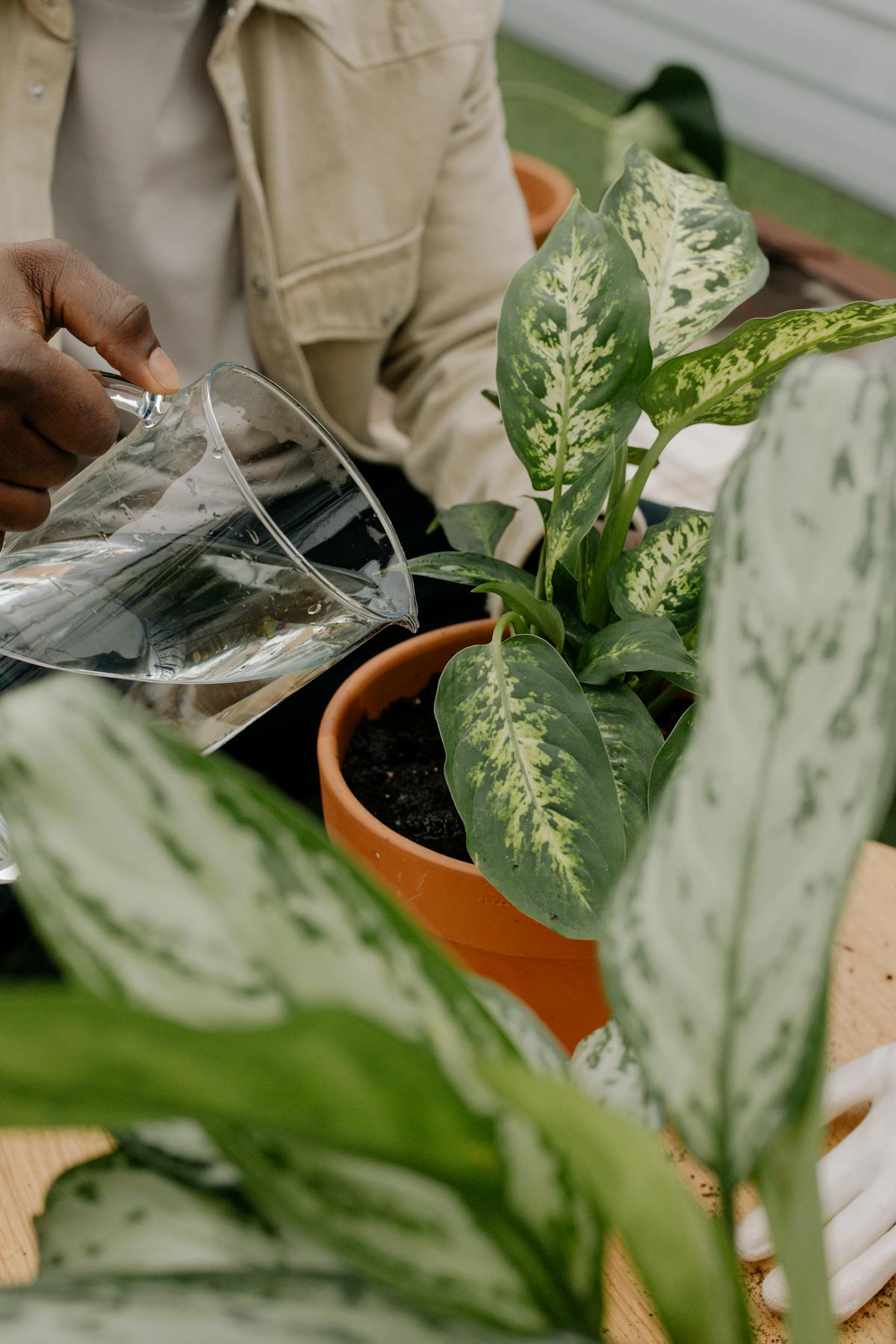
Capillary action is the upward movement of liquid through narrow spaces against the force of gravity. According to the Wikipedia capillary action article it is the same phenomenon that lifts water through plant xylem and through porous building materials. In a Peperomia pot, three physical forces operate together:
- Adhesion. Water molecules are polar and form weak bonds with the polar surfaces of organic substrate particles (coir, peat, bark). The water film clings to the particle surface rather than running off.
- Cohesion. Hydrogen bonding between water molecules creates a continuous chain — as the leading molecule advances upward along a soil particle, it pulls subsequent molecules behind it.
- Surface tension. At the air-water interface within each microscopic pore, the water surface curves into a concave meniscus. The pressure difference across this curved interface (the Young-Laplace pressure) generates a suction that draws water upward into the pore.
The height of capillary rise is inversely proportional to pore radius. Narrow pores (≤0.1 mm — typical of coir and fine peat) lift water 10–15 cm; macro-pores (≥1 mm — typical of orchid bark and perlite) lift water only 1–2 cm but provide the air-filled porosity that roots require for respiration. A well-constructed Peperomia substrate has both, organised as a dual-path system: micro-pores wick water upward while macro-pores remain air-filled.
The soil-hysteresis catch. Dry organic substrate is not always wettable. As coir or peat dries below ~15% water content the pore walls develop a hydrophobic surface chemistry, and the contact angle between water and particle exceeds 90°. Capillary rise stalls. This is the "ink-bottle effect" — pore necks narrow during drying into a configuration that resists re-wetting. The visible signature is a pot that has been bottom-watering successfully for months and one day refuses to take up water at all. The correction is a single top-watering (with a few drops of horticultural surfactant or warm water) to break the surface chemistry, after which routine bottom-watering resumes. Severely root-bound and contracted root balls may need full immersion for 5–10 minutes to re-establish capillary contact.
2. Three Mechanistic Benefits for P. obtusifolia
Eradicating the fungus-gnat oviposition zone. Sciaridae females require substrate water content above 50% in the top 1 cm to deposit eggs; egg viability drops sharply below 20%. Top-watering keeps that surface layer continuously moist and supplies an unbroken nursery. Bottom-watering reverses the gradient — the saturated zone is at the base of the pot, the dry zone at the surface. Once the surface dries to ~15% water content (typically 24 hours after the soak in a 22 °C room), it is structurally hostile to oviposition. The colony cannot establish in a substrate it cannot lay eggs in.
Eliminating standing water in the leaf axils. Peperomia obtusifolia grows in a dense rosette with closely-set petioles meeting the stem at acute angles. Top-watering deposits water into these axil pockets, and in low-airflow indoor environments the water persists for hours before evaporating. Standing axil water is the entry condition for Pseudomonas cichorii (bacterial leaf spot) and the soft-rot bacteria that cause stem rot on this species. Bottom-watering bypasses the foliage entirely.
Even hydration of the root ball. Top-watering relies on gravity to distribute water, and gravity preferentially channels water through the path of least resistance — the wall-to-substrate interface, the centre of any compacted column, and the existing drainage tracks left by previous waterings. The result is dry pockets in the root ball even when the saucer fills with runoff. Capillary rise is more uniform: every pore that meets the water surface becomes part of the active wicking network, and water arrives at every root-zone cohort approximately together.
3. The Five-Step Protocol
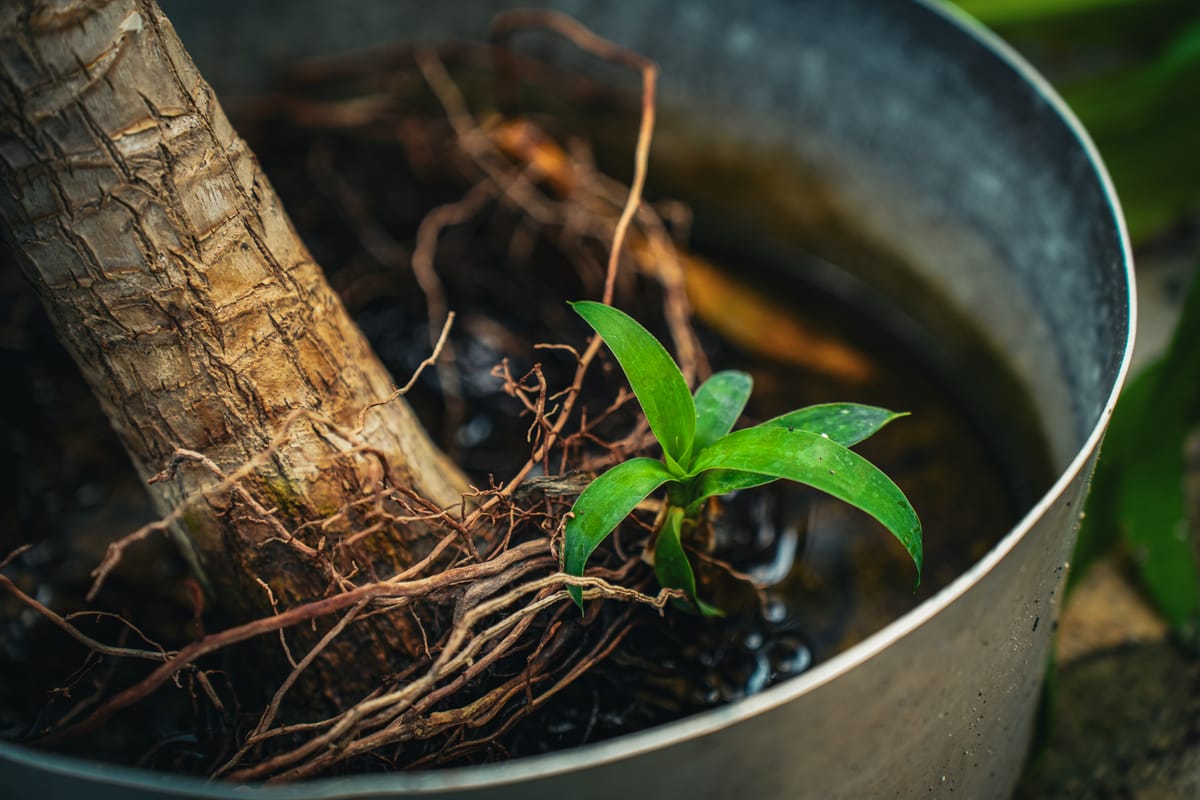
Prerequisite. The plant must be in a pot with drainage holes. Sealed decorative cachepots will not work — the inner nursery pot must be removed for the soak. The pot height must be no greater than the wicking height of the substrate (10–15 cm for a 50/30/20 coir-perlite-bark mix). A 25 cm pot will leave the upper substrate dry while the lower substrate stays permanently wet — an unbalanced rhizosphere that causes more problems than it solves.
- Verify the dry-down trigger. Push a wooden skewer to the bottom of the pot. If it emerges damp from the mid-pot zone, wait. If it emerges dry and the pot weight is noticeably reduced, proceed. Do not water on a fixed schedule — schedule-based watering is the proximal cause of Pythium-driven root rot in this species.
- Prepare the bath. Fill a tray, basin, or shallow plant saucer with 2–5 cm of room-temperature water. The depth should reach ≈1/3 of the pot height. Cold tap water (<15 °C) is briefly thermally stressful to roots adapted to 18–24 °C; allow tap water to equilibrate to room temperature for 30 minutes before use.
- Soak. Place the pot in the water. Set a timer for 20 minutes as a starting point.
- Check capillary completion. At 15–20 minutes, touch the substrate surface. A cool or slightly damp top layer signals that capillary rise has reached the surface. The pot weight has typically increased by 30–50% relative to the dry baseline. If the surface is still bone-dry at 30 minutes, the substrate is likely hydrophobic — see the surfactant correction in Section 1.
- Drain. Remove the pot and let it sit in an empty sink or on a drainage rack for 10 minutes. Gravity removes the excess "perched water" that would otherwise accumulate at the pot base. Returning a freshly soaked pot to a saucer that retains water creates a permanently saturated lower zone — the precondition for root anoxia.
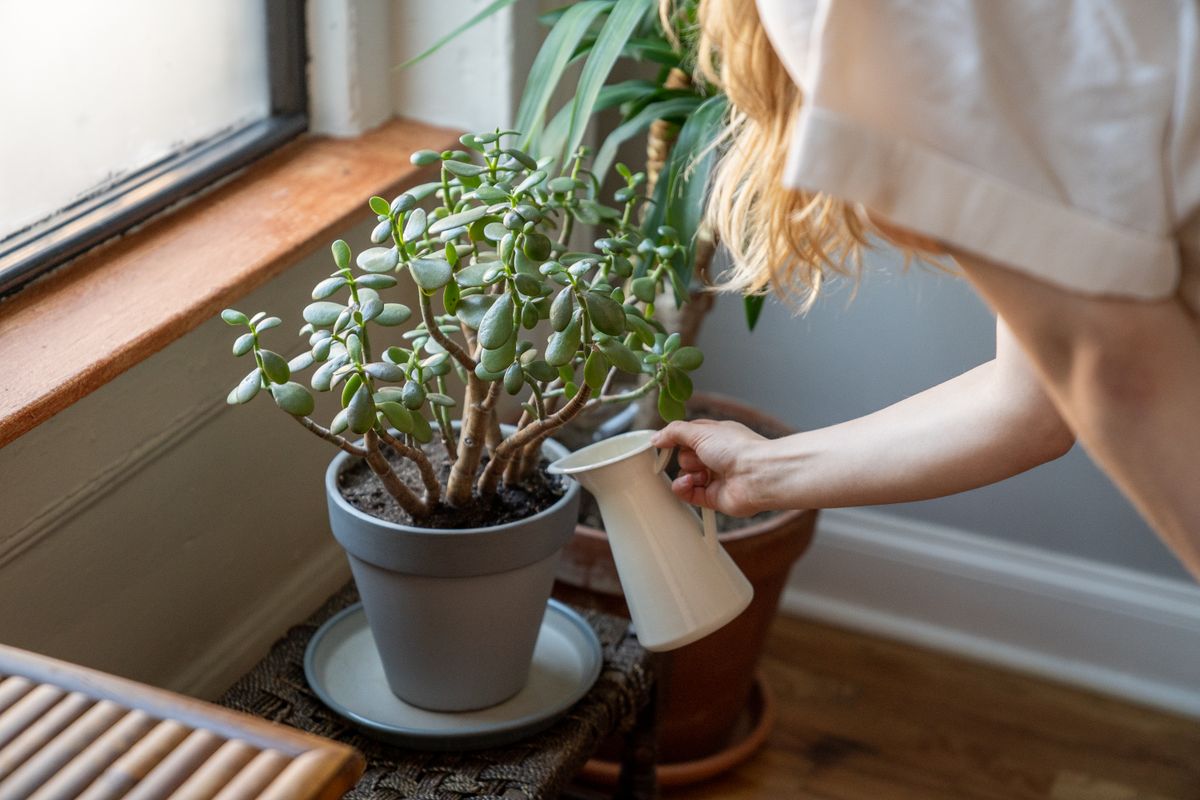
4. The Mandatory Salt Flush — and Why "Bottom-Water Forever" Is Wrong
This is the section that distinguishes a correct protocol from the version repeated in most houseplant blogs.
Bottom-watering moves water in one direction only — upward. Tap water typically carries 50–300 mg/L of dissolved minerals (calcium, magnesium, sodium, chloride, bicarbonate), and standard balanced fertiliser at 50% label rate adds further dissolved salts. As each soak's water evaporates from the substrate surface, those salts remain behind. The accumulation is invisible at 4 weeks, visible as a faint white crust at 8 weeks, and dense enough to disturb root osmotic potential at 12–16 weeks. The diagnostic signature is leaf-tip browning on older leaves while new growth remains normal — see Pattern 6: the salt-encrusted bottom-watered specimen for the full diagnostic case.
The correction is a top-flush every 8–12 weeks. Take the plant to a sink. Pour low-mineral water (rainwater, distilled, or filtered to <50 mg/L total dissolved solids) from above the substrate surface, slowly enough to soak rather than channel through, until 3× the pot volume has run through and water runs freely from the drainage hole for 60 seconds continuously. The downward flow leaches accumulated surface salts out of the drainage hole. Return to the bottom-watering routine.
This is the one position this guide takes without softening: bottom-watering is not the universally superior method it is often claimed to be. The "bottom-water exclusively, never top-water again" instruction that circulates on plant forums is the proximal cause of the salt-crust pots that grow tip-browning on otherwise vigorous specimens. Bottom-water as default; top-flush periodically. Either-or framing is wrong.
5. Pot, Substrate, and Plant-Size Matching
The technique's efficiency depends on three variables that must be matched together. Mismatched, even a correct protocol fails.
Pot material. Terracotta is porous and exchanges moisture with ambient air; substrate inside terracotta dries 1.5–2× faster than the same substrate in plastic. This suits high-RH rooms and over-waterers but in dry winter indoor conditions (RH <40%) it can produce chronic underwatering. Plastic and glazed ceramic retain moisture for longer and pair best with a free-draining substrate (≥30% perlite by volume). Self-watering pots with continuous wicking are not recommended for P. obtusifolia — they maintain substrate moisture above the species' tolerance and reproduce the conditions of root anoxia.
Substrate composition. The site's standard is 50% peat-free coir-based compost, 30% perlite, 20% fine orchid bark (recipe and reasoning). The coir supplies micro-pores for capillary rise; the perlite supplies macro-pores for root respiration; the bark supplies slow-decomposing structure. Pure peat wicks aggressively but stays saturated too long and starves the root zone of oxygen. Pure bark provides excellent aeration but inadequate capillary continuity — water from the soak reaches 2–3 cm above the bath surface and stalls.
Pot height. Wicking height for the standard mix is 10–15 cm. In a pot taller than this, capillary rise from a 2–5 cm bath cannot reach the upper substrate, and the upper root zone remains chronically dry while the lower zone stays chronically wet. P. obtusifolia's shallow root system fits comfortably in pots 10–15 cm tall and 12–18 cm wide; this is also the geometry that bottom-watering serves correctly. Deep narrow pots that suit Sansevieria or Dracaena are the wrong vessel geometry for this species.
6. When Bottom-Watering Is the Wrong Tool
The method is not universally appropriate.
- Freshly repotted specimens (first 7–14 days). Disturbed root systems take up water inefficiently regardless of delivery method. Top-water lightly until new fine roots establish, then transition to bottom-watering.
- Pots taller than 15 cm. As noted above — wicking height is exceeded and the upper substrate stays dry.
- Severely root-bound plants with contracted root balls. The substrate has shrunk away from the pot walls, leaving a gap that water bypasses without entering the substrate. Re-hydrate by full immersion for 5–10 minutes, then assess whether repotting is required.
- Outdoor specimens during summer. Rainfall and higher transpiration rates change the moisture economy; bottom-watering is unnecessary and impractical at scale.
- Hanging planters. Removal from the hook for each soak is logistically inconvenient; an extended-spout watering can applying water carefully at the substrate margin (avoiding the foliage) is an acceptable substitute, with quarterly removal for a full bath and salt-flush.
The general principle is that bottom-watering is a delivery method, not a religion. Use it for routine maintenance, switch tools when the geometry or plant state changes, and always include the periodic top-flush.
Conclusion
Capillary action is a predictable result of adhesion, cohesion, and surface tension operating within a substrate's pore architecture. Bottom-watering uses it to deliver even saturation of the lower root zone of Peperomia obtusifolia while keeping the top 1–2 cm of substrate dry — the configuration that denies Sciaridae their oviposition zone and prevents standing water in the leaf axils. The catch is salt accumulation at the surface, and the correction is a quarterly top-flush with low-mineral water. The technique fails when pot height exceeds substrate wicking height, when substrate dries into a hydrophobic state, or when the plant has been freshly repotted. Routine application of the 20-minute soak with the 10-minute gravity drain — and the discipline of the 8–12 week top-flush — gives this species the water-delivery profile it evolved to use, applied through a container the wild plant never had to contend with.
Related watering and substrate resources:
- Best Peperomia Soil Mix Recipe — the 50/30/20 standard
- Overwatering Rescue and Root-Rot Diagnostics
- Terracotta vs Plastic vs Ceramic — Pot Material Comparison
- Fungus Gnats on Peperomia: The Substrate-First Protocol
- Subirrigation — the broader irrigation category
- BBC Gardeners' World — General Houseplant Watering Guidance
Care FAQ
How long should I bottom-water my Peperomia obtusifolia?
15–30 minutes is the standard interval for a 12 cm pot in a 50% coir / 30% perlite / 20% bark substrate. The soak is complete when the top 1–2 cm of substrate feels cool or slightly damp to the touch (a thermal cue from capillary rise) or when the pot weight has noticeably increased. Above 45 minutes, capillary water has reached saturation and additional time only increases the risk of root anoxia. Remove the pot, allow 10 minutes for gravity drainage, then return it to its growing location.
Can you overwater a Peperomia by bottom-watering?
Not from a single session — the soak is self-limiting in volume by the substrate's pore capacity. Overwatering on a bottom-watered plant comes from frequency, not volume: re-soaking before the substrate has dried to within 2–3 cm of the bottom maintains continuous saturation, eliminates air-filled porosity, and reproduces the conditions of root anoxia within ~5 days. The dry-down trigger — not a fixed schedule — governs the next watering.
Does bottom-watering get rid of fungus gnats?
It prevents new outbreaks by denying Sciaridae females their preferred oviposition zone — the moist top 1 cm of substrate. With consistent bottom-watering, that surface stays below 20% water content and is structurally hostile to egg deposition. Existing infestations require concurrent substrate-directed treatment (BTI drench) over the 17–28 day generation cycle; bottom-watering alone is preventative, not curative.
How often should I bottom-water Peperomia obtusifolia?
On dry-down trigger, not schedule. In summer (18–24 °C, standard indoor RH) a 12 cm pot typically reaches the trigger every 10–14 days. In winter (cooler temperatures, slower metabolism) the interval extends to 21–28 days. Verify with a wooden skewer drawn from mid-pot — if the lower 3–5 cm is still damp, wait. The pot-weight comparison method is the most reliable diagnostic across all seasons.
What is the salt flush, and why is it required?
Exclusive bottom-watering moves moisture upward via capillary action; it never moves moisture downward. Tap-water minerals (calcium, magnesium, sodium, chloride) and fertiliser salts dissolved in the soak water are deposited at the substrate surface as water evaporates, accumulating into a white crust over 3–4 months. As substrate ionic concentration rises, root osmotic potential is compromised and leaf-tip browning appears. The correction is a top-flush every 8–12 weeks: water from above with 3× the pot volume of low-mineral water (rainwater, distilled, or filtered) until water runs freely from the drainage hole for 60 seconds. This is not optional — bottom-water as default, top-flush periodically.
Why won't dry substrate take up water by bottom-watering?
Dry peat- or coir-based substrate becomes hydrophobic — its surface contact angle with water exceeds 90°, and capillary rise stalls. This is the soil-hysteresis "ink-bottle effect": pore necks dry into a configuration that resists re-wetting. The correction is a single top-watering with a few drops of horticultural surfactant (or warm water) to break the surface tension, after which routine bottom-watering resumes its normal capillary efficiency. Heavily root-bound plants with severely contracted root balls may need to be removed and re-hydrated by full immersion for 5–10 minutes.
Is bottom-watering safe for all pot types?
It works in terracotta, plastic, glazed ceramic, and nursery pots with drainage holes. It does not work in sealed decorative cachepots — the inner pot must be removed for the soak. Terracotta dries the substrate faster than plastic after a soak, which suits over-waterers and high-RH rooms; plastic and glazed ceramic retain moisture longer and pair best with a free-draining substrate (≥30% perlite by volume). The pot must be no taller than the wicking height of the substrate (typically 10–15 cm for a coir/perlite/bark mix) — a 25 cm pot will leave the upper substrate dry while the lower substrate stays permanently wet.