
Peperomia Auxin Hormone: How It Controls Weak Growth
Auxin is the plant hormone responsible for three separate Peperomia obtusifolia growth patterns that often get attributed to the wrong cause: a stem leaning toward a window, a plant that grows as one long stem instead of branching, and a cutting that roots from its cut end. All three come from the same underlying process — auxin concentrating unevenly across plant tissue — but the practical fix is different for each, so telling them apart matters more than memorising the hormone's name.
What Auxin Actually Is
Auxin is a plant hormone, not a nutrient or a fertiliser component — it does not feed the plant, it directs it. Specifically, it triggers nearby cells to elongate and, depending on the tissue, either promotes or suppresses new growth from a bud. A useful way to think about it: light and water are the raw materials for growth, while auxin is closer to the instructions for where that growth actually happens.
What Is Actually Known About This Species Specifically
Auxin's role in phototropism, apical dominance, and adventitious rooting is well documented across flowering plants generally, and P. obtusifolia's observable behaviour — leaning toward light, growing as a dominant single stem when unpruned, rooting readily from stem cuttings — matches that general model closely. What has not been separately measured in this species is the precise concentration gradient involved, or a quantified comparison of rooting speed with versus without synthetic auxin. Treat the mechanism below as a reliable general-botany explanation for what you can already observe in the plant, not as a set of Peperomia-specific laboratory findings.
How the Mechanism Works
Auxin is produced mainly at the stem's growing tip (the apical meristem) and in young, expanding leaves, then moves down the stem in one direction — toward the roots, not back up. Three consequences follow from where it accumulates and how different tissues respond to it.
Phototropism — the lean toward a window. Light striking one side of a stem causes auxin to shift toward the shaded side rather than being produced or destroyed. Because auxin speeds up cell elongation in stem tissue, the shaded side's cells grow longer than the lit side's, and that uneven elongation physically bends the stem toward the light. This is a distinct process from the gravity-driven bending covered in the geotropism and gravity guide — the two mechanisms can reinforce or fight each other depending on how a plant is positioned, which is part of why an unrotated plant near a single window develops such a pronounced lean over time.
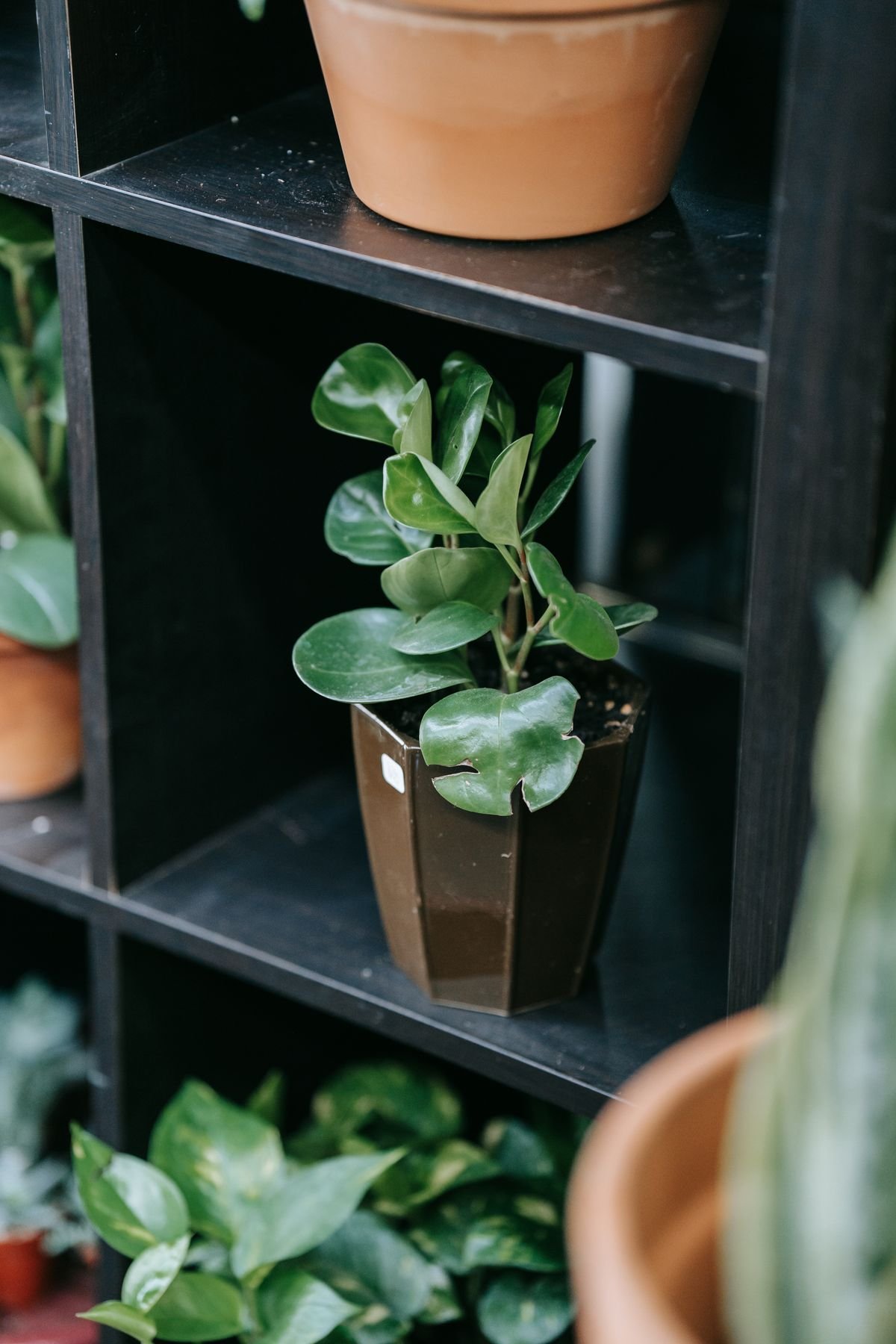
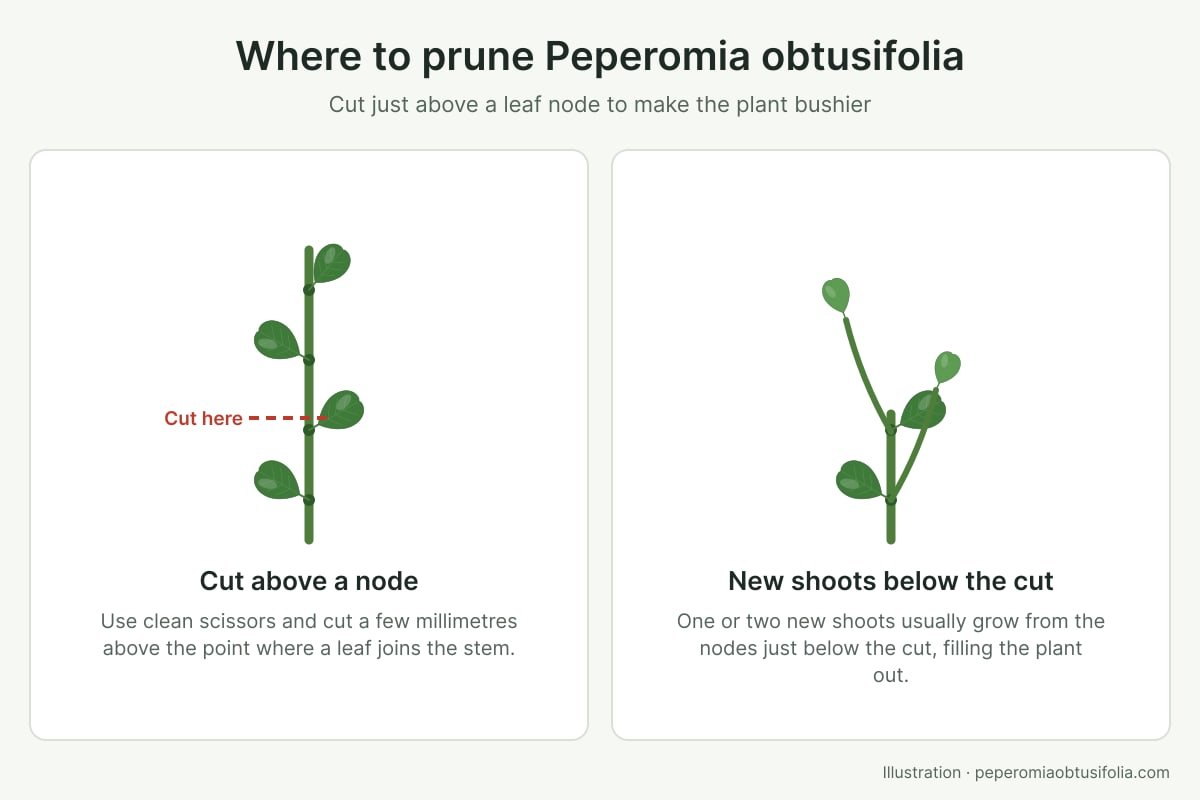
Apical dominance — the single-vine habit. The actively growing tip produces auxin continuously, and as it flows past the dormant side buds lower on the stem, high local auxin concentration keeps those buds suppressed. Left uninterrupted, this is why an unpruned P. obtusifolia tends to grow as one long stem rather than branching out. Removing the tip removes the source of that suppression, and the nearest dormant buds below the cut typically begin growing within a few weeks — the mechanism behind the pruning guide's recommendation to cut back a leggy stem for a fuller shape.
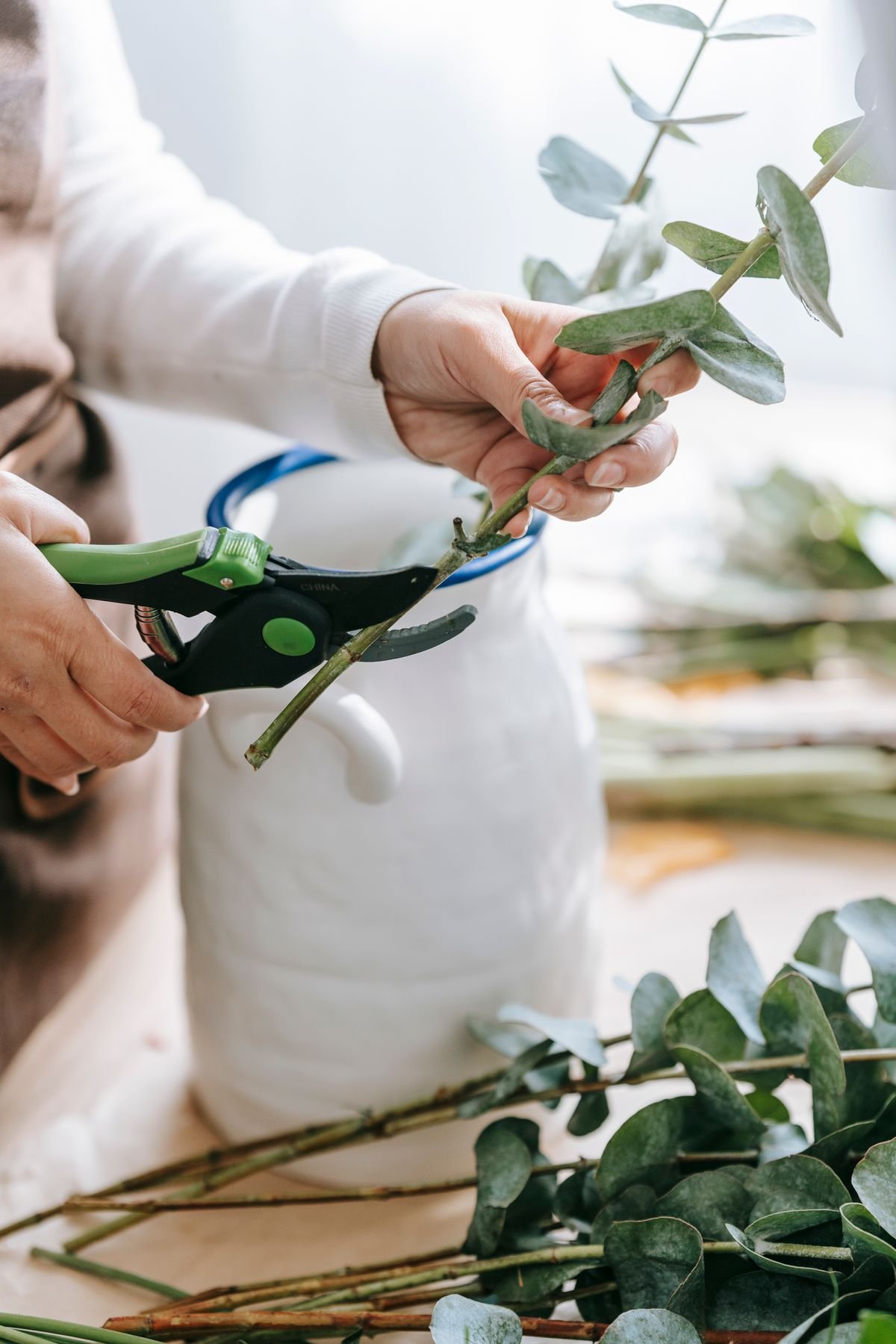
Adventitious rooting — why a cutting roots at all. When a stem is cut, the auxin that was flowing downward has nowhere left to go and pools at the cut end instead. That local concentration is part of what signals nearby cells to switch from producing stem or leaf tissue to forming new root tissue. P. obtusifolia pools enough of its own auxin to root readily without any product added — stem cuttings usually root within a few weeks in warm conditions; see the node propagation guide for the method. Commercial rooting products (usually IBA or NAA) supply synthetic auxin that reinforces this same natural pooling rather than substituting for a signal the plant lacks; the rooting hormone comparison guide covers when a product genuinely helps versus when it is an unnecessary step for an already easy-to-root species.
What This Changes for Growers
Because the same hormone drives all three behaviours, the practical response to each is different rather than interchangeable. A leaning plant needs rotation, not pruning — cutting the tip off a plant that is simply chasing light does not address a hormone imbalance, since there isn't one; it addresses legginess instead, which is a separate (if related) issue covered in the leggy and leaning guide. A plant that refuses to branch, by contrast, genuinely does need its growing tip removed — rotating it will not break apical dominance. And a cutting that has not rooted after several weeks is more likely dealing with a temperature, humidity, or rot problem than a lack of auxin, since the hormone response happens automatically at the cut surface regardless of product use.
What This Does Not Prove
None of this means auxin is "deciding" anything in a deliberate sense — concentration gradients and differential cell elongation are chemical and physical processes, not choices. It also does not mean synthetic rooting hormone is required for successful propagation in this species: P. obtusifolia already roots well from its own auxin pooling, and a product's main value is speeding up or improving consistency for cuttings that are otherwise slow, not rescuing a cutting that would fail without it. Nor does understanding apical dominance mean every unbranched Peperomia is a care failure — a young, recently propagated cutting is expected to grow as a single stem for a while before it has enough size to prune productively.
Evidence Quality and Sources
Auxin's role in phototropism, apical dominance, and adventitious rooting is foundational, long-established plant physiology, described in standard botanical references and demonstrated experimentally across many plant families. Species-specific confirmation for P. obtusifolia — exact concentration levels, a controlled rooting-speed comparison with and without synthetic auxin — has not been separately published; the explanation here is a well-supported extension of general plant hormone biology to an observable, consistent pattern in this species, not a Peperomia-specific study result. For the broader growth framework this hormone operates within, see the complete care guide.
Care FAQ
What does the auxin hormone actually do in Peperomia obtusifolia?
Auxin (indole-3-acetic acid) is the growth hormone that drives cell elongation and directs where new roots form. It is produced mainly at the growing tip and in young leaves, then moves downward through the stem, and its concentration on one side of a stem versus the other is what makes the stem lean, branch, or root from a cut end.
Why does my Peperomia lean toward the window instead of growing straight?
Light striking one side of the stem causes auxin to accumulate on the shaded side, and auxin speeds up cell elongation in stem tissue — so the shaded side grows longer than the lit side, bending the stem toward the light. This is phototropism, a separate mechanism from the gravity-based bending covered in the geotropism guide.
Why does my Peperomia grow as one long stem instead of branching?
Apical dominance. The actively growing tip produces auxin that flows down the stem and suppresses the dormant side buds below it. Removing the tip by pruning breaks that suppression, and nearby side buds typically resume growth within a few weeks.
Does rooting hormone actually help Peperomia cuttings root faster?
It can, though the effect size has not been separately measured for this species. A cut stem already pools its own auxin at the base, which is enough to trigger root formation without any product in most cases — P. obtusifolia roots readily on its own. Synthetic auxin (IBA or NAA) reinforces that same natural pooling rather than replacing a missing signal, and it is more useful for slower-rooting or stressed cuttings than a routine requirement.