Peperomia Obtusifolia 'Albo-Marginata': Safe Care Guide
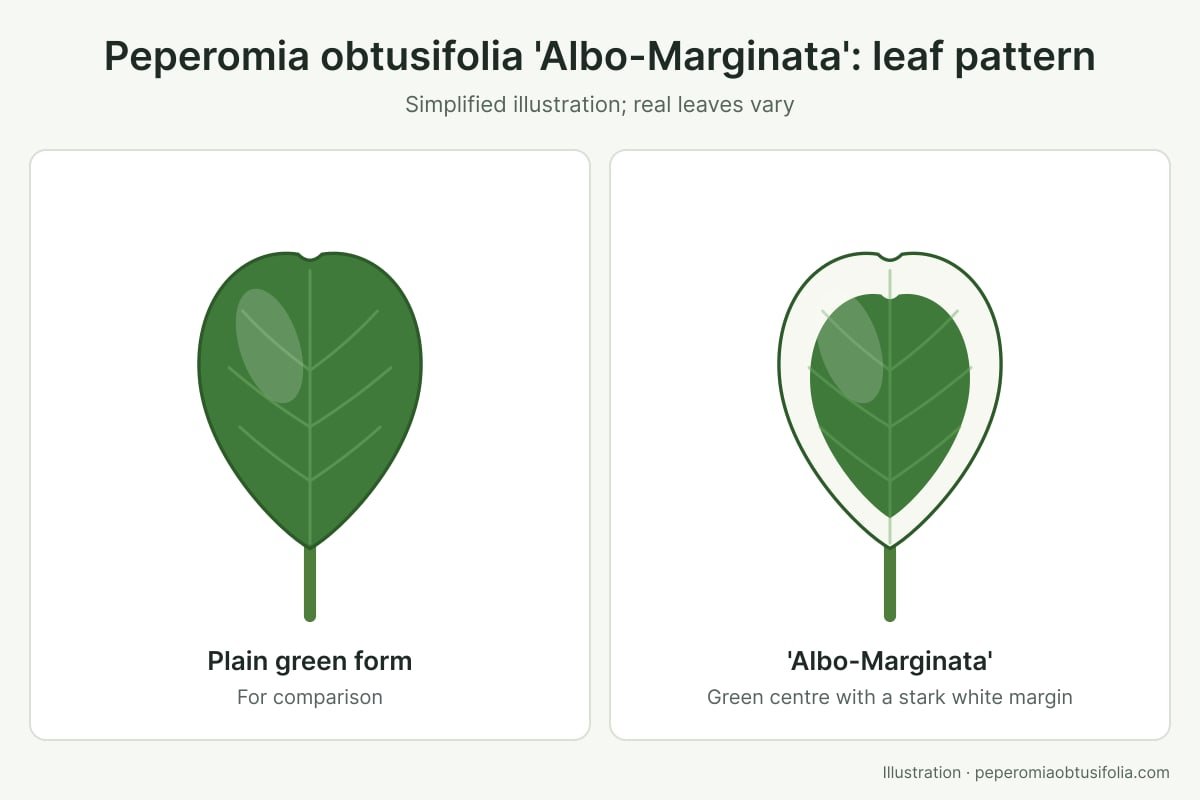
Peperomia obtusifolia 'Albo-Marginata' is identified by a stable, well-defined white margin surrounding a solid green centre — a periclinal chimera distinct from the more randomly splashed 'Marble' pattern. The white tissue produces no energy of its own and has no light-buffering pigment, which makes this cultivar more sensitive than most to both insufficient light and direct sun, and quicker than most to show stress from mineral salts in the water.
Is This Cultivar Name Verified?
'Albo-Marginata' is an established, widely recognised trade name in the P. obtusifolia cultivar trade — "albo" (white) and "marginata" (margined) describe the pattern precisely: a stable white edge around a green centre, botanically a periclinal chimera where two genetically distinct cell layers grow side by side. This is a different, more stable pattern than 'Marble', where the white and green mix irregularly rather than forming a consistent border.
Identification Traits
The leaf centre is solid, typical Peperomia green, surrounded by a distinct, largely unbroken margin of stark white running around the leaf's outer edge. Occasional flecks of grey-green may intrude slightly into the white band, but the overall pattern stays far more consistent leaf-to-leaf than 'Marble's random splash. It is structurally the cool-toned counterpart to 'Golden Gate', which shares the same green-centre-plus-margin structure but with a warm yellow-to-cream edge rather than white, and the inverse of 'Lemon Lime', which has a pale centre and darker edges.
Quick Care Table
| Factor | Requirement |
|---|---|
| Light | Bright, filtered light toward the upper end of roughly 2,000-4,000 lux; not direct sun |
| Watering trigger | Top 2-3 cm of substrate dry, same as the species generally |
| Substrate | Free-draining mix, ~30% perlite or bark by volume |
| Water quality | More sensitive than most cultivars to hard tap water — distilled, filtered, or rainwater reduces margin stress |
| Temperature | 18-30°C (RHS); keep above 10°C |
| Fertiliser | Balanced feed at half strength, monthly, spring-summer only |
Light and Colour Stability
The white margin carries no functional chlorophyll, so the green centre alone supplies the energy for the entire leaf — the same trade-off behind every variegated cultivar's higher light demand, but more pronounced here since the margin can represent a substantial share of total leaf area. Keep this cultivar toward the upper end of the roughly 2,000-4,000 lux working range; below it, new growth trends toward less white margin as the plant favours energy-efficient green tissue. At the other extreme, the white tissue has no pigment to buffer excess light energy the way the green portions do, so it scorches more readily under unfiltered direct sun — bright filtered light, such as an east-facing window, suits this cultivar better than a south-facing sill without protection.
Watering, Soil, and Pot Choice
The standard top-2-3cm-dry trigger and free-draining substrate apply as they do to the species generally. The one genuine cultivar-specific consideration is water quality: because the white margin lacks chlorophyll to buffer cellular stress, it tends to show the crisping and browning associated with mineral salt accumulation sooner and more visibly than a solid green leaf would under the same hard-water conditions — see the white crust and salt buildup guide for the flush protocol if this is already showing, and consider distilled, filtered, or rainwater for ongoing watering if tap water in your area is notably hard.
Reversion, Propagation, and Pruning
Like other variegated cultivars, insufficient light shifts new growth toward proportionally more green and less white as the plant favours energy-efficient tissue — prune a stem back to the last well-margined node if it's producing solid green leaves, rather than expecting it to self-correct. Propagate from stem cuttings that include a variegated node; leaf cuttings typically regenerate as all-green plantlets, since the chimeric margin pattern lives in a cell layer leaf cuttings don't reliably reproduce.
Common Problems and Lookalike Cultivars
Crispy, brown leaf margins are the most frequent complaint with this cultivar, and the cause is most often mineral salt buildup from hard water rather than a pathogen or pest — confirm by checking for a white crust on the substrate surface, covered in the white crust guide. The main identification mix-up is with 'Golden Gate', distinguished by margin colour (white here, warm yellow-cream there) rather than pattern structure, which is otherwise similar between the two.
Sourcing and Authenticity Checklist
Confirm the margin is genuinely white rather than pale cream or yellow before paying a premium specifically for 'Albo-Marginata' over 'Golden Gate', since the two are easy to conflate in a photo under warm indoor lighting. Look for a reasonably consistent margin across multiple leaves in listing photos — while some natural variation is expected, this cultivar's pattern should read as noticeably more stable and defined than 'Marble's characteristic randomness.
Care FAQ
Why are the white edges of my Albo-Marginata turning brown and crispy?
Most often mineral salt accumulation, not disease. Because the white margin has no chlorophyll to buffer it, it tends to show stress from hard tap water or fertiliser residue before the green centre does. See the white crust and salt buildup guide for the flush protocol, and consider switching to distilled, filtered, or rainwater going forward.
How is Albo-Marginata different from Golden Gate?
Both share a green centre with a contrasting margin, but Golden Gate's edge is warm yellow-to-cream, while Albo-Marginata's is a stark, cool white with essentially no chlorophyll at all — making Albo-Marginata the more light-demanding and salt-sensitive of the two.
Does Albo-Marginata need more light than a solid green Peperomia?
Yes. The white margin contributes no photosynthesis, so the green centre works harder to support the whole leaf — the same mechanism behind every variegated cultivar's need for brighter light than the plain green form. Aim for the upper end of the site's working target of roughly 2,000-4,000 lux.
Can direct sun damage the white margin specifically?
Yes, more readily than the green centre. The white tissue has no pigment to absorb or buffer excess light energy, so it scorches faster than green tissue under the same unfiltered direct sun exposure. Filtered bright indirect light is safer for this cultivar than for the plain green form.