
Peperomia Obtusifolia 'Golden Gate': Best Care Guide
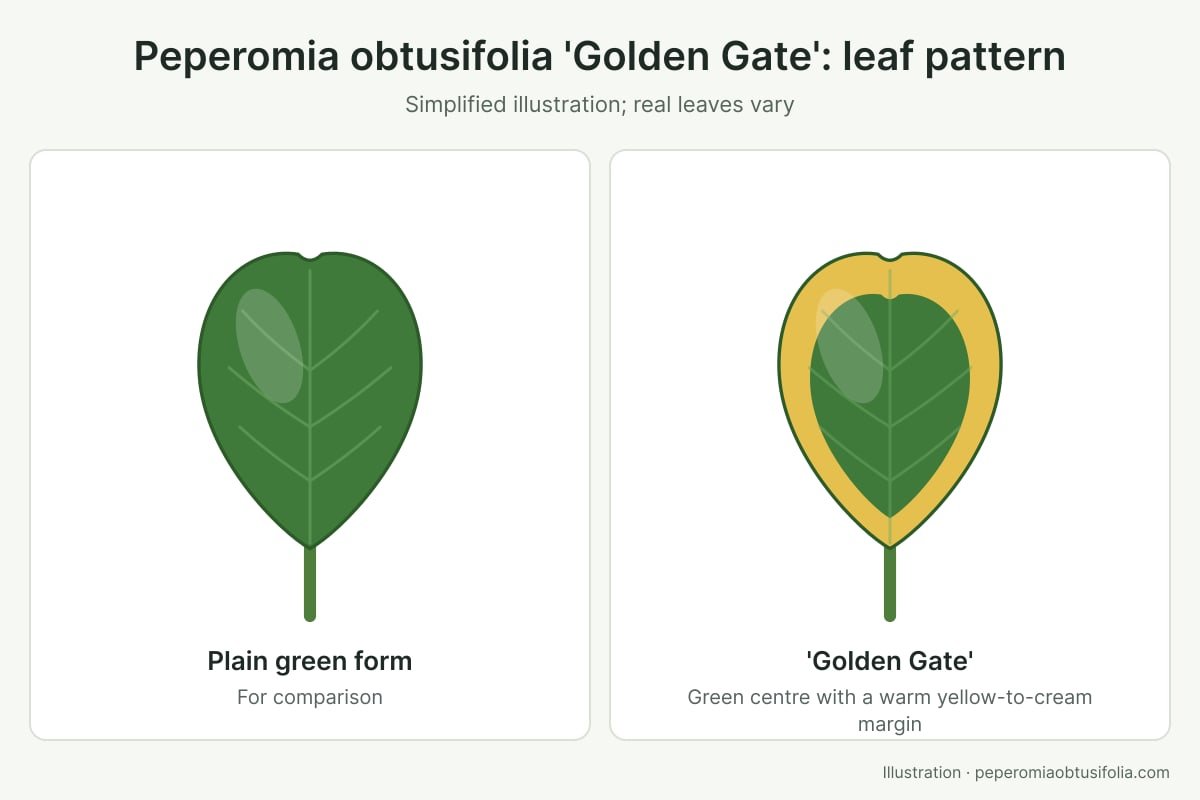
Peperomia obtusifolia 'Golden Gate' is identified by a defined, warm yellow-to-cream margin around a solid green centre — a pattern that stays notably more consistent across propagated cuttings than the random splash of 'Marble', which is a large part of why it's the variegated form most commonly sold at general retail.
Is This Cultivar Name Verified?
'Golden Gate' is a well-established, widely available trade name in the P. obtusifolia cultivar trade. The pattern it describes — a defined, relatively stable yellow-to-cream margin around a green centre — is consistent enough across commercial stock to treat as a genuine, identifiable cultivar. It's a marginal chimera, meaning the mutated and normal tissue sit in a relatively organised arrangement at the growing tip, which is the structural reason this cultivar propagates true to pattern far more reliably than a sectoral chimera like 'Marble'.
Identification Traits
The leaf centre is solid green, bordered by a warm yellow-to-cream margin running consistently around the leaf's edge — a noticeably warmer tone than the stark white of 'Albo-Marginata', which shares the same basic structure. The margin width and placement stay fairly consistent leaf to leaf on a healthy specimen, distinct from 'Marble's leaf-to-leaf unpredictability. New leaves typically emerge already showing the margin, rather than developing it gradually.

Quick Care Table
| Factor | Requirement |
|---|---|
| Light | Above the species' 2,000-4,000 lux optimum — toward the upper end to maintain margin colour |
| Watering trigger | Top 2-3 cm of substrate dry, same as the species generally |
| Substrate | Free-draining mix, ~30% perlite or bark by volume |
| Temperature | 18-24°C day; avoid sustained exposure below 10°C |
| Fertiliser | Balanced feed at half strength, monthly, spring-summer only |
| Mature size | Similar to the species generally |
Light and Colour Stability
The yellow margin carries some functional pigment (xanthophylls, part of the same light-harvesting pigment family as chlorophyll) but still contributes less photosynthetic capacity than solid green tissue, which is why this cultivar — like any variegated P. obtusifolia — needs more light than the plain green form to maintain its margin. Below the species' optimum range, new growth trends toward a muddier, more chlorophyll-heavy margin rather than a crisp yellow one, the same reversion mechanism seen across variegated cultivars generally. Bright, filtered indirect light suits this cultivar well; avoid unfiltered direct sun strong enough to scorch, since the margin has less protective pigment than the green centre.
Watering, Soil, and Pot Choice
No meaningful cultivar-specific adjustment applies — the standard top-2-3cm-dry trigger and free-draining substrate recommended for the species generally apply here without modification. Bottom-watering works well as a default, as it does for the species generally, though there's nothing about this cultivar specifically that requires it.
Reversion, Propagation, and Pruning
Golden Gate's marginal chimera structure makes it one of the more forgiving variegated cultivars to propagate — because the variegated layer sits in a relatively consistent position at the growing tip, stem cuttings taken from healthy, well-margined growth reproduce the pattern reliably more often than a sectoral chimera like 'Marble' would. Still use stem cuttings with a variegated node rather than leaf cuttings, since leaf cuttings generally fail to preserve chimeric patterns regardless of cultivar. If a stem reverts to solid green under insufficient light, prune it back to the last well-margined node rather than expecting it to self-correct.
Common Problems and Lookalike Cultivars
The most common mix-up is with 'Gold Coast', which shares a similar warm colour palette but shows a more uniform overall wash rather than Golden Gate's defined margin structure — check for a distinct green centre with a separate margin, versus an evenly blended tone, to tell them apart. 'Albo-Marginata' shares the same structural pattern but with a cool white margin rather than warm yellow.
Sourcing and Authenticity Checklist
Since Golden Gate propagates relatively true to pattern, a listing showing consistent, well-defined margins across multiple leaves is a reasonably good sign of an authentic, healthy specimen — more so than for a sectoral chimera cultivar where leaf-to-leaf variation is expected. Confirm the margin reads as a genuine warm yellow-to-cream rather than a cooler white before paying a premium specifically for this name over a similarly priced 'Albo-Marginata'.
Care FAQ
What is the difference between Golden Gate and a generic "variegated Peperomia"?
Golden Gate is a specific cultivar with a defined warm yellow-to-cream margin around a green centre. "Variegated" is a general description that could refer to several different patterns — Variegata, Marble, Albo-Marginata — each with a distinct look and different care nuances.
Why is my Golden Gate turning green or losing its yellow margin?
Insufficient light. Even though this cultivar has a relatively stable chimeric structure compared to Marble, low light still pushes new growth toward more chlorophyll-rich, less yellow tissue, since green tissue is more efficient at capturing limited available light. Moving the plant to brighter indirect light restores more yellow in new growth.
Is Golden Gate more stable than Marble?
Yes. Golden Gate has marginal variegation, where the different cell layers stay in a relatively consistent arrangement at the growing tip, producing a fairly predictable pattern across propagated cuttings. Marble is a sectoral chimera with a genuinely random, unpredictable mix, so no two Marble leaves look alike in the way Golden Gate leaves generally do.
Does Golden Gate need different watering from a solid green Peperomia?
No meaningful difference in the trigger itself — still water on the top-2-3cm-dry rule. The main practical note is that a plant with a genuine variegation-related light deficit may show a slower dry-down than a healthy specimen, so confirm light levels are adequate before assuming a watering problem if dry-down seems unusually slow.