Peperomia Obtusifolia 'Green Gold': Best Care & Colour
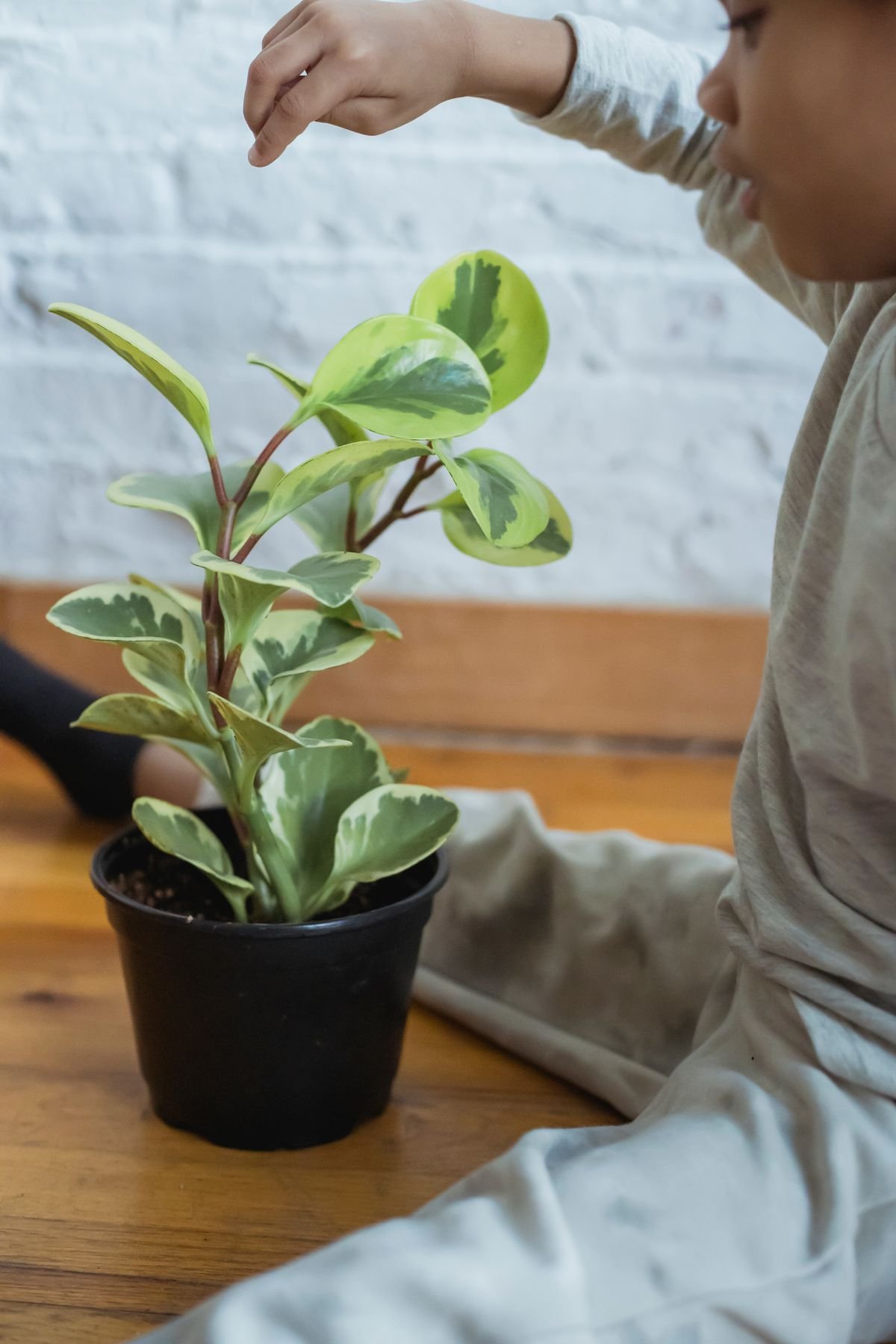
Peperomia obtusifolia 'Green Gold' is identified by an irregular patchwork of gold and deep-green patches on each leaf — unlike the more uniform glow of 'Gold Coast', no two Green Gold leaves show quite the same pattern. It needs more light than the plain green form to keep its contrast, and it is the one cultivar in the species where pruning genuinely lets a grower nudge the pattern, since cutting back to a strongly-patterned node has a reasonable chance of continuing that look.
Is This Cultivar Name Verified?
'Green Gold' is an established trade name in the P. obtusifolia cultivar trade, distinct from the similarly-named but visually different 'Golden Gate' (fine marginal variegation) and 'Gold Coast' (more uniform overall colour shift). The defining trait — an irregular, "shattered" chimeric boundary rather than a neat margin or uniform wash — is consistent enough across nursery stock sold under this name to treat it as a real, identifiable pattern rather than an inconsistent marketing label. Confirm what's actually in hand against the traits below rather than the name on the tag alone, since retail mislabelling between the gold-toned cultivars is common.
Identification Traits
Each leaf shows patches of yellow-gold and deep green with irregular, sometimes sharply defined, sometimes blurred boundaries between them — the proportion of gold-to-green varies leaf to leaf on the same plant, occasionally as much as mostly-gold on one leaf and mostly-green on its neighbour. This is the key trait that separates it from 'Gold Coast', which shows a more even, uniform yellow-green tone across the whole leaf rather than distinct patches. New leaves emerge showing whatever balance of tissue that particular node's meristem carries, and the pattern is not fixed generation to generation the way a marginal variegation (a defined white or cream edge) typically is.
Quick Care Table
| Factor | Requirement |
|---|---|
| Light | The upper end of the site's working target of roughly 2,000-4,000 lux — variegated tissue needs brighter light than the green form to avoid reversion |
| Watering trigger | Top 2-3 cm of substrate dry, same as the species generally |
| Substrate | Free-draining mix, ~30% perlite or bark by volume |
| Temperature | 18-24°C day; avoid sustained exposure below 10°C |
| Fertiliser | Balanced feed at half strength, monthly, spring-summer only |
| Mature size | Similar to the species generally, roughly 20-30cm indoors |
Light and Colour Stability
The gold patches carry little chlorophyll and rely on nearby green tissue for the energy they can't generate themselves, which is the same trade-off underlying reversion in any variegated Peperomia. Keep this cultivar toward the upper end of the species' light range — brighter indirect light than the plain green form needs, towards the top of the roughly 2,000-4,000 lux working target — to maintain contrast; below that, new growth increasingly favours green tissue and the pattern muddies. As with any variegated cultivar, avoid unfiltered direct sun strong enough to scorch, since the gold patches have less chlorophyll to buffer against high-intensity light than the green portions do.
Watering, Soil, and Pot Choice
No cultivar-specific adjustment applies beyond the general species requirements — the same free-draining substrate and top-2-3cm-dry watering trigger apply regardless of leaf pattern.
Reversion, Propagation, and Pruning
Because the chimeric boundary in this cultivar is irregular rather than a clean margin, its response to pruning is genuinely different from most variegated P. obtusifolia: cutting back to a node that produced a strongly gold-patterned leaf gives the resulting branch a reasonable, though not guaranteed, chance of continuing a similar pattern — an effect worth exploiting if a particular branch is trending too green. The opposite correction also applies: if a branch is producing mostly all-gold leaves, which carry too little chlorophyll to sustain themselves long-term, prune back to a node with a more balanced gold-and-green leaf to restore the branch's photosynthetic capacity before it stalls. As with other variegated cultivars, propagate from stem cuttings that include a variegated node rather than leaf cuttings, since leaf cuttings typically regenerate as all-green plantlets.
Common Problems and Lookalike Cultivars
The most frequent confusion is with 'Gold Coast', which shares a similar colour palette but shows a uniform wash rather than distinct patches — see the Gold Coast guide for a direct comparison. 'Golden Gate' is a third, separate cultivar with fine marginal variegation rather than either pattern. A Green Gold specimen that has fully reverted to green in new growth is not a different cultivar — it's the same plant responding to insufficient light, correctable by relocating it rather than something to troubleshoot as disease or pest damage.
Sourcing and Authenticity Checklist
Buy from a seller whose photos show the actual specimen rather than a stock image, and check that what's pictured shows genuine irregular patching rather than the more uniform tone of 'Gold Coast' mislabelled under this more sought-after name. Since the pattern is inherently variable leaf-to-leaf, expect and accept some inconsistency across a single plant — that variability is the defining trait, not a sign of a mislabelled or lower-quality specimen.
Care FAQ
Is Green Gold the same cultivar as Gold Coast?
No. Gold Coast has a relatively uniform yellow-green glow across the leaf. Green Gold shows an irregular, unpredictable "shattered" pattern of distinct gold and deep-green patches, and no two leaves look quite the same. Both are recognised trade names for genuinely different variegation patterns in this species.
Why is my Green Gold reverting to mostly green?
Insufficient light. Below the species' light threshold, the meristem favours all-green tissue because it photosynthesises more efficiently than the gold patches — the same mechanism behind reversion in any variegated cultivar. Moving the plant to brighter light restores more gold in new growth; existing green leaves do not re-pattern.
Can pruning change how much gold a Green Gold plant shows?
To a limited extent. Because the chimeric boundary is irregular in this cultivar, cutting back to a node that produced a strongly patterned leaf gives the new branch a reasonable chance of continuing that pattern, though the outcome is not fully predictable given the nature of a shattered chimera.
Is an all-gold leaf on a Green Gold a problem?
It can become one if a branch produces mostly all-gold leaves for an extended period, since gold tissue carries little chlorophyll and depends on nearby green tissue to supply energy. A branch stuck producing almost entirely gold growth can stall; pruning back to a node with a more balanced leaf restores the branch's photosynthetic capacity.