Peperomia Obtusifolia 'Gold Coast': Best Care Guide
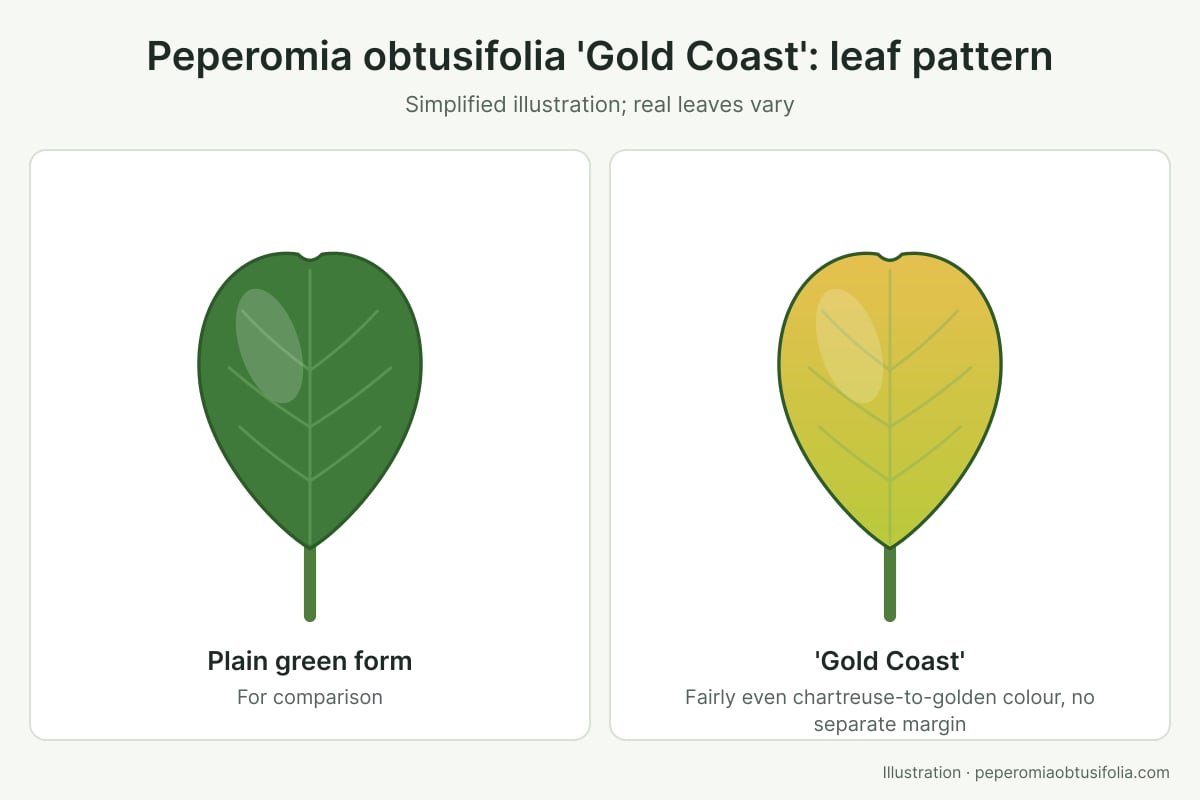
Peperomia obtusifolia 'Gold Coast' is identified by a relatively uniform chartreuse-to-golden leaf colour rather than distinct patches or a defined margin — a genuine difference in pigment ratio from the plain green form, not a chimeric pattern in the same sense as 'Marble' or 'Variegata'. Like other light-sensitive colour forms in this species, it needs more light than the plain green form to hold its gold tone, fading toward ordinary green under insufficient light.
Is This Cultivar Name Verified?
'Gold Coast' is an established trade name in the P. obtusifolia cultivar trade for a form showing a relatively uniform yellow-green to gold leaf tone, distinct from the centre-and-margin structure of 'Golden Gate' or the random patching of 'Marble'. The underlying mechanism — a higher ratio of yellow accessory pigments (xanthophylls, part of the same pigment family involved in light harvesting generally) relative to chlorophyll — is a plausible, commonly cited explanation for this kind of colour form, though the exact pigment ratios have not been separately measured for this specific cultivar.
Identification Traits
Leaves show a fairly even chartreuse-to-golden-yellow tone across the whole blade rather than a distinct green centre with a separate margin, which is the key trait separating it from 'Golden Gate'. The tone can vary somewhat with light conditions — brighter light generally produces a more saturated gold, while lower light shifts new growth toward a duller, greener cast. Because the colouring is distributed fairly evenly rather than sectoral, leaf-to-leaf consistency tends to be higher than in a genuinely random chimera like 'Marble'.
Quick Care Table
| Factor | Requirement |
|---|---|
| Light | Bright indirect light, toward the upper end of roughly 2,000-4,000 lux, to maintain gold tone |
| Watering trigger | Top 2-3 cm of substrate dry, same as the species generally |
| Substrate | Free-draining mix, ~30% perlite or bark by volume |
| Temperature | 18-30°C (RHS); keep above 10°C |
| Fertiliser | Balanced feed at half strength, monthly, spring-summer only |
| Mature size | Similar to the species generally |
Light and Colour Stability
Because Gold Coast's yellow tissue retains some photosynthetic capacity — unlike the chlorophyll-free white tissue of a cultivar like 'Albo-Marginata' — it is generally considered one of the more forgiving colour forms to keep looking healthy, though it still needs brighter light than the plain green form to maintain its distinctive tone. Keep it toward the upper end of the roughly 2,000-4,000 lux working range; below that, new growth trends duller and greener as the plant favours chlorophyll production to compensate for reduced light. As with any lighter-toned cultivar, avoid unfiltered direct sun strong enough to bleach or scorch — this species' general direct-sun damage threshold applies here as it does across the species.
Watering, Soil, and Pot Choice
No cultivar-specific adjustment applies — the standard top-2-3cm-dry watering trigger and free-draining substrate recommended for the species generally apply here without modification.
Reversion, Propagation, and Pruning
If a branch is producing consistently greener, less gold-toned growth than the rest of the plant under otherwise adequate light, pruning it back can help prevent that more chlorophyll-efficient growth from eventually outcompeting and shading the gold-toned portions of the plant. Propagate via standard stem cuttings — this cultivar's relatively uniform colour distribution tends to reproduce more predictably from cuttings than a sectoral chimera would, though as always, select cutting material that shows the colour you want to preserve.
Common Problems and Lookalike Cultivars
The main identification overlap is with 'Golden Gate', which shares a similar warm colour palette but shows a defined green centre and separate margin rather than Gold Coast's more uniform overall wash — this structural difference, not colour intensity alone, is the more reliable way to tell them apart. A Gold Coast specimen that has faded toward plain green under low light is not diseased or a different cultivar — it's the same plant responding to insufficient light, correctable by relocating it.
Sourcing and Authenticity Checklist
Look for a specimen showing a genuinely even gold-to-chartreuse tone across its leaves in listing photos taken under adequate lighting, rather than a plant that already looks predominantly green — a faded, under-lit specimen may not show this cultivar's defining trait clearly even if it is the correct cultivar.
Care FAQ
Why is my Gold Coast Peperomia turning green?
Insufficient light. Under low light the plant increases chlorophyll production to capture more of the limited available light, which masks the yellow tone across the leaf. Moving it to brighter indirect light restores more gold colour in new growth; existing green leaves do not shift back.
Is Gold Coast the same as Golden Gate?
No. Golden Gate has a defined green centre with a separate yellow-to-cream margin. Gold Coast shows a more uniform overall chartreuse-to-gold wash across the whole leaf rather than a distinct centre-and-margin structure.
How much light does Gold Coast need to stay gold?
Toward the upper end of the site's working target of roughly 2,000-4,000 lux, brighter than the plain green form needs, the same general rule that applies to variegated cultivars. Below that range, new growth trends toward a duller, greener tone.
Is Gold Coast more stable than Marble?
Generally yes. Because its colour is distributed fairly uniformly across the leaf rather than in an unpredictable sectoral pattern, Gold Coast tends to show more consistent colouring leaf to leaf than a sectoral chimera like Marble, provided light stays adequate.