
Peperomia Obtusifolia 'Variegata': Best Care & Chimeras
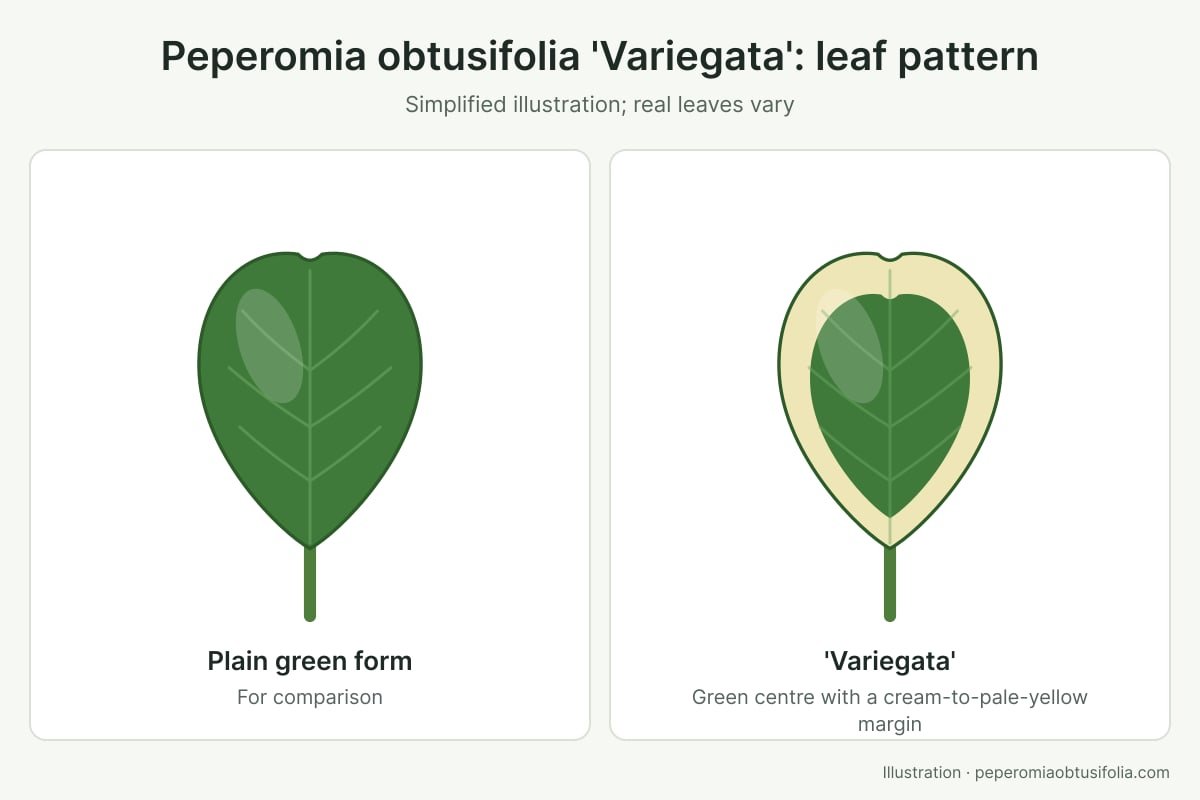
Peperomia obtusifolia 'Variegata' is identified by a green centre bordered by a cream-to-yellow margin — a periclinal chimera pattern that stays reasonably consistent across the plant, distinct from the randomly splashed 'Marble'. Because the margin carries little functional chlorophyll, this cultivar needs meaningfully more light than the plain green form to keep its pattern from fading toward solid green.
Is This Cultivar Name Verified?
'Variegata' is a long-established trade name in the P. obtusifolia cultivar trade, describing a green-centre, cream-margin pattern produced by a periclinal chimera — the growing tip carries a genetically distinct outer cell layer alongside the normal inner layers. It's worth noting that "variegated" is also used loosely as a general description across the houseplant trade, so confirm the specific pattern (green centre, cream margin) rather than assuming any cream-and-green P. obtusifolia sold as "variegated" is this specific cultivar.
Identification Traits
The leaf centre is solid green, with a cream-to-pale-yellow margin running around the outer edge in a pattern that stays fairly consistent leaf to leaf, though margin width can vary somewhat with light conditions. New leaves generally emerge already showing the margin. This pattern sits structurally opposite to 'Lemon Lime', which has a pale centre and darker edges, and shares its basic green-centre-plus-margin structure with 'Golden Gate' and 'Albo-Marginata', differing mainly in the specific margin tone.

Quick Care Table
| Factor | Requirement |
|---|---|
| Light | Brighter than the green form's working target of roughly 2,000-4,000 lux, to maintain variegation |
| Watering trigger | Top 2-3 cm of substrate dry, same as the species generally |
| Substrate | Free-draining mix, ~30% perlite or bark by volume |
| Temperature | 18-30°C (RHS); keep above 10°C |
| Fertiliser | Balanced feed at half strength, monthly, spring-summer only |
| Mature size | Similar to the species generally |
Light and Colour Stability
The cream margin carries little to no functional chlorophyll, so the green portion of each leaf effectively works harder to fuel the whole leaf. This is the reason variegated cultivars need brighter conditions than the plain green form, whose working target is roughly 2,000-4,000 lux. In poor light, new growth increasingly favours green tissue over margin, since chlorophyll-bearing cells capture more of the limited available light — the mechanism behind reversion in this and every other variegated cultivar in the species.
Watering, Soil, and Pot Choice
No cultivar-specific adjustment applies beyond the general species requirements — the same top-2-3cm-dry watering trigger and free-draining substrate apply regardless of variegation pattern.
Reversion, Propagation, and Pruning
Because the outer, variegated cell layer is genetically distinct from the inner green layers, a stem cutting that includes an intact node carries all the layers needed to reproduce the pattern reliably. A leaf cutting, by contrast, typically has to regenerate an entirely new growing point from a single cell — usually one from the green inner layer — which is why leaf-only propagation of variegated chimeral Peperomia gives all-green plants rather than variegated ones (UF/IFAS). If a stem starts producing solid green leaves under correct light, that section has likely reverted permanently; prune it back to the last well-margined node rather than waiting for it to self-correct.
Common Problems and Lookalike Cultivars
The main identification overlap is with 'Golden Gate' (warmer, more consistently yellow margin) and 'Albo-Marginata' (cooler, starker white margin) — both share the same basic green-centre-plus-margin structure and are best told apart by the specific margin tone rather than pattern shape. A Variegata that has fully reverted to green in new growth is not a different plant or a disease — it's the same cultivar responding to insufficient light, correctable by relocating rather than something requiring treatment.
Sourcing and Authenticity Checklist
Check that listing photos show the actual specimen with a genuine, defined margin rather than a stock image, and that the margin tone reads as cream-to-yellow specifically rather than stark white (which would suggest 'Albo-Marginata' instead) or an irregular splash (which would suggest 'Marble'). Reasonable consistency across leaves is expected for this cultivar, unlike the leaf-to-leaf variability that's normal for 'Marble'.
Care FAQ
What causes the Variegata pattern?
A periclinal chimera — the growing tip carries an outer cell layer with a mutation that prevents chlorophyll production, while the inner layers stay genetically normal and green. As the leaf develops, the outer layer forms the margin and the inner layers form the green centre, producing the characteristic cream-edged pattern.
Why is my Variegata reverting to solid green?
Insufficient light. Chlorophyll-carrying tissue is more efficient at capturing limited light than the chlorophyll-free margin, so under low light the plant favours growth from cells that produce more green tissue. Once new growth is coming in solid green, prune that stem back to the last well-margined node.
Does Variegata need more light than the plain green form?
Yes. It needs brighter light than the plain green form, whose working target is roughly 2,000-4,000 lux at leaf level. The cream margin carries little to no functional chlorophyll, so it contributes little to no energy, and the green portion of the leaf has to support more total leaf area per unit of photosynthesis than an all-green leaf would.
Can I propagate Variegata from a leaf cutting?
Not reliably. The chimeric pattern lives in the meristem's outer cell layer, which a leaf cutting fails to regenerate — UF/IFAS notes that leaf cuttings of variegated chimeral Peperomia give all-green plants. Use a stem cutting that includes a variegated node instead.