Peperomia Curling Leaves: Direction-Based Diagnosis
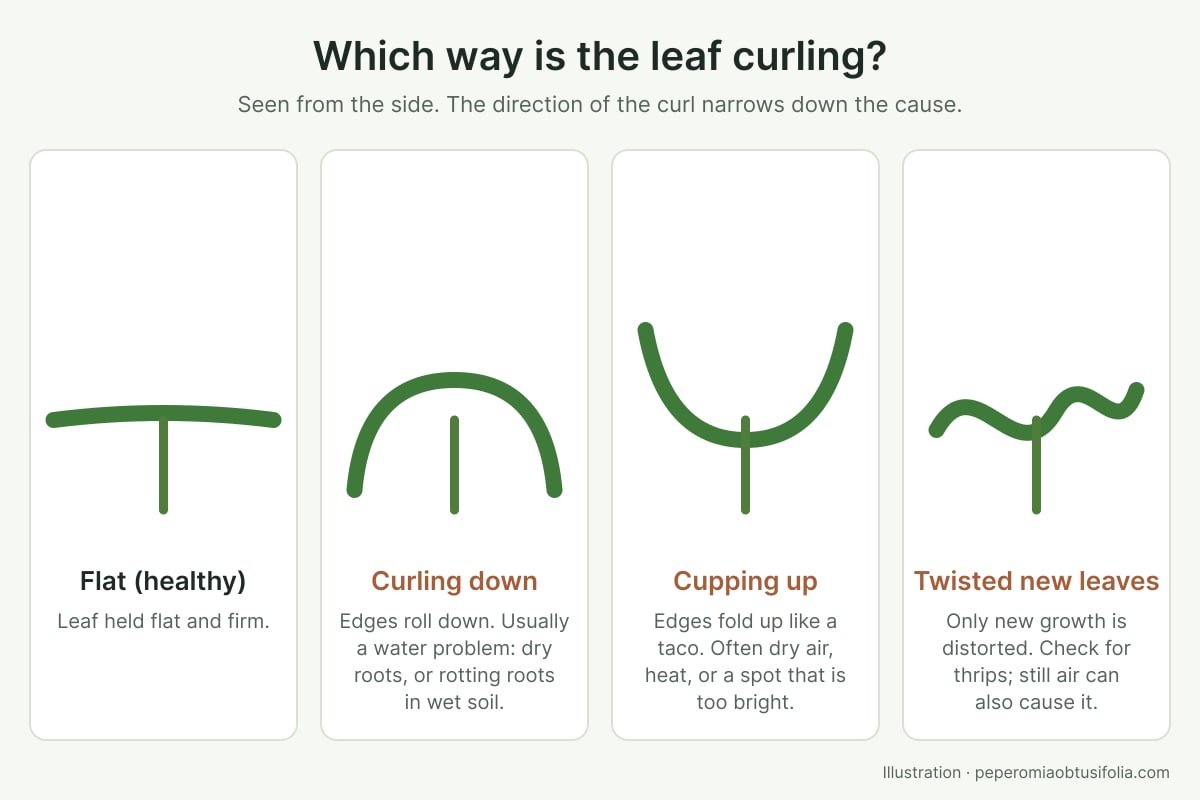
A downward curl on Peperomia obtusifolia paired with moist substrate is usually root failure, not thirst — appearance alone can't tell the two apart, and adding water to the wrong one accelerates the damage. Before treating anything, fold a mature leaf gently between your fingers: firm resistance means the curl is structural (light, salt, or nutrient-related); soft, pliable folding means turgor has collapsed, and the substrate condition — not the leaf — decides whether the fix is watering or the opposite.
Quick Diagnosis
| Curl pattern | Location | Likely cause | Confirming check | First action |
|---|---|---|---|---|
| Downward, soft, substrate wet | All leaves | Root failure / overwatering | Sour smell, soft dark roots on inspection | Stop watering; unpot and inspect roots |
| Downward, soft, substrate bone-dry | All leaves | Underwatering | Pot feels noticeably light | Water thoroughly, ideally by bottom-watering |
| Upward bowl or inward "taco" | All mature leaves | Low humidity / high VPD | Hygrometer reads below 30% RH, or heat above 28°C | Move from heat source; raise humidity with a humidifier |
| Twisted, crinkled | New growth only | Pest damage (thrips/mites) | Magnify undersides of new leaves for webbing or frass | Isolate and begin pest treatment |
| Sudden, firm, cool to touch | All growth, after a cold event | Temperature stress | Correlates with a draft, window, or AC vent | Relocate away from the cold source |
What This Symptom Looks Like
Curling on this species is a turgor signal before it's anything else, and the direction and firmness narrow the cause quickly. A downward, soft, wilted curl means the leaf has lost internal water pressure — the question is only whether the substrate is the cause (too dry) or the roots have failed despite adequate substrate moisture (too wet, for too long). An upward or inward "taco" cupping is different: the leaf is still turgid but curling defensively to trap humid air against its stomata, a response to dry or hot air rather than a substrate problem at all. Twisting confined to new growth only, with older leaves staying flat, points away from environment entirely and toward pest damage at the meristem. The taco test separates the two soft-curl causes fast: gently fold a mature leaf — firm resistance means the curl is structural (light deficit, salt buildup, or nutrient excess, none of which respond to watering); soft, easy folding means turgor has collapsed, and the substrate check that follows determines the direction of the fix.
Causes Ranked From Most to Least Likely
1. Overwatering and root failure
Soil that stays wet for long periods loses its air-filled porosity, root respiration fails, and Pythium or Phytophthora colonises the anoxic roots — the plant then wilts and curls in wet substrate because it cannot draw water even though water surrounds it (NC State Extension; University of Illinois RPD 653). Confirm it: unpot and check for a sour smell and soft, dark roots; yellowing lower leaves that detach with no resistance are a common companion sign.
2. Underwatering
Water-storage tissue in the thick leaves empties under sustained drought, and internal pressure drops enough that the leaf rolls downward and inward to reduce its exposed surface area. Confirm it: substrate is dry well past the top 2-3 cm, the pot feels distinctly light, and there's no sour smell.
3. Low humidity or high vapour pressure deficit
Below roughly 30% RH, or with heat above 28°C, the air pulls moisture through the stomata faster than the roots can resupply, and the plant cups or rolls its leaves to trap a humid boundary layer against the underside. Confirm it: a hygrometer at leaf height reads low, or the plant sits near a heat source; substrate moisture is normal.
4. Pest damage to new growth
Thrips rasp at meristematic tissue in developing leaves, and the punctured cells fail to expand evenly, producing permanent twisting confined to new growth while older leaves stay flat. Spider mites produce fine webbing and stippling instead. Confirm it: magnify the undersides of the newest leaves for silvering, dark frass specks, or fine webbing.
5. Temperature stress or cold drafts
Sustained leaf-surface exposure below roughly 10°C damages membranes and turgor regulation outright; a brief cold draft from a single-glazed window or AC vent can impair stomatal function without full cellular damage, producing a subtler curl. Confirm it: onset correlates with a seasonal change, relocation, or proximity to a window or vent, and affected leaves may feel cool.
6. Calcium delivery failure from still air
Calcium is phloem-immobile and moves only via the transpiration stream; in stagnant air with little airflow, transpiration slows and calcium fails to reach the newest, actively dividing cells, producing cupped or hooked new growth even with adequate soil calcium. Confirm it: deformity is confined to new growth, older leaves are flat, no pests are visible under magnification, and substrate and fertilising are already correct.
Less common causes worth ruling out if the above don't fit: salt buildup from tap water or over-fertilising (a white crust on the substrate surface, brown crisping tips); repotting shock from disturbed root hairs (resolves in two to four weeks); light extremes at either end (bleached patches from strong direct sun, or etiolated stretching below roughly 800 lux); and nutrient excess producing a firm, hook-like "claw" rather than a soft wilt.
Step-by-Step Recovery Plan
If the taco test shows soft, pliable leaves and wet substrate: stop watering immediately. Unpot, trim any black or soft roots back to firm white tissue with sterilised scissors, and repot into a free-draining mix — see the soil mix recipe — in a container only 2-3 cm larger than the surviving root mass. Withhold water for 7-10 days afterward.
If the taco test shows soft leaves and dry, light substrate: water thoroughly, ideally by bottom-watering for 20-30 minutes if the mix has become hydrophobic from a long dry spell, then resume the normal top-2-3cm-dry interval.
If leaves are cupping or tacoing but substrate and roots check out fine: address the room's humidity and heat exposure rather than the pot — move the plant away from direct sun, radiators, and AC vents, and raise ambient humidity with a room humidifier rather than misting, which only raises RH for a few minutes.
What not to do: don't add water to a plant that's curling in already-wet substrate — this is the single fastest route to accelerating root failure. Don't add calcium fertiliser for cupped new growth before ruling out an airflow problem, since calcium delivery failure won't respond to more calcium in the soil.
Recovery Signs and Realistic Timeline
Turgor-based curling from underwatering or a brief humidity spike typically resolves within 12-24 hours of correction. Root-rot recovery and repotting-shock recovery take longer — expect two to four weeks before new growth confirms the root system has re-established, judged by new leaves emerging flat and glossy rather than by whether the already-curled leaves themselves flatten out, since damaged tissue in an affected leaf does not reverse. Pest-related twisting, cold-induced oedema, and light-bleaching damage are permanent in the leaves already affected; the only valid measure of recovery is normal-looking new growth after the cause is corrected.
How to Prevent Recurrence
Water on the top-2-3cm-dry trigger rather than a fixed schedule, and check root and substrate condition together rather than judging by the leaf alone. Watch for very dry air with a hygrometer at leaf height, and keep the plant clear of radiators, AC vents, and single-glazed windows in winter. Provide roughly 2,000-4,000 lux of indirect light, and run a gentle fan through a still room periodically to keep calcium delivery to new growth reliable. For the general framework these thresholds sit within, see the complete care guide.
Related Diagnoses
If curling is specifically downward with no upward or inward component, the downward curling guide covers that presentation in more depth. If the leaves are wrinkling and going soft rather than curling in a defined direction, see the wrinkled leaves guide. If curling is accompanied by leaves dropping outright, see the leaf drop guide. For the full diagnostic reference across all symptom types, see the complete problems guide.
Sources
Mechanism references: turgor pressure, vapour pressure deficit. Species and pest documentation: NC State Extension and the University of Illinois IPM Peperomia disease reference.
Care FAQ
Which curl direction points to overwatering rather than underwatering?
A downward curl combined with moist or wet substrate points to root failure, not thirst — the roots cannot draw water even though water is present. A downward curl with bone-dry, lightweight substrate points to genuine underwatering instead. Checking the substrate directly, not just the leaf, is what separates the two.
Why are my Peperomia leaves curling upward or inward like a taco?
This is a defensive response to high vapour pressure deficit — low humidity, often below 30% RH, or heat above 28°C. The plant curls its leaves to trap a humid boundary layer against the stomata on the leaf underside, slowing water loss until the atmosphere is corrected.
Will curled leaves straighten back out once the cause is fixed?
Turgor-based curling from underwatering or a brief humidity spike typically resolves within 12-24 hours once corrected. Curling from repotting shock or salt buildup can take two to four weeks. Curling from pest damage, cold-induced oedema, or light-related bleaching is permanent in the affected tissue — judge recovery by the new growth that follows, not by whether existing curled leaves flatten.
Does misting help fix curling leaves?
No. A hand mister raises humidity around the foliage for only a few minutes before it returns to the room baseline, and the waxy cuticle does not absorb the moisture regardless. For genuine low-humidity stress, a room humidifier with a hygrometer is the reliable fix — see the humidity guide for the full comparison of methods.