Peperomia Obtusifolia Jade: Best Low-Light Cultivar
Peperomia obtusifolia 'Jade' is the trade name for the species' plain, solid-green form — not the unrelated Jade Plant (Crassula ovata), and not a separately registered botanical variety. It is worth owning specifically because a fully green leaf has no white or cream tissue to support, which makes it the most forgiving option in the species for a genuinely dim spot.
Is This Cultivar Name Verified?
"Jade" functions as a retail trade name rather than a formally registered cultivar name with a distinct pattern — it describes the ordinary green-leaved P. obtusifolia that predates the named variegated forms ('Variegata', 'Marble', 'Albo-Marginata') sold alongside it. Some nurseries sell an unlabelled green P. obtusifolia as simply "Peperomia obtusifolia"; others market the identical plant as "Jade" to give it a name that reads well next to variegated siblings on a shelf. Functionally these are the same plant. The important disambiguation for buyers: "Jade Plant" as a common name almost always refers to Crassula ovata, a completely unrelated succulent in a different family that is toxic to cats and dogs — see the Peperomia vs Jade Plant comparison if there's any doubt which plant is actually in hand.
Identification Traits
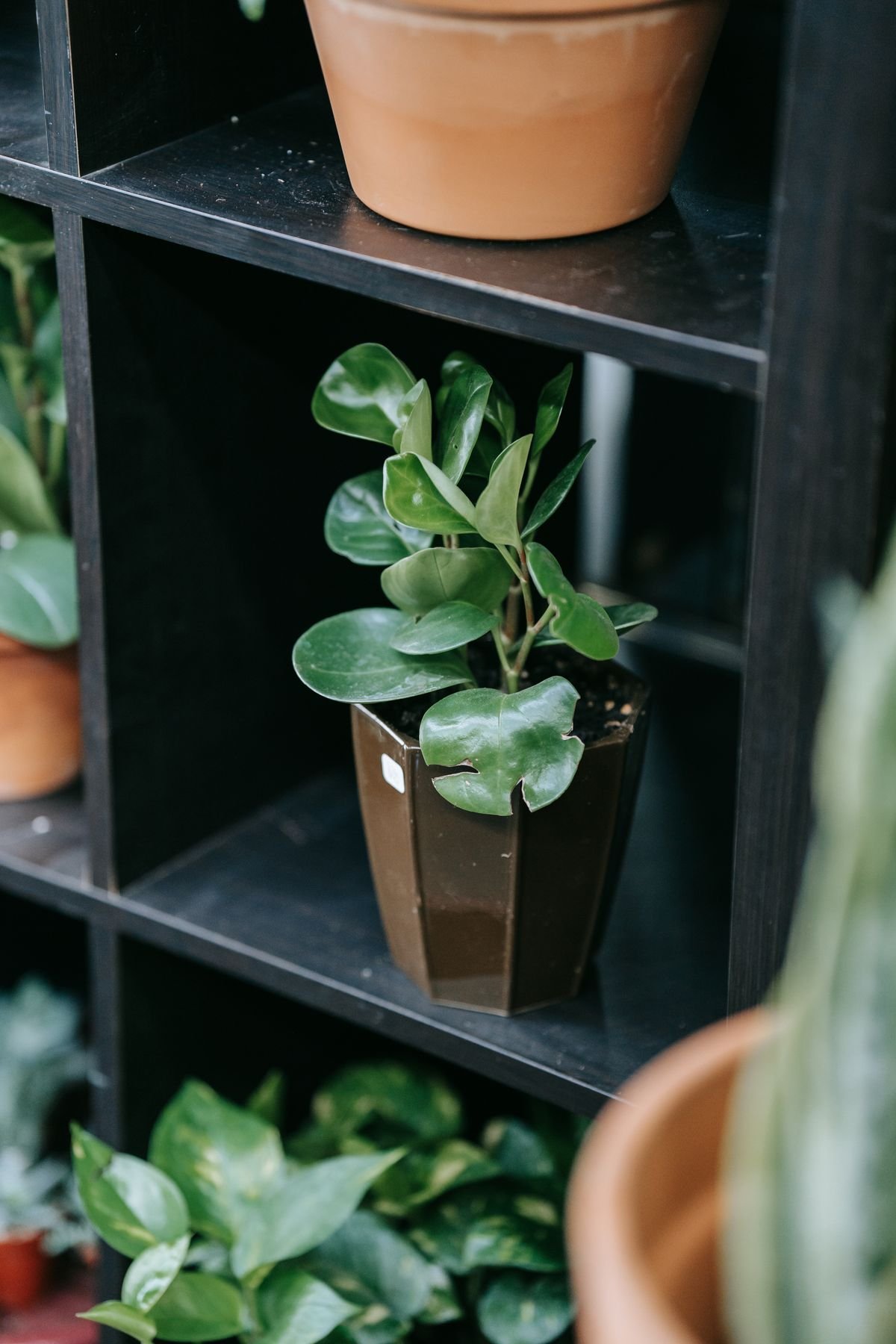
Leaves are the standard P. obtusifolia shape — obovate, blunt-tipped, thick and fleshy — but solid mid-to-deep green with no white, cream, or coloured margin anywhere on the leaf, including new growth. New leaves emerge a slightly paler green and darken as they mature and the wax layer develops, the same pattern as any green-form specimen. Growth habit, stem thickness, and leaf arrangement (alternate, one per node) match the species baseline exactly, since there is no variegation-related growth difference to account for.
Quick Care Table
| Factor | Requirement |
|---|---|
| Light | Roughly 2,000-4,000 lux, bright indirect; tolerates the lower end of this range more comfortably than variegated forms |
| Watering trigger | Top 2-3 cm of substrate dry |
| Substrate | Free-draining mix, ~30% perlite or bark by volume |
| Temperature | 18-24°C day; avoid sustained exposure below 10°C |
| Fertiliser | Balanced feed at half strength, monthly, spring-summer only |
| Mature size | Similar to the species generally — a compact, upright plant reaching roughly 20-30cm indoors |
Light Tolerance Without a Colour-Stability Concern
Because every part of the leaf carries chlorophyll, this form has no variegation to protect and no reversion risk to manage — the light-stability concerns that apply to 'Variegata' or 'Marble' simply don't apply here. It still benefits from the site's working target of roughly 2,000-4,000 lux for compact, glossy growth, and it will still etiolate under sustained light below roughly 800 lux like any P. obtusifolia, but it tolerates the lower-middle of the range without the colour trade-offs a variegated sibling shows.
Watering, Soil, and Pot Choice
No cultivar-specific adjustment applies. Use the same top-2-3cm-dry watering trigger and the same free-draining substrate recommended for the species generally — there is no documented reason a plain green form needs different substrate, pot material, or watering frequency than a variegated one.
Reversion, Propagation, and Pruning
There is no reversion risk with this form, since reversion specifically describes variegated tissue reverting to green — a solid-green leaf has nothing to revert from. This also makes it the most straightforward form to propagate: any stem or leaf cutting reliably reproduces identical, fully green offspring, unlike variegated cultivars where leaf cuttings typically produce all-green plantlets that lose the parent's pattern. See the node propagation guide for the standard method, which applies here without modification.
Common Problems and Lookalike Cultivars
The main real-world confusion is not with another Peperomia cultivar but with the unrelated Crassula ovata, sold under the same "Jade Plant" common name — check leaf arrangement (alternate on P. obtusifolia, opposite on Crassula) if the labelling is ambiguous, covered in the comparison guide. Among Peperomia cultivars, an unlabelled green P. obtusifolia and one specifically marketed as "Jade" are typically indistinguishable, so there's no meaningful identification error to correct there — the name is a marketing distinction, not a botanical one.
Sourcing and Authenticity Checklist
Since "Jade" is not a registered cultivar with a distinct verifiable pattern, there is nothing to authenticate beyond confirming the plant is genuinely P. obtusifolia rather than a similar species — check leaf shape and sap colour against the identification guide. Any seller asking a premium specifically for the "Jade" name over an unlabelled green specimen of the same species is charging for branding, not a genetically distinct plant.
Care FAQ
Is Peperomia Jade the same plant as the Jade Plant?
No. "Peperomia Jade" is a nursery trade name for the plain green form of Peperomia obtusifolia (Piperaceae). "Jade Plant" is the common name for Crassula ovata (Crassulaceae), an unrelated succulent that is toxic to cats and dogs. The shared name is a coincidence of the retail trade, not a botanical relationship.
Is Jade better for low light than variegated Peperomia cultivars?
Yes. Every part of a solid-green leaf carries chlorophyll, so the whole leaf surface contributes to photosynthesis. Variegated cultivars have white or cream tissue with little to no chlorophyll, so they need brighter light than the green form to avoid reversion. The Jade form has no reversion risk to manage at all.
Does the Jade form need different care from other Peperomia obtusifolia?
No. Light, watering, substrate, and temperature needs are identical to the species generally — see the complete care guide. The only meaningful difference is that Jade tolerates the lower end of the species' light range more comfortably, since it has no variegated tissue to support.
Does Jade grow faster than variegated cultivars?
It can, under matched conditions, since a fully green leaf photosynthesises more per unit area than a partly white one. The difference is a plausible consequence of more functional chlorophyll, not a measured growth-rate figure specific to this cultivar.