Peperomia Leaves Curling Down: Causes and Fixes
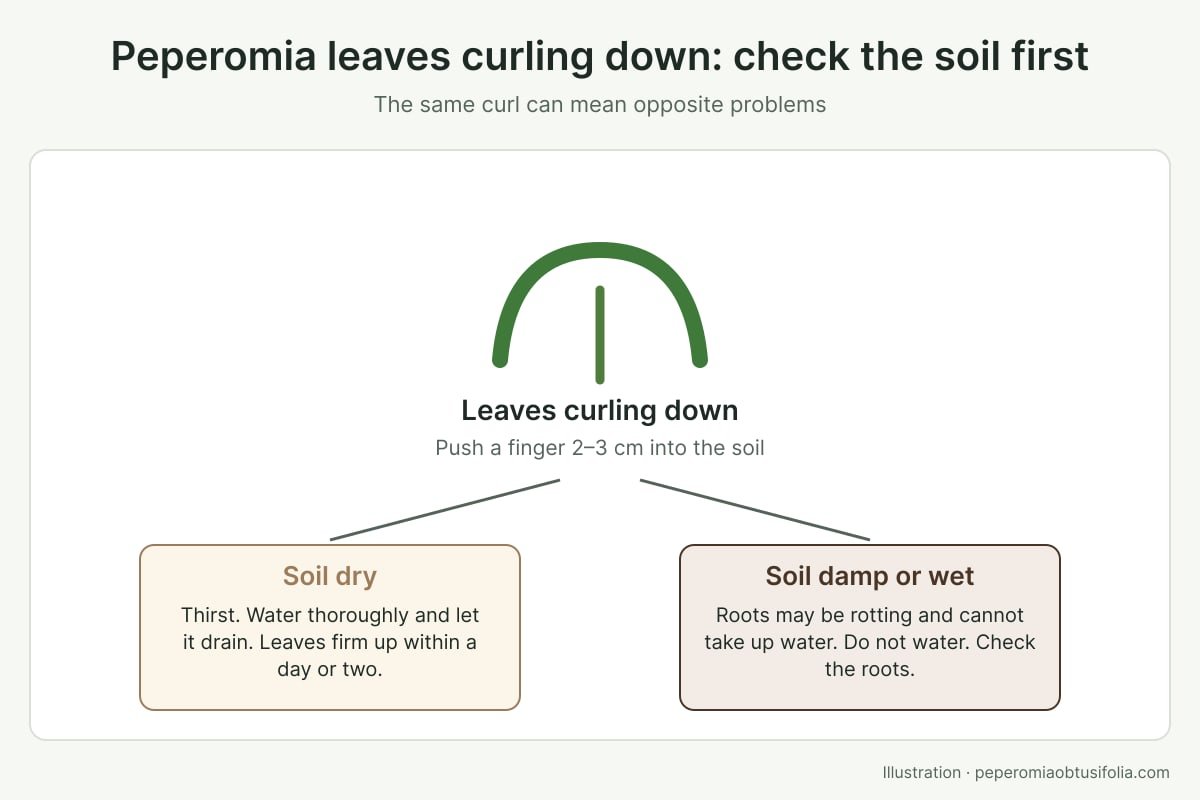
Peperomia obtusifolia leaves curl downward when internal turgor pressure fails — most often because anoxic roots can no longer pump water to the leaf, not because the plant is thirsty. The thick, semi-succulent tissue of P. obtusifolia is heavy. Without the hydraulic pressure that keeps it inflated, the lamina sags downward under its own weight in the shape growers describe as the "claw." A second, structurally different downward curl — a rigid, dome-like bowing — signals chronic light deficit. A third, sharp, firm hook signals nutrient toxicity. Each direction maps to a different mechanism, and adding water to the wrong cause accelerates the failure.
This guide takes the downward axis specifically — the soft claw, the rigid dome, the drought roll, and the toxicity hook — and walks through the diagnostic that separates them. For curl in all directions (upward cupping, inward "taco", twisted new growth), see the complete curling-leaves diagnostic, or the full symptom index if the presentation doesn't match curling at all.
Peperomia Leaves That Curl Downward: Quick Diagnostic Table
| Curl Pattern | Leaf Texture | Substrate State | Most Likely Cause |
|---|---|---|---|
| Soft downward sag | Limp, folds easily | Wet or moist | Root rot + ethylene epinasty |
| Soft downward roll | Limp, folds easily | Bone-dry | Underwatering (turgor collapse) |
| Rigid downward dome | Firm, resists folding | Within range | Light deficit (low light) |
| Sharp downward hook | Firm, resists folding | Within range | Nutrient toxicity (over-fertilising) |
| Downward + tip browning | Variable | Wet or salty crust visible | Salt accumulation (osmotic stress) |
| Downward + asymmetric | New growth only | Within range | Vascular pest sabotage (thrips, mealybugs) |
1. The Hydraulic Mechanism: Why This Species Sags Downward
In a healthy Peperomia obtusifolia, every leaf is a small pressurised reservoir. The parenchymal storage cells of the lamina — the same semi-succulent tissue that lets the plant tolerate seasonal drought in its native Venezuelan and Colombian understorey, as documented by NC State Extension — hold water under internal hydrostatic pressure called turgor. Turgor is what keeps the leaf flat, firm, and oriented horizontally to capture light. Roots act as the pump; the petiole acts as the structural joint that holds the leaf upright against gravity.
When turgor drops, two failures compound:
- The lamina loses internal rigidity. Cell walls are no longer pressed firmly outward by the vacuole's water content. The leaf becomes pliable.
- The petiole loses its support angle. The joint where leaf meets stem can no longer hold the now-heavier-than-it-can-support lamina in a horizontal position. Gravity wins. The leaf sags downward.
This is why P. obtusifolia, with its thick succulent leaves, droops downward rather than crisping at the edges like a thin-leaved species would. The downward direction is not a defensive response — it is mechanical failure of the hydraulic structure. The cause behind the failure is what the rest of this guide diagnoses.
2. The Wet Claw: Root Rot and Ethylene Epinasty
The single most common downward-curl case is also the most counterintuitive: leaves sag as if thirsty, in a pot of wet soil.
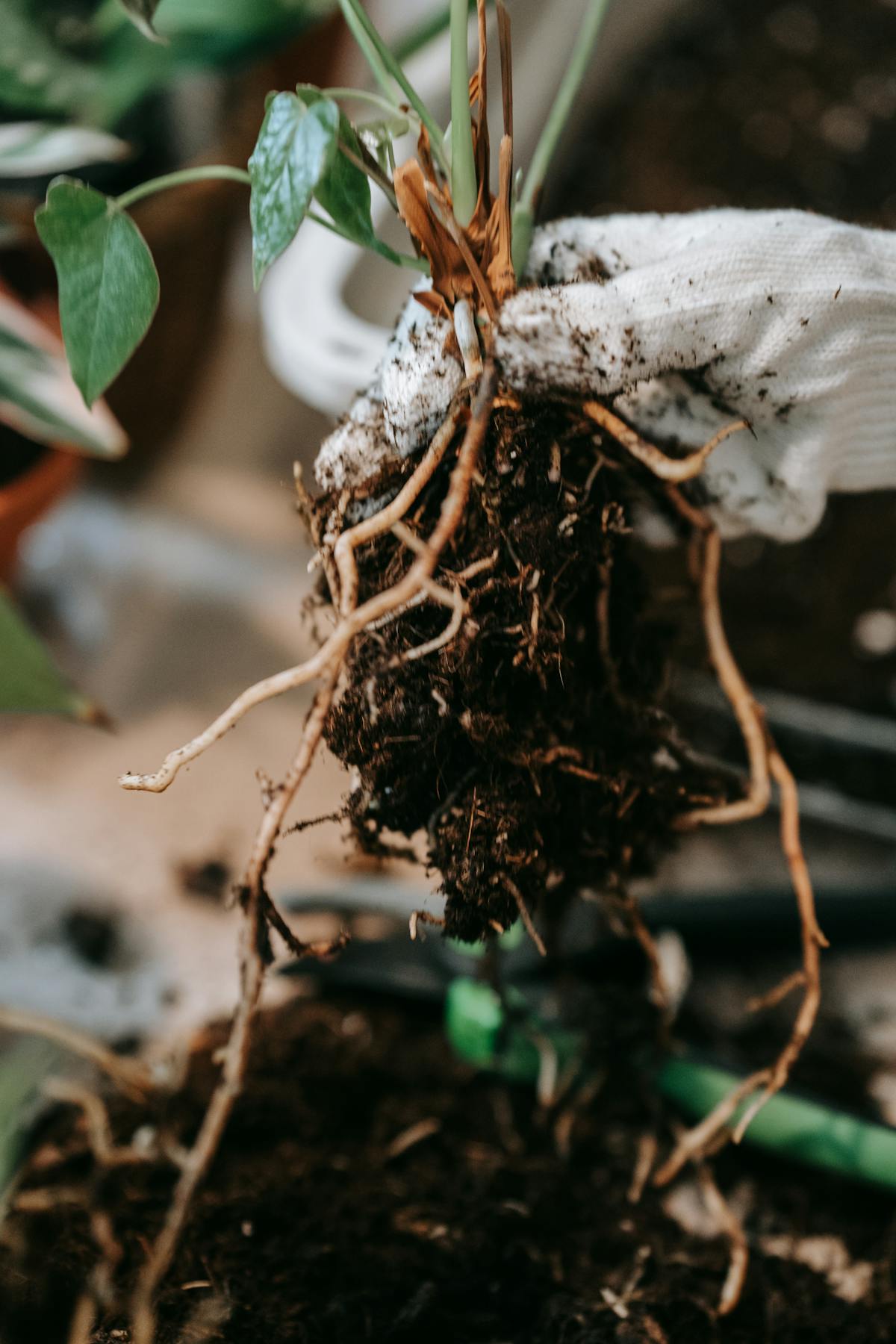
A common situation: lower-leaf yellowing that has progressed upward over weeks. The substrate is moist or wet on inspection. The plant has been watered on a fixed weekly schedule for several months. What has happened is sequential. Soil that stays wet for long periods loses its air spaces; root respiration fails; Pythium or Phytophthora colonises the anoxic root zone; functional root mass collapses from the fine root hairs inward. The plant cannot draw water even though water surrounds it.
There is a second, less-discussed layer to the downward presentation specifically. Anoxic roots release ethylene — a gaseous plant hormone — into the vascular system. Ethylene travels to the petiole, where it triggers asymmetric cell expansion: cells on the upper side of the petiole elongate faster than cells on the underside. The petiole bends downward. The phenomenon is called epinasty. It is why over-watered specimens often "claw" more dramatically downward than thirst-stressed specimens, which sag from pure turgor loss alone.
Diagnostic indicators: A sour or foul smell from the substrate; yellowing lower leaves that detach with no resistance; a soft, sometimes mushy stem base; substrate that feels wet and heavy despite the plant looking parched. The Taco Test (Section 7 below) returns pliable. If the leaves are detaching rather than just curling, the sudden leaf drop guide covers the same root-anoxia mechanism from the abscission side. A stem base that feels soft or the plant leaning under its own weight are both consistent with the same root failure — see the falling-over and weak-stems guide if support loss is the dominant symptom.
The fix: Stop watering. Unpot the plant. Trim all black, soft, or sour-smelling roots back to clean white tissue with sterilised scissors. Repot into a free-draining mix — 50% coir-based compost, 30% perlite, 20% fine orchid bark — in a container only 2–3 cm larger than the surviving root mass. Withhold water for 7–10 days. The full triage protocol is in the overwatering rescue guide.
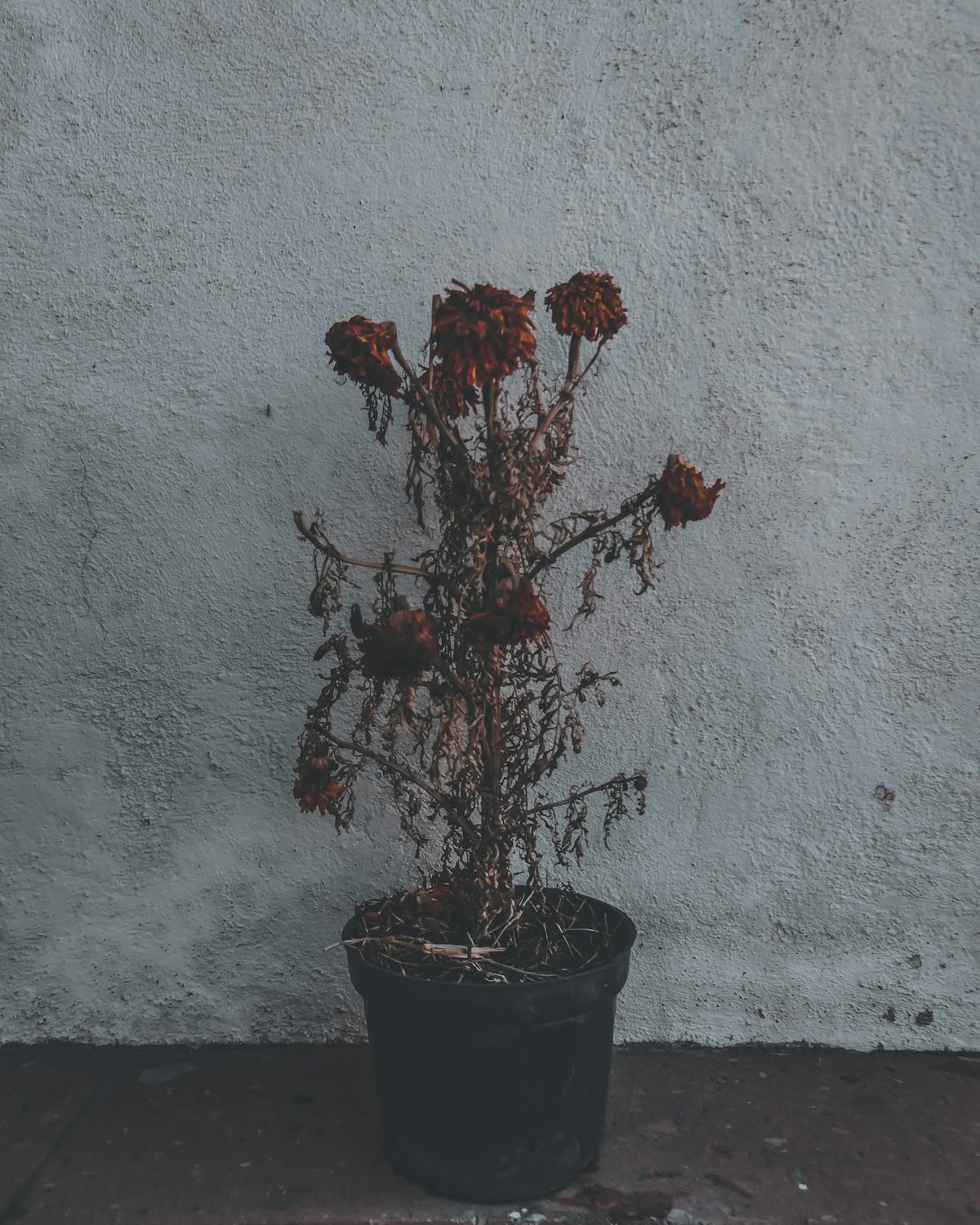
3. The Drought Roll: When the Curl Really is Thirst
When P. obtusifolia is genuinely underwatered, the downward curl looks similar to the wet claw but the substrate context inverts. The soft downward sag accompanies a bone-dry substrate, a pot that lifts noticeably lighter than usual, and no sour smell.
A complicating factor: the peat or coir component in old substrate often becomes hydrophobic after a missed watering cycle of three or more weeks. Top-watering then runs straight down the inside wall of the pot and out the drainage holes, leaving the root core entirely dry. The pot can appear "watered" from above while the root zone receives nothing.
The fix: Bottom-water — place the pot in 3–5 cm of lukewarm water for 20–30 minutes until the substrate surface darkens with moisture. Drain fully. Turgor returns within 12–24 hours; the leaves flatten. Going forward, the watering interval is every 10–14 days in summer and every 21–28 days in winter for a 12 cm container in standard indoor conditions — triggered by the top 2–3 cm of substrate fully drying, not by the calendar. The detailed protocol is in the bottom-watering guide. The same drought mechanism produces the softened, wrinkled texture covered in the wrinkled leaves guide — the two symptoms frequently appear together on the same specimen.
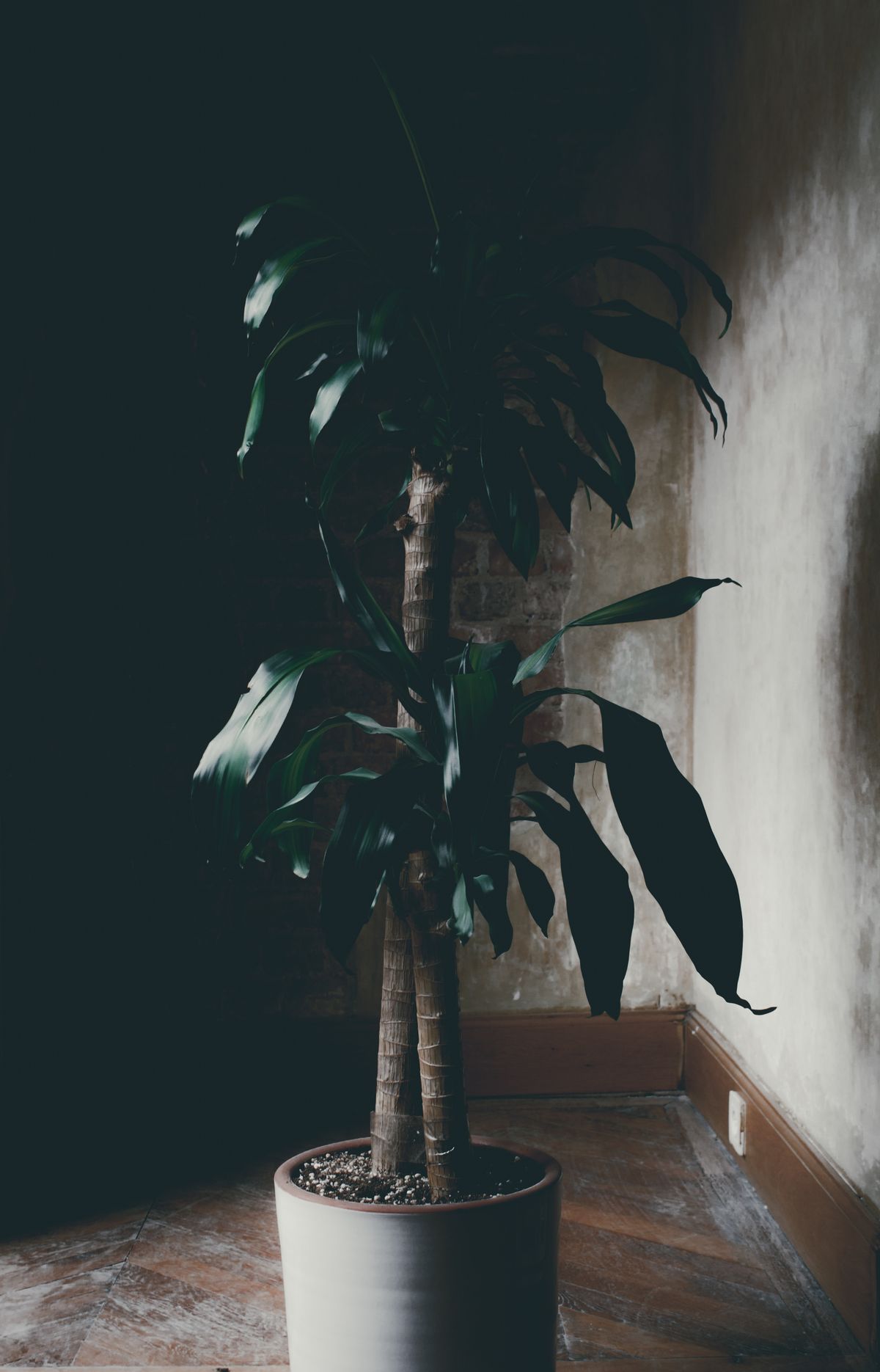
4. The Rigid Dome: Light Deficit, Not Water
Light deficit produces a downward curl that is morphologically and texturally distinct from the soft claw. The leaf is firm, dark green, and bowed downward in a rigid, dome-like shape — the lamina arches downward at the edges while the central vein remains slightly elevated. The Taco Test on a domed leaf returns firm resistance, not pliable folding.
The mechanism is photomorphogenic, not hydraulic. The site's working target for P. obtusifolia is roughly 2,000–4,000 lux measured at the leaf surface, based on UGA Extension's indoor light categories. In sustained low light, down towards the tolerated minimum of about 800 lux, the meristem responds by changing leaf morphology to maximise photon capture. Edge growth is suppressed; the centre of the leaf elongates relative to the margins; the resulting geometry is a downward dome that exposes more total surface area to overhead light than a flat leaf would. This is an irreversible adaptation in the affected tissue.
Diagnostic indicators: Curl is uniform across all leaves regardless of age. Substrate moisture is in range. No sour smell. Leaves feel firm and rigid. The pot has been in a dim corner — more than 2 m from a window, north-facing, or in a fluorescent-lit office.
The fix: Relocate to roughly 2,000–4,000 lux measured with a meter or a calibrated phone app at the leaf surface. Variegated cultivars — 'Variegata', 'Albo-Marginata', 'Alba' — need brighter light than the green form because their tissue carries less chlorophyll. In winter, when light levels drop sharply even near a window, a supplemental LED grow light positioned 30–40 cm above the canopy maintains compact form. Already-domed leaves will not flatten; the diagnostic measure of correction is the form of new growth that emerges 4–6 weeks after relocation.
5. The Firm Hook: Nutrient Toxicity and Salt Accumulation
If the downward curl presents as a sharp, hook-like curve rather than a soft sag, and the leaf retains rigidity (firm Taco Test response), the cause is chemical rather than hydraulic.
Over-fertilisation distorts the osmotic equilibrium within the leaf. Excess phosphorus or nitrogen causes upper mesophyll cells to expand faster than lower mesophyll cells, pushing the leaf tip sharply downward into a permanent hook. The leaf stays firm because turgor is intact — the curl is a structural artefact of uneven expansion, not a deflation. P. obtusifolia's correct fertiliser regime is a balanced NPK 20-20-20 at 50% of label rate, monthly during spring and summer only — never in autumn or winter, where reduced uptake produces salt accumulation rather than growth.
Salt accumulation from tap water or chronic bottom-watering produces a related but distinct presentation. Dissolved calcium, magnesium, sodium, and chloride from tap water concentrate in the upper substrate over months. As ionic concentration rises, root osmotic potential is compromised. At sufficient concentrations the gradient inverts — water moves out of root cells into the substrate rather than the other way. This is a chemical drought: the leaves wilt and curl downward despite moist substrate, and tip browning develops simultaneously. A white crust on the substrate surface or pot rim is the confirming visual sign.
The fix: Flush the substrate thoroughly with low-mineral water — distilled, filtered, or rainwater — applying 3–5× the pot volume from above over 20–30 minutes, allowing free drainage. Switch routine watering to low-mineral water where the tap supply is hard. Resume fertiliser only after 4 weeks at the corrected 50% label rate. The full leaching procedure is in the substrate flush protocol.
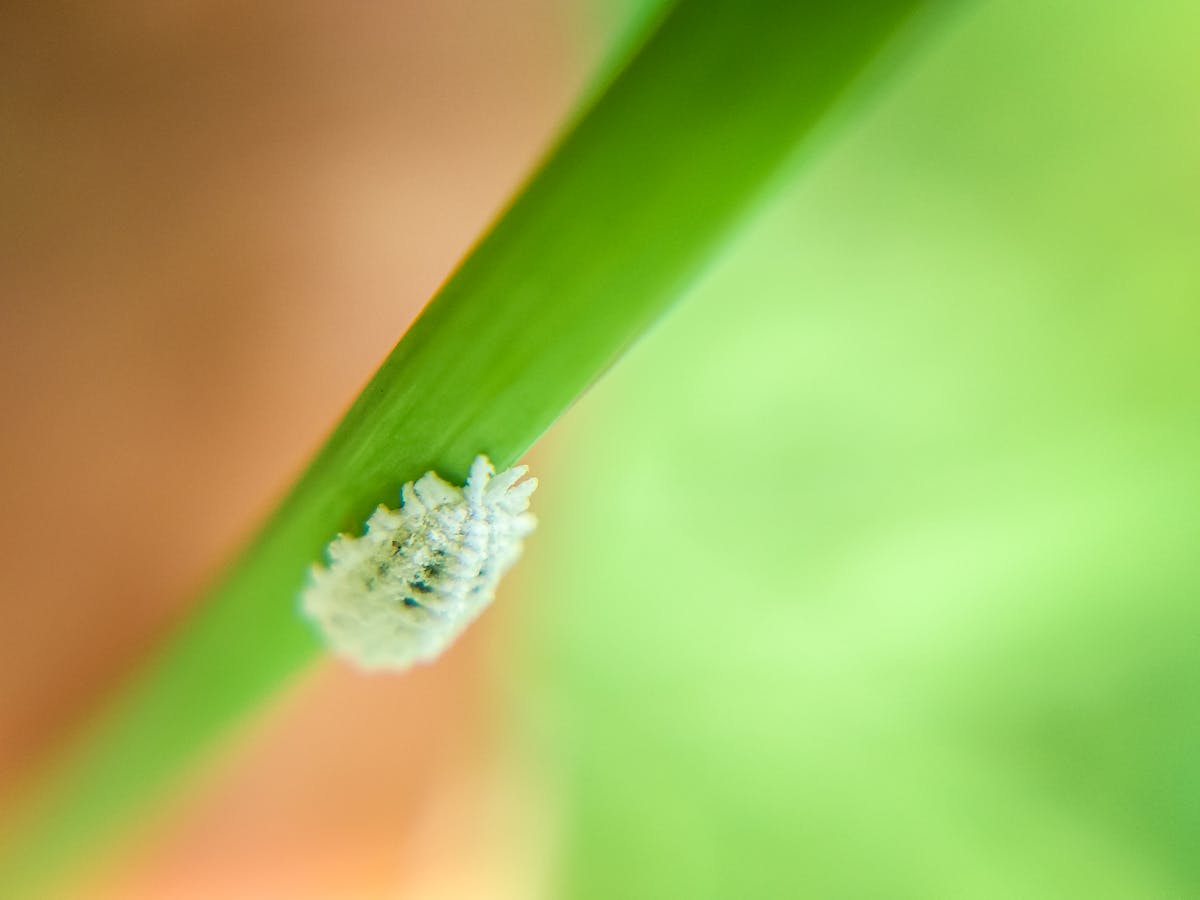
6. Vascular Sabotage: When Pests Cause Downward Curl
Heavy infestations of sap-sucking pests — mealybugs, aphids, or scale — feeding at the petiole-stem junction can produce a localised downward curl that mimics turgor failure. The mechanism is direct: these pests target the vascular bundle where the leaf joins the stem, the "highway" for water and nutrient delivery. Removing sap from the vascular tissue starves the affected leaf of water; the leaf wilts and curls downward at the feeding site while neighbouring leaves remain unaffected.
Diagnostic indicators: Downward curl is asymmetric — affecting only a subset of leaves while others remain flat. Honeydew residue (sticky, glossy droplets) is visible on the leaf surface or stem below the affected leaves. White cottony masses in leaf axils indicate mealybugs; sticky honeydew without visible insects is aphid-driven; raised brown discs on the stem are scale. The petiole at the feeding site may show physical damage on close inspection.
The fix: Isolate the plant. Wipe off mealybug colonies with a cotton swab dipped in 70% isopropyl alcohol. Apply a neem oil solution (2 ml neem per litre of water, plus a drop of mild soap as emulsifier) every 5–7 days for three treatment cycles to disrupt the pest reproductive cycle. Severely affected stems should be pruned away; the remaining cuttings can be re-rooted to start a clean specimen.
7. The Taco Test: Distinguishing Soft Curl from Structural Curl
Before reaching for the watering can in any downward-curl case, perform the Taco Test on a mature leaf. It separates the two mechanism families in ten seconds and prevents the most common fatal misdiagnosis.
- Gently fold a mature leaf between thumb and forefinger — as if closing a taco shell.
- Firm resistance, leaf will not fold: turgor is intact. The curl is structural. The cause is light deficit (Section 4) or nutrient/salt toxicity (Section 5). Watering will not help.
- Soft, pliable, folds easily: turgor has collapsed. Now read the substrate:
- Bone-dry, pot is light: drought (Section 3). Bottom-water now.
- Moist or wet, pot is heavy: root failure (Section 2). Do not water. Unpot and inspect.
The third branch is the editorial position that this site holds without softening: do not "rescue" a wilted P. obtusifolia by watering immediately. Wilting in wet substrate is root failure, not water deficit. Adding water accelerates the failure. Diagnose first; intervene only after the substrate and root state are known.
Will the Downward Curl Reverse?
Whether the leaf flattens depends on which mechanism caused it.
- Reversible within 12–24 hours: drought-driven turgor curl, once rehydrated correctly.
- Reversible over 2–4 weeks (in new growth only): light-deficit doming, once relocation to roughly
2,000–4,000 luxis in effect; ethylene-driven epinasty, once the anoxic root zone is cleared and replaced. - Permanent in affected tissue: nutrient-toxicity hooks, salt-osmotic damage (the leaf tip), pest-driven petiole damage. The leaves themselves do not un-hook or re-flatten.
The diagnostic measure of recovery in every case is the form of the new growth that emerges after the mechanism is corrected — compact internodes (1–2 cm), flat lamina, firm to the touch. That is the reference state. If new growth continues to deform, the cause was not the one corrected.
The direction and texture of the curl — not the presence of curling alone — is what separates a five-minute fix from a plant that needs unpotting today.
Care FAQ
Why are my Peperomia leaves curling downward?
Downward curling in Peperomia obtusifolia is a loss of turgor pressure within the leaf, most commonly caused by root failure from prolonged substrate saturation. The roots can no longer pump water to the leaves; the heavy, succulent tissue sags downward under its own weight. Underwatering produces a similar but distinct soft downward roll. The substrate moisture reading distinguishes the two — wet substrate plus drooping leaves equals root rot, not thirst.
How do you fix curling-down leaves on a Peperomia?
First perform the Taco Test — gently fold a mature leaf between thumb and forefinger. If the leaf is firm and the curl is rigid, the cause is light deficit (move to roughly 2,000–4,000 lux) or nutrient toxicity (flush the substrate). If the leaf is soft, check substrate moisture: bone-dry means bottom-water for 20–30 minutes; wet means unpot, trim rotted roots, and repot into a free-draining mix with 30% perlite.
Why do overwatered Peperomia leaves droop and curl down?
Soil that stays wet for long periods fills the air spaces the roots need. Root respiration fails and root rots such as Pythium or Phytophthora take hold (University of Illinois RPD 653). Without functional roots the plant cannot pump water, and the thick succulent leaves sag downward. Anoxic roots also release ethylene gas, which travels to the petiole and triggers epinasty — a hormonal downward bending of the leaf joint that compounds the visible claw.
Will downward-curled leaves recover?
Turgor-based downward curl from underwatering reverses within 12–24 hours of rehydration. Light-deficit doming reverses only in new growth after relocation to roughly 2,000–4,000 lux — already-domed leaves remain domed. Pest-damaged tissue is permanent. The diagnostic measure of recovery is the form of new leaves, not the old ones.
How do I tell underwatering from overwatering when leaves curl down?
The substrate decides. Wilted, soft leaves with substrate that is dry beyond the top 2–3 cm and a pot that lifts unusually light is drought — rehydrate. Wilted, soft leaves with substrate that feels wet or moist and a pot that lifts heavy is root failure — stop watering and unpot. Adding water to a root-rot case accelerates the collapse.
What is the "claw" position in Peperomia leaves?
The claw is a downward, hook-like leaf curl with two distinct forms. The soft claw is anoxic root failure with ethylene-mediated epinasty — the leaf is limp and sags. The firm claw is nutrient toxicity from over-fertilisation — the leaf retains rigidity but hooks downward as cells expand unevenly. The texture of the leaf (soft vs firm) is the diagnostic signal.
Can salt build-up cause downward curling?
Yes. Tap water and fertiliser leave behind chloride, sodium, calcium and magnesium salts that accumulate in the upper substrate, especially in chronically bottom-watered specimens. As ionic concentration rises, root osmotic potential reverses — water moves out of root cells rather than in. This produces a chemical drought that mimics overwatering: wilting and downward curl despite moist substrate.