
How Long to Callus Peperomia Cuttings? 3 Safe Rules
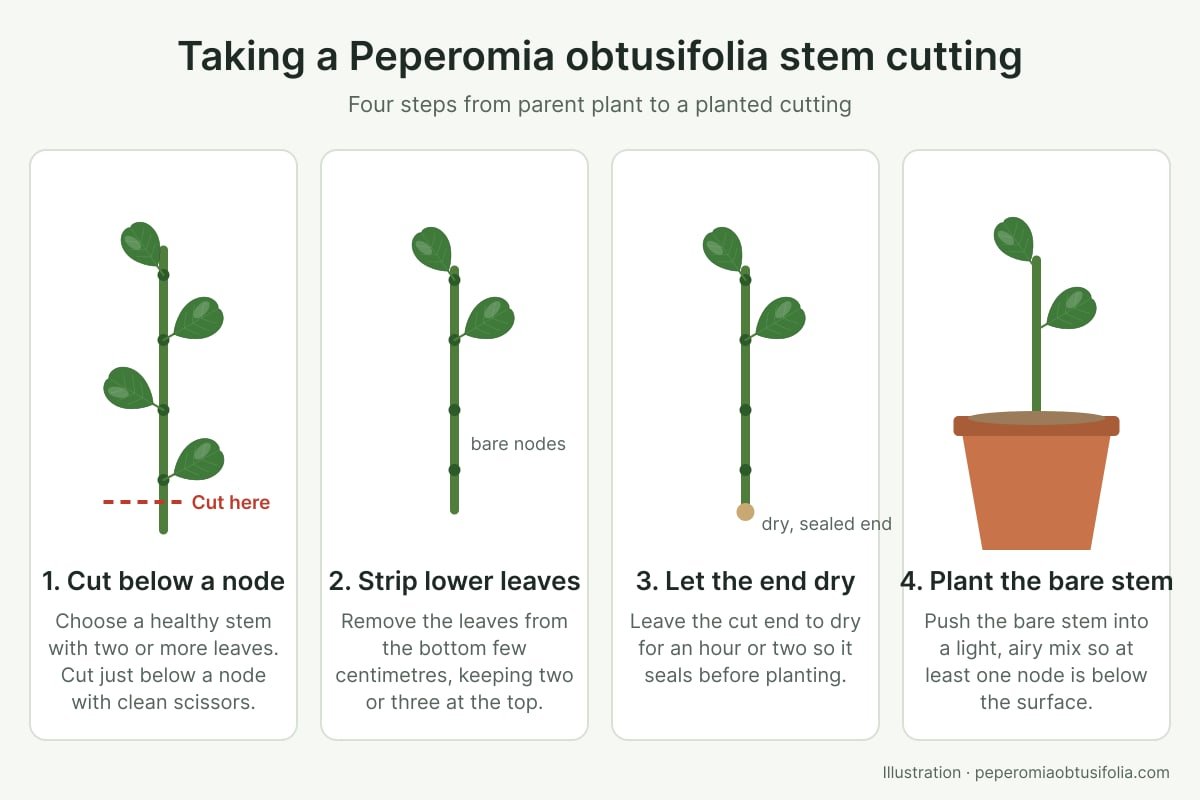
How long to callus peperomia cuttings? For Peperomia obtusifolia, air-dry stem cuttings 24–48 hours before soil or organic mixes, and typically overnight (~12–24 hours) before water or highly aerated inorganic media, until the cut end feels dry, matte, and slightly toughened. That window is wound sealing (suberin deposition and surface drying) — not a full rooting phase.
Full rooting methods live in the stem-cutting guide, water propagation, and rot troubleshooting — or see the complete propagation guide for how all four methods compare. This article is callus timing and readiness only.
| Destination medium | Typical air-dry | Ready when |
|---|---|---|
| Soil / peat–coir mixes | 24–48 h | Dry, matte, not sticky |
| Perlite / pumice | 12–24 h | Same texture test |
| Water | ~12–24 h (overnight preferred) | Cork-like seal; leaves still firm |
1. How Long to Callus Peperomia Cuttings: What “Callus” Means Here
A fresh cut opens xylem and phloem. P. obtusifolia stems hold substantial water in parenchyma, so an open wound stays wet longer than a woody cutting and offers an easy colonisation path for opportunistic organisms in damp media (plant propagation overview; species context: NC State).
Suberization deposits suberin — a hydrophobic biopolymer — in wound-adjacent cells while the surface dries. Growers call the result a callus or “corky seal.” It is a thin protective layer, not a white tumour of undifferentiated tissue. You are waiting for a sealed cut face, not for roots.
2. Three Safe Rules for Callus Timing
Rule 1 — Match time to medium risk. Organic, moisture-holding mixes need the longer 24–48 h window. Clean water and open inorganic media tolerate the shorter overnight band because oxygen and lower pathogen load reduce, but do not erase, risk. Site water protocol still prefers a full dry overnight before immersion (water method).
Rule 2 — Judge the cut end, not the calendar. Ready: dry, matte, slightly toughened, no free moisture when pressed lightly on paper. Not ready: glossy, sticky, or wet green. Over-ready: leaves soft and shrivelled from multi-day desiccation — pot or jar immediately and raise humidity slightly after sealing.
Rule 3 — Airflow without direct sun. Place cuttings on a clean paper towel in bright indirect light with gentle air movement. Direct sun cooks the open face; stagnant high RH (>~70%) slows surface drying and can push timing toward 48–72 h.
3. Humidity, Temperature, and Why Speeds Differ
| Condition | Effect on seal speed | Practical note |
|---|---|---|
| RH below about 40% | Faster surface dry | Watch leaf wilt; do not exceed readiness |
| RH about 40–60% | Typical indoor timing | Default table above |
| RH above about 70% | Slower | Add gentle airflow; extend toward 48 h+ |
| Cool room (<18 °C) | Slower metabolism + dry | Still use texture test |
| Warm room (22–25 °C) | Faster metabolism | Still avoid direct sun on the wound |
Semi-succulent stems desiccate from leaves while the base seals. If lamina soften before the cut looks corky, shorten the wait slightly and move into a lightly moist, highly aerated medium rather than forcing another day of open-air drying. Batches of cuttings taken at the same time from the same parent plant do not always seal at identical speed, since stem thickness and how recently the parent was watered both shift the timeline slightly — check each cutting individually rather than moving the whole batch on the same schedule.
Common timing errors. Sticking a wet cut straight into peat-heavy mix is the primary rot pathway. Leaving cuttings on a windowsill in full sun for “faster callus” scorches the wound. Sealing for four or five days “to be safe” in dry heated air trades pathogen risk for desiccation failure — once the end passes the matte test, proceed.
4. Extra: Stem vs Leaf, and What Callusing Does Not Fix
Stem cuttings (node included) follow the table above. Leaf cuttings with petiole still need a dry petiole seal — usually overnight to ~24 h — before moist medium; method and timelines belong in leaf propagation. Leaf cuttings of variegated forms give all-green plants regardless of callus quality (UF/IFAS) (variegated leaf guide).
Opinion: Callusing is wound management, not a substitute for an aerated medium. A perfectly sealed cutting still fails in chronically wet, oxygen-poor mix — fix substrate and watering after the seal (soil mix; rot patterns: cuttings rotting).
Optional antifungal dust (e.g. cinnamon) may reduce surface microbes; it does not replace air-drying, and P. obtusifolia roots readily without hormone for routine work (RHS species profile; Missouri Botanical Garden).
If cutting-based propagation keeps producing rot or stalled nodes despite correct callusing, dividing a mature multi-stem specimen is worth considering as an alternative — each division already carries established roots and skips the callus-and-root sequence entirely.
Conclusion
How long to callus peperomia cuttings? Use 24–48 hours before soil, about 12–24 hours overnight before water or open inorganic media, and always confirm a dry, matte cut end. Then root by your chosen method. The seal closes an open vascular entry path for pathogens; it does not create roots on its own — and over-drying past readiness costs the cutting more than it gains.
Care FAQ
How long should I let Peperomia cuttings callus?
For soil or organic mixes, air-dry 24–48 hours until the cut end is dry and matte. For water or highly aerated perlite/pumice, an overnight window of about 12–24 hours is the usual site protocol. Judge readiness by texture, not the clock alone.
What is a callus on a plant cutting?
A callus here means wound-sealing tissue formed as the cut surface dries and deposits suberin — a waxy, hydrophobic polymer — plus corky cells. The sealed end resists rapid waterlogging of open xylem and reduces an easy entry path for rot organisms.
Can I propagate Peperomia without callusing?
Yes, especially in clean water or sterile, highly aerated media, but soil and peat-heavy mixes raise rot risk when the wound is still wet and open. Skipping the air-dry step is the most common preventable failure mode for semi-succulent stems.
Should I callus Peperomia leaf cuttings?
Yes. Petiole wounds still need a dry seal — typically at least overnight, often toward 24 hours — before they sit in moist medium. Leaf method detail and variegation limits belong in the leaf-propagation and variegated-leaf guides.
Can I callus Peperomia cuttings too long?
Yes. Multi-day air-drying in low humidity can shrivel leaves and deplete stored water before roots form. Once the cut end is dry, matte, and slightly toughened, move to the rooting medium.
Do water-propagated Peperomia cuttings need callusing?
A short seal still helps. Site water-propagation protocol uses about 24 hours on a dry surface before the stem touches water, so the end feels cork-like rather than wet and sticky.