
Powdery Mildew on Peperomia: 4 Proven Steps
Powdery mildew on Peperomia obtusifolia is a dry, flour-like white fungal coat that wipes off the leaf but returns if the underlying infection and room conditions aren't addressed. The first containment step is isolating the plant from others immediately, since the fungus spreads by airborne spores — confirm the identification with a simple wipe test before treating, since several unrelated problems produce a similar white appearance.
Identification Checklist
- Texture: dry and dusty, like a light dusting of flour, not sticky or cottony.
- Pattern: starts as discrete circular white-to-grey patches, often on the upper leaf surface first, and expands into a continuous coat if untreated.
- Wipe test: a light rub with a dry finger or cloth smears the powder away, though it returns within days if the infection underneath is still active.
- Where to inspect: upper and lower leaf surfaces, stems, and especially leaf axils, where airflow is weakest and outbreaks establish first.
- Progression: yellowing and distorted new growth follow chronic, heavy coverage, since haustoria embedded in the leaf tissue extract sugars continuously.
Lookalikes to Rule Out First
| Clue | Powdery mildew | Lookalike |
|---|---|---|
| Texture | Dry, dusty, flour-like | Mealybugs: cottony and sticky |
| Wipe response | Smears off; returns if infection is active | Oedema: hard, corky scarring that will not wipe off |
| Location pattern | Leaf surface, spreads via air | Mineral crust: chalky, concentrated at leaf tips and margins |
| Substrate involvement | Leaf-only; soil unaffected | Soil surface mould: white fuzz confined to the mix, a different organism entirely |
If the white material is on the substrate surface rather than the leaves, that is a separate saprophyte living on damp organic matter, not powdery mildew — see the mould on leaves vs soil guide for that distinction, and the white spots guide for the fuller differential against oedema, cystoliths, and pests.
Isolate and Clean the Plant
Move the affected plant away from other houseplants immediately — spores travel on air currents and on tools, and a nearby plant can pick up the infection within days in a still room. Wipe pruning shears with 70% isopropyl alcohol between every cut, and between plants if working on more than one specimen. Bag and dispose of heavily coated leaves rather than composting them indoors, where spores simply recirculate into the room air.
Treatment Ladder
Step 1 — Mechanical removal first. Prune away any leaf more than roughly half-coated; this is the least disruptive step and removes the bulk of active spore production immediately.
Step 2 — Mix and patch-test a bicarbonate spray. In 1 litre of water, dissolve approximately 1 teaspoon of potassium bicarbonate plus a few drops of a mild Castile or insecticidal soap as a surfactant, so the mix actually wets this species' waxy cuticle rather than beading off. Spray a single lower leaf and wait 24 hours to check for leaf burn before treating the whole plant.
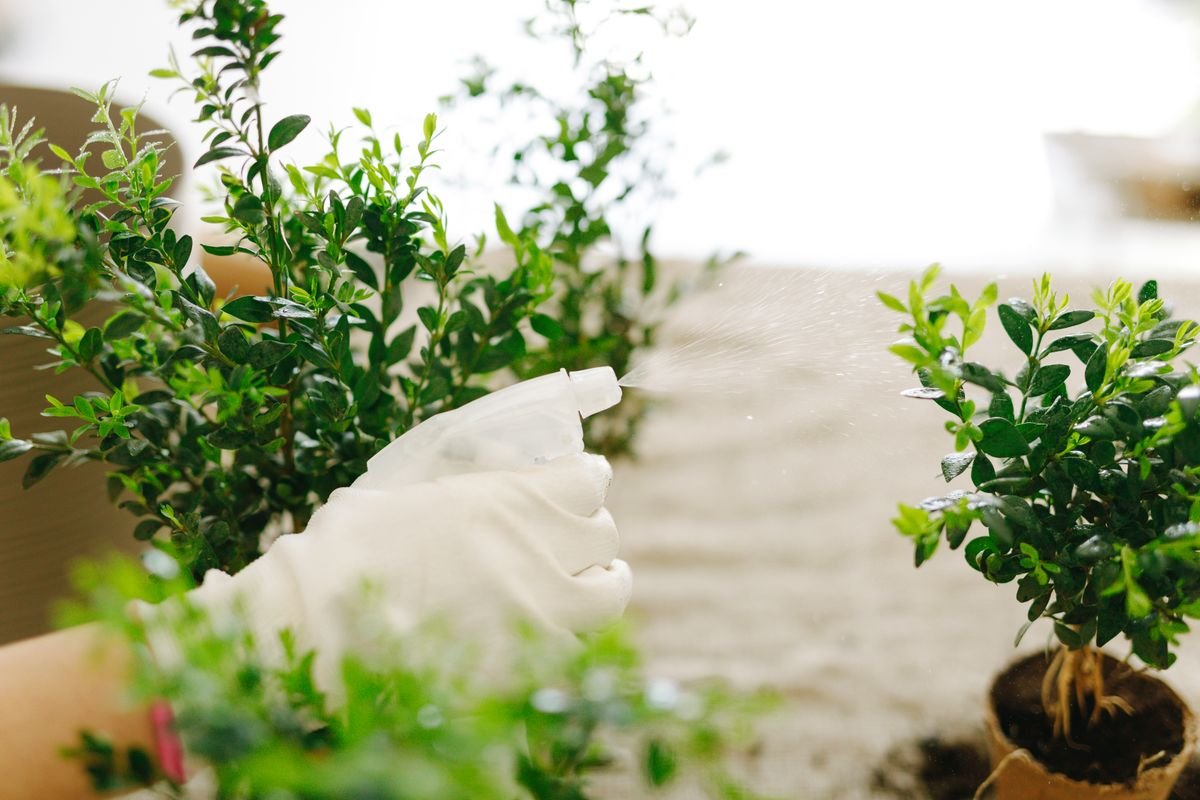
Step 3 — Full coverage, repeated weekly. Wet both leaf surfaces and the stems — contact with the fungus is what stresses it, so partial coverage leaves untreated patches to reinfect the rest of the plant. Repeat every 5-7 days until new growth stays clean for a full two weeks. Spray in shade rather than direct sun, since a wet, alkaline film under strong light raises the risk of leaf burn.
Step 4 — Correct the room. Space plants apart, add gentle airflow, and water the substrate rather than the canopy — misting is unnecessary and counterproductive here, as covered in the humidity guide's misting section. Hold humidity in the 40-60% optimum band without stagnant pockets, since fungal risk rises with still air above roughly 75% RH; see the humidity guide. Cut back high-nitrogen feeding that produces soft, mildew-prone new growth, and raise usable light toward the 2,000-4,000 lux optimum, since a shaded, crowded shelf is exactly the microclimate this fungus favours.
When to Discard, Prune, or Repot
Prune and keep treating if coverage is patchy and the crown and growing tip remain clean — this is the great majority of cases, and the plant recovers fully once the environment is corrected. Escalate to a labelled fungicide (see below) if two full weeks of the bicarbonate protocol haven't stopped new coverage from appearing. Consider discarding only if nearly every leaf is coated and the crown itself is collapsing or has stopped producing clean new growth — at that point, the plant is no longer a good candidate for recovery, and keeping it risks reinfecting other specimens nearby. Repotting has no role in treating powdery mildew specifically, since the infection is a leaf-surface and airborne issue, not a root or substrate problem.
When Bicarbonate Is Not Enough
For a valuable specimen where the cultural fix and bicarbonate spray haven't resolved the outbreak after a full treatment cycle, a labelled indoor fungicide — including some sulfur-based or systemic products where available — is the appropriate next step. Follow the product label exactly rather than guessing at concentration, and keep treated plants out of hot direct sun afterward. Dilute milk sprays and labelled neem or horticultural oil appear in general houseplant practice as secondary options; patch-test any of these on P. obtusifolia first, since oils and stronger mixes can mark the waxy cuticle on this species' thicker leaves.
Prevention and Monitoring
Quarantine new plants for 2-3 weeks before introducing them to an existing collection, and inspect leaf axils specifically during that period, since airflow is weakest there and outbreaks establish before they're visible elsewhere on the plant. Keep humidity in the 40-60% band with active airflow rather than a still, shaded corner — a gentle fan is enough to break up the stagnant air this fungus favours. Avoid heavy nitrogen feeding, which produces the soft, fast new growth most susceptible to infection; see the fertiliser guide for the correct feeding rate. Recheck weekly during treatment and continue monitoring monthly afterward, since a recovered plant returned to the same crowded, still shelf commonly relapses within weeks.
Safety Notes
Always follow the product label on any fungicide, including how long to keep pets away from treated foliage and the recommended re-entry interval. Wear gloves when mixing concentrated products, and avoid skin or eye contact with bicarbonate solutions, oils, or labelled fungicides alike. Never mix a fungicide with another pesticide or fertiliser unless the label explicitly permits it — unlabelled tank mixes can cause leaf burn or unpredictable chemical reactions. For pest problems that sometimes coexist with a mildew outbreak in the same crowded conditions, see the dedicated guides for mealybugs, aphids, and thrips, and the complete problems guide for the full diagnostic reference across all symptom types.
Sources
Mechanism and treatment guidance are consistent with UC IPM, the RHS, and Missouri Botanical Garden guidance on indoor powdery mildew management.
Care FAQ
What is the white powder on my Peperomia leaves?
Most often powdery mildew (Erysiphales): a dry, flour-like coat that wipes off but returns if untreated. Confirm with a wipe test — mealybugs are cottony and sticky rather than dry and dusty; oedema scars are hard, corky, and will not wipe off at all; mineral crust is chalky and concentrated near leaf tips.
Does powdery mildew need wet leaves to grow?
Usually no. Spores germinate on dry leaf surfaces when air is stagnant, which is why overhead misting is not the trigger and why improving airflow matters more than simply keeping foliage dry.
How does potassium bicarbonate stop powdery mildew?
It raises leaf-surface pH and stresses fungal cells on contact. Potassium bicarbonate is preferred over sodium bicarbonate (baking soda) for repeated spraying, since baking soda leaves sodium residue behind with each application, adding salt stress this species is already sensitive to.
Will powdery mildew kill my Peperomia obtusifolia?
Rarely quickly. It drains sugars through haustoria embedded in the leaf, causes yellowing, and spreads by airborne spores, but severe cover combined with stagnant air is what collapses a plant's vigour over time — isolating the plant early and correcting the room prevents that outcome.