Peperomia vs Hoya: Care, Growth and Key Differences
Peperomia obtusifolia and Hoya are routinely sold as interchangeable "easy waxy-leaved" windowsill plants, but they are unrelated species from different plant families, and the resemblance is convergent evolution rather than shared biology. Care overlaps substantially in substrate and watering, but breaks down on light ceiling, growth habit, and what it takes to get each one to flower — choose P. obtusifolia for a compact, forgiving foliage plant, and Hoya if you want a trailing or climbing specimen and are willing to meet its higher light demand to see it bloom.
Side-by-Side Comparison
| Factor | Peperomia obtusifolia | Hoya (e.g. H. carnosa) |
|---|---|---|
| Family | Piperaceae (pepper family) | Apocynaceae (dogbane family) |
| Growth habit | Upright, compact, semi-succulent | Trailing or climbing vine |
| Leaf arrangement | Alternate (one per node) | Opposite (two per node) |
| Sap | Clear and watery | White, sticky latex |
| Light for healthy foliage | 2,000-4,000 lux | Similar range, tolerates brighter |
| Light needed to flower | Not a factor — flowers regardless | Meaningfully brighter than its foliage minimum |
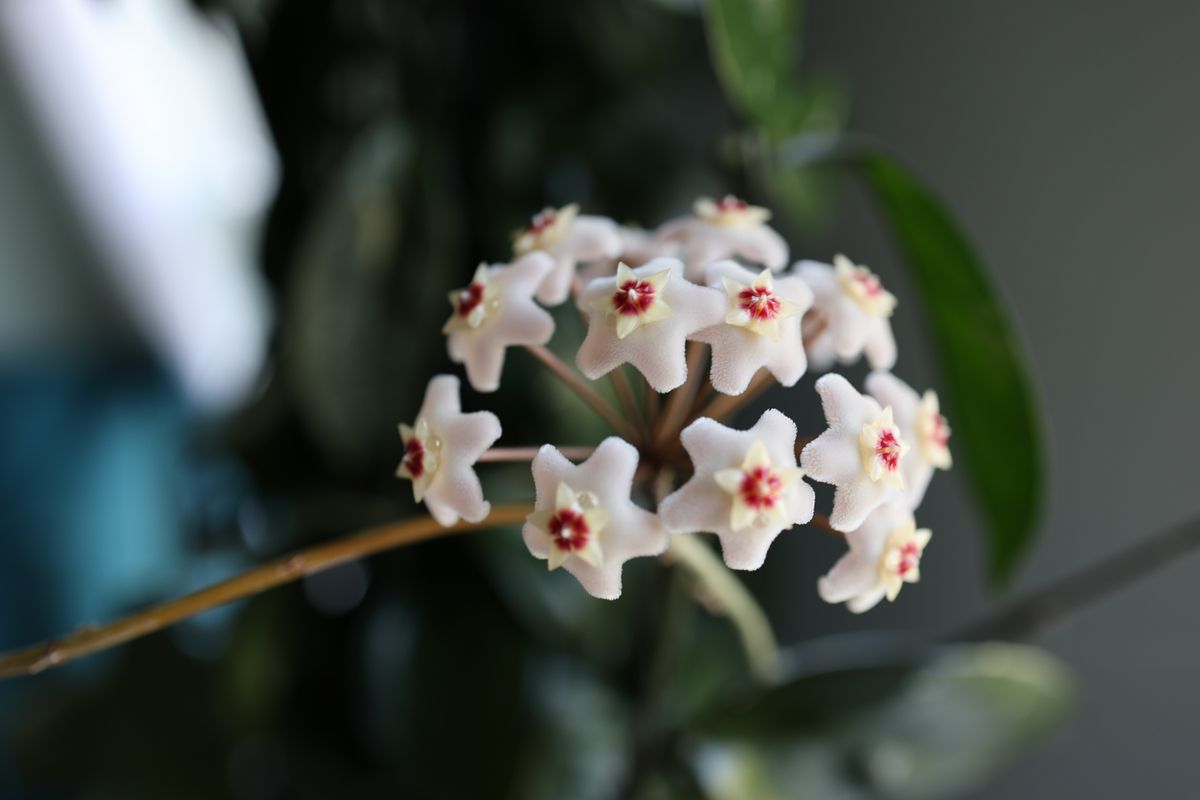
| Flower type | Spadix — unscented spike, no petals | Umbel — clustered, waxy, often fragrant |
| Toxicity (ASPCA) | Non-toxic to cats, dogs, horses | Non-toxic to cats and dogs; latex can irritate skin |
| Substrate | Free-draining, coir/perlite/bark based | Similar free-draining mix, slightly chunkier |
| Watering | Top 2-3 cm dry before rewatering | Similar dry-down cycle |
| Support needed | None | Benefits from a pole, trellis, or hanging position |
How to Tell Them Apart
Four checks settle the identification in under a minute, useful both at the nursery and for an already-owned plant with an uncertain label.
- Leaf arrangement. P. obtusifolia leaves are alternate — one per node, spiralling up the stem. Hoya leaves are opposite — two per node, directly across from each other.
- Growth habit. P. obtusifolia grows as a compact, upright cluster of thick stems from the base. Hoya produces long, thin, trailing or climbing stems that will hang over a pot's edge or climb a support if given one.
- Sap test. Nick a stem in a discreet spot. P. obtusifolia releases clear, watery sap. Hoya releases white, sticky latex within seconds.
- Flower structure, if present. P. obtusifolia produces a leafless, cream-white spadix spike. Hoya produces a rounded umbel cluster of small, waxy, star-shaped flowers, often fragrant.
The sap test is the fastest single check — there is no case where Peperomia produces latex or Hoya does not.
Care Differences That Actually Change the Outcome
Substrate, watering rhythm, temperature, and humidity preferences overlap closely enough between the two that repeating them in full would just be two care guides pasted together — both want a free-draining, low-organic mix, a thorough dry-down between waterings, 18-24°C, and 40-60% RH, and both are vulnerable to root anoxia in substrate kept wet for more than about a week. The differences that actually change what you do are narrower:
- Light ceiling and flowering threshold. P. obtusifolia produces its spadix regardless of light level, so there is no flowering-specific light target to hit — the
2,000-4,000 luxfoliage optimum is the only number that matters. Hoya foliage tolerates a similar or brighter range, but flowering specifically requires meaningfully more light than bare survival does — a Hoya kept at the low end of its tolerated range will stay healthy but rarely bloom. - Growth habit and support. P. obtusifolia needs no support and stays a compact, self-supporting cluster. Hoya is a natural climber and trailer; left unsupported it will simply hang, which is a legitimate display choice but not the plant reaching its full growth potential the way a trellis or pole allows.
- Peduncle handling. Hoya flowers emerge from a persistent woody spur (peduncle) that produces further blooms in later seasons — removing it after a flowering cycle sacrifices future flowers from that point. P. obtusifolia's spadix has no equivalent structure and can be removed cleanly with no consequence for future flowering.
- Sap handling during pruning. Hoya's latex is a mild skin irritant for sensitive individuals, worth a wipe-down after propagation work. P. obtusifolia's clear sap has no comparable irritation history.
Which Is Easier for a Specific Home
- Low or moderate light, no direct sun: P. obtusifolia is the safer choice — it completes its full life cycle, including flowering, without needing the brighter conditions Hoya wants to bloom.
- Bright windowsill with some direct sun available: Either works, but this is where Hoya can actually reach its flowering potential.
- Small, fixed display space: P. obtusifolia's compact, non-vining habit suits a shelf or small pot far better than a Hoya, which will eventually trail or need a climbing support.
- Households with pets that chew plants: Both are ASPCA non-toxic, but Hoya's latex is a mild irritant on contact — P. obtusifolia's clear sap is the cleaner option for a household with a persistent chewer.
- Frequent travel or inconsistent watering: P. obtusifolia's water-storing semi-succulent tissue tolerates a missed watering cycle comfortably; Hoya is similarly forgiving on drought but more likely to drop developing flower buds under stress.
Common Misidentification and Buying Mistakes
- Assuming "waxy leaves" alone confirms either species — glossiness is convergent and shared with several unrelated genera, not a reliable identifier on its own.
- Buying a non-flowering Hoya expecting blooms without checking the light situation at home — a plant that never sees enough light to flower is not necessarily unhealthy, just under-lit for that specific goal.
- Removing a Hoya's spent peduncle out of tidiness, not realising it sacrifices the next bloom cycle from that spot.
- Assuming both species want identical pot support — potting a Hoya as though it were a self-supporting upright plant like P. obtusifolia wastes its natural climbing or trailing habit.
Final Decision Guide
Choose Peperomia obtusifolia if you want a compact, upright plant that stays a consistent size, tolerates a wider range of indoor light without a flowering threshold to chase, and you'd rather avoid latex sap entirely.
Choose Hoya if you want a trailing or climbing specimen, have a genuinely bright spot (including some direct sun) available, and flowering is part of the appeal — and you're willing to leave spent peduncles in place between bloom cycles.
Choose both if your room has a range of light levels — Hoya in the brightest spot, P. obtusifolia a metre or two back in the softer light — which mirrors how epiphytic plants naturally partition a shared space by height and light rather than competing for the same position.
For the comparable mix-up with a completely different plant, see the Baby Rubber Plant vs Rubber Tree comparison; for verifying P. obtusifolia's own identity independent of this comparison, see the identification guide. Readers comparing houseplants specifically for claimed air-quality benefits should see the air purification myths guide rather than assuming either species offers a meaningful effect, and those weighing a humidifier purchase for either plant should see the humidifier comparison.
Care FAQ
Are Peperomia and Hoya the same plant?
No. Peperomia obtusifolia belongs to Piperaceae (the pepper family); Hoya belongs to Apocynaceae (the dogbane family) — different orders entirely. Their shared thick, glossy, semi-succulent leaf is convergent evolution, the same independent solution to bright, humid understorey conditions, not a sign of shared ancestry.
Which is easier to care for, Peperomia or Hoya?
Peperomia obtusifolia is generally easier for a beginner: it tolerates a wider light range for healthy foliage and has no flowering-specific light threshold to hit. Hoya is more demanding only if flowering is the goal — it needs meaningfully brighter light to bloom than it does to simply survive, and its trailing growth habit needs more deliberate placement.
What is the main difference in how they flower?
Peperomia obtusifolia produces a spadix — an unscented, petal-less, cream-white spike carrying many microscopic flowers. Hoya produces an umbel — a clustered dome of small, waxy, star-shaped, often fragrant flowers. The two structures reflect each species' own family lineage rather than a shared flowering strategy.
Is Hoya toxic to cats and dogs?
No — the ASPCA lists Hoya (wax plant) as non-toxic to cats and dogs, the same non-toxic status Peperomia obtusifolia carries. The practical difference is Hoya's latex sap, which can cause mild skin irritation on contact even though it is not classified as toxic on ingestion; Peperomia's sap is clear and has no comparable irritant history.