Peperomia Fertiliser Burn: Symptoms, the Salt Mechanism & Soil-Flush Fix

Fertiliser burn (US spelling fertilizer burn; the URL of this article retains the US form for search continuity) is not a feeding deficit — it is the opposite. It is osmotic injury caused by too much dissolved salt in the substrate. Peperomia obtusifolia is a slow-growing, semi-succulent epiphyte with a fine, shallow root system; it is a light feeder by adaptation, and it is correspondingly susceptible to the chemical injury that follows over-application.
The short answer: Fertiliser burn presents as crispy, sharp-bordered brown leaf margins, systemic yellowing, and a hard white or tan salt crust on the substrate surface. It happens because concentrated fertiliser salt reverses the osmotic gradient at the root — water is pulled out of the root cells rather than in (reverse osmosis and plasmolysis). To fix it, leach the salt out with a 5-minute soil flush of 3–5 pot-volumes of low-mineral water, trim the necrotic tissue, and withhold all fertiliser for 6 weeks. The pot can feel heavy and wet while the plant is dehydrating from the inside.
For the foundational feeding framework, see the fertiliser guide.
Diagnostic Table: Fertiliser Burn vs Its Look-Alikes
The decisive discriminator is the salt crust plus the sharp margin border — no other cause produces both.
| Feature | Fertiliser burn | Underwatering | Humidity-deficit tips | Bacterial leaf spot |
|---|---|---|---|---|
| Margin texture | Crispy, sharp-bordered, often yellow halo | Soft, wrinkled, whole-leaf curl | Crispy, crumbly, gradual | Soft, water-soaked → necrotic |
| Substrate state | Often moist | Bone-dry, light pot | Variable | Variable |
| Salt crust on soil/rim | Yes — white or tan | No | No | No |
| Onset | Days after feeding | Over weeks of neglect | Slow, winter-correlated | Spreads in days |
| Roots | Dark, limp, shrivelled | Intact, dry | Intact | Intact unless rot follows |
| Spreads after correction | No | No | No | Yes |
1. The Mechanism: Reverse Osmosis and Plasmolysis
Synthetic liquid and granular fertilisers are concentrated mineral salts — nitrogen, phosphorus, potassium, plus carrier ions. At the correct dosage, these dissolve in the substrate water at a concentration lower than the concentration of dissolved solutes inside the root cells. Water therefore moves by osmosis from the dilute substrate into the more-concentrated root cells. This is normal uptake.
Over-application inverts the gradient. When the salt concentration in the substrate rises above the concentration inside the root cells, the substrate becomes hypertonic. Water now moves the wrong way — out of the root cells, into the substrate. Inside each root cell, the loss of water causes the protoplast to shrink and pull away from the cell wall. This is plasmolysis, and it is the cellular event behind every case of fertiliser burn. The fine root hairs — the structures that perform the actual absorption — dehydrate and die first.
The consequence is a plant that is dehydrating at the leaf tips and margins (the points farthest from the vascular supply) while the substrate around its roots is wet. The browning is necrosis from water deficit; the water deficit is caused not by drought but by chemistry. This is why the standard "the leaves are crispy, it must need water" response is precisely wrong here — adding more water without flushing the salt does nothing to reverse the osmotic gradient.
2. Reading the Salt Crust — The Decisive Diagnostic
Fertiliser burn is routinely misdiagnosed as underwatering, low humidity, or sunscorch because the leaf symptom — crispy brown margins — overlaps with all three. One physical sign separates it from every look-alike: the mineral crust.
- The substrate surface. A white, crystalline, or yellowish-white crust on the top of the potting mix is unabsorbed fertiliser salt that has crystallised as water evaporated from the surface.
- The pot rim. On terracotta, salts wick through the porous clay and crystallise as a pale "efflorescence" on the outside of the pot rim. See the pot-material comparison for how pot choice interacts with salt visibility.
- The margin border. Fertiliser burn produces a sharply-defined line between dead brown tissue and living green, frequently with a thin yellow transition halo. Underwatering, by contrast, wrinkles and curls the whole leaf without that crisp boundary.
A recurring diagnostic case illustrates the overlap with the other salt source. A specimen develops white surface crust and tip-browning on its older leaves. The grower has not over-fed — but has bottom-watered exclusively for 12+ months. Here the salts are tap-water minerals (calcium, magnesium, sodium, chloride) drawn upward by capillary action and never flushed downward, accumulating to the same osmotic-reversal concentration that over-fertilising produces. The diagnostic key is identical — white crust plus tip-browning plus moist substrate — and so is the fix: leach the salt out. The two salt sources, fertiliser over-application and unflushed tap-water minerals, converge on the same injury. The salt-leaching protocol and the white-crust diagnostic cover the tap-water route in detail.
3. The Emergency Soil Flush
If the diagnosis is fertiliser burn, the salt must be physically removed — there is no waiting it out. Every hour the roots sit in a hypertonic substrate, more root-hair plasmolysis occurs. The intervention is leaching: dissolving the crystallised salt and washing it out the drainage holes.
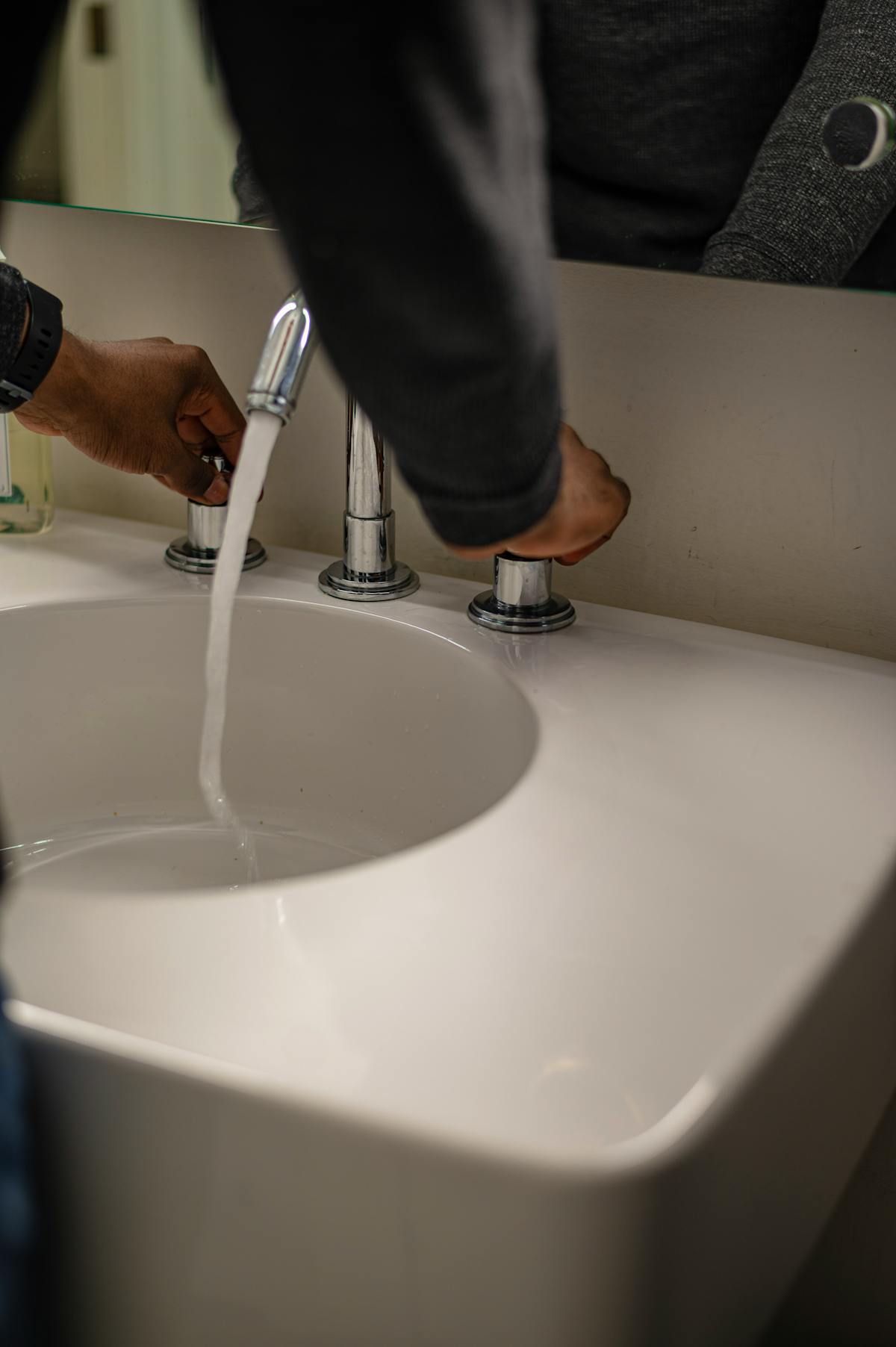
- Move the plant to a sink or bath. Remove any saucer so dissolved salt cannot be reabsorbed.
- Run low-mineral water at a gentle flow — distilled, filtered, or rainwater is ideal; lukewarm tap water (≈
20°C) is acceptable in a single flush. A high-pressure stream displaces substrate; use a steady, low flow over the surface. - Flush for 5 full minutes, passing roughly
3–5×the pot volume through the substrate. The runoff may look discoloured initially as the salt dissolves. - Drain completely. Place the plant in a warm, well-ventilated spot with
2,000–4,000 luxof bright indirect light so it can use the residual water; do not leave it standing in runoff. - Do not water again until the top
2–3 cmof substrate is dry — a freshly flushed pot is fully saturated, and immediate re-watering invites secondary root rot.
Trim leaves that are more than ~50% necrotic with scissors sterilised in 70% isopropyl alcohol; the plant cannot repair dead tissue and the energy is better spent on new growth. Then withhold all fertiliser for at least 6 weeks while the fine root hairs regenerate.
4. When a Flush Is Not Enough: Emergency Repot
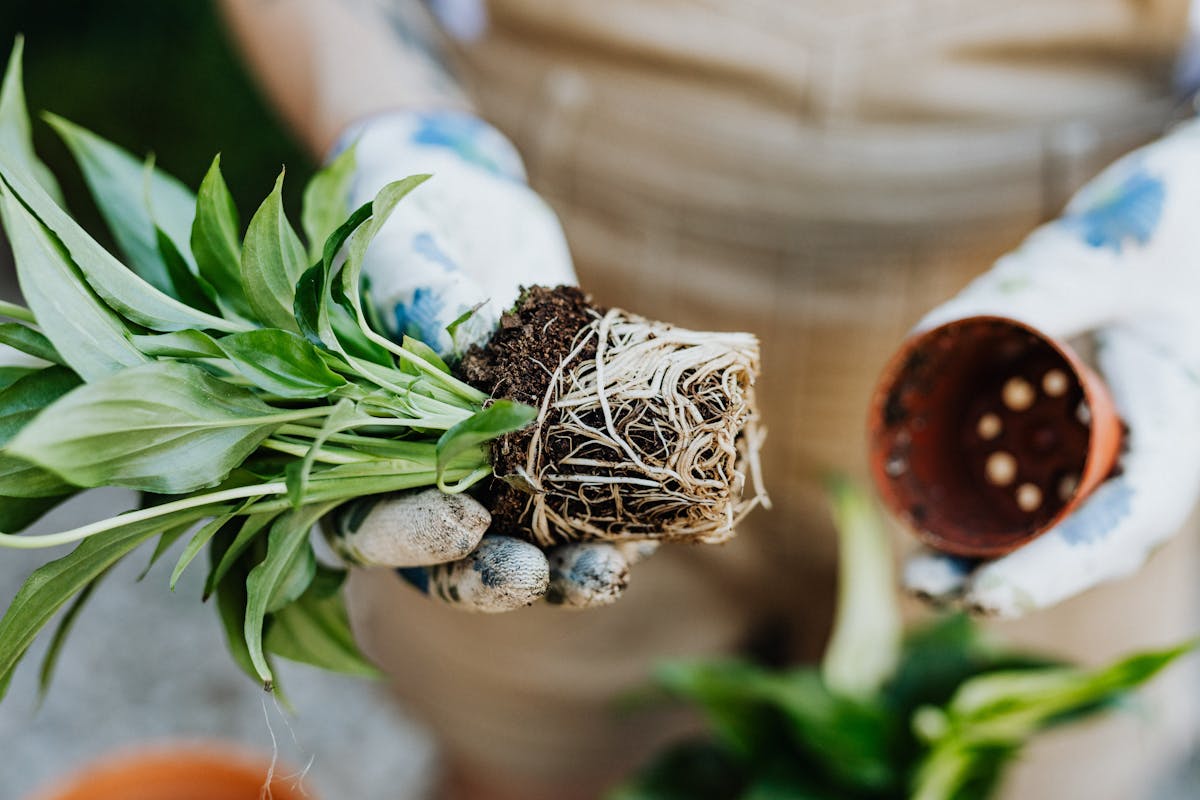
Two scenarios defeat a flush and require physically removing the substrate:
- Slow-release granules (Osmocote-type prills) release salt every time they get wet. If over-applied, flushing only triggers more release. The granules must be removed from the environment.
- Undiluted concentrate poured directly into the pot saturates the substrate with salt beyond what a 5-minute flush can clear.
In either case: remove the plant, rinse all contaminated substrate off the root ball in room-temperature water, and inspect the roots. Trim any black, mushy, or shrivelled sections with sterilised scissors. Repot the surviving root mass into a fresh, free-draining, unfertilised mix — the canonical 50% coir-based compost, 30% perlite, 20% fine orchid bark. Withhold water for 5–7 days to let cut surfaces callus, then resume a reduced watering schedule.
5. Recovery Timeline
Fertiliser burn recovery follows a predictable sequence, and knowing it prevents the panic-driven over-intervention that compounds the damage:
- Days 0–3 after the flush: No visible improvement. Existing brown margins remain brown — they are dead tissue and will not regreen.
- Weeks 1–3: Root hairs regenerate in the cleared substrate. No new top growth yet; the plant is rebuilding its absorption surface underground.
- Weeks 3–6: The first new leaves emerge. If they are smooth, full-sized, and scar-free, the osmotic balance has been restored and recovery is confirmed.
- Week 6 onward: Resume feeding only now, at the corrected dilution.
The measure of success is never whether the burned leaves recover — they do not. It is the quality of the new growth.
6. Prevention: Feed Light, Flush Routinely, and Stop in Winter
Three habits prevent recurrence, each tied to a threshold rather than a vague instruction.
Dilute to 50% and feed monthly, spring–summer only. The canonical regime for P. obtusifolia is a balanced NPK 20-20-20 at 50% of label rate, applied monthly during active growth. Commercial label rates are calibrated for fast-growing, high-light annuals, not slow-metabolism understorey epiphytes.
Maintain a leaching fraction. Ensure roughly 20% of every watering drains out of the bottom. This small, regular flush prevents salt from ever reaching the osmotic-reversal concentration. Never apply fertiliser to a bone-dry pot — water lightly first so the salt enters an already-hydrated root zone rather than a concentrated one.
Do not fertilise in winter. This is the single most reliable way to avoid burn in this species. From roughly November to February in temperate homes, P. obtusifolia growth slows to near zero under reduced light and cooler temperatures. Feeding into a dormant or near-dormant plant means the salts are not taken up — they accumulate in the substrate until the concentration reverses the osmotic gradient. The plant is not "hungry" in winter; it is metabolically idle, and salt added to an idle root zone is salt that simply concentrates. The corrective is to stop entirely until active growth resumes in spring. See the winter dormancy guide for the seasonal thresholds.
Recommended Tools
- Distilled or filtered water / RO pitcher — low-mineral water for the flush avoids adding more salt during the rescue, and prevents tap-water mineral accumulation long-term.
- Liquid measuring syringe or dosing cup — the only reliable way to hit the
50%dilution; eyeballing the dose is how over-application happens. - Sterile pruning snips — for trimming necrotic tissue and root triage. Disinfect with 70% isopropyl between cuts.
Sources and Related Reading
- Wikipedia — Fertilizer burn (definition and osmotic-injury mechanism)
- Wikipedia — Plasmolysis (the cellular dehydration event)
- Wikipedia — Osmosis (the gradient that reverses under high salinity)
- NC State Extension — Peperomia obtusifolia (species profile and indoor cultivation reference)
Internal mechanism references on this site:
- Peperomia obtusifolia fertiliser guide — the correct feeding regime and NPK thresholds.
- Salt-leaching protocol — the detailed flush procedure for both salt sources.
- White crust / salt buildup diagnostic — identifying the crust and its tap-water route.
- Brown leaves diagnostic — the broader symptom map, including the fertiliser-burn differential.
- Best peperomia soil mix recipe — the free-draining substrate that supports a leaching fraction.
- Best pots for Peperomia — pot-material interaction with salt accumulation and visibility.
- Winter dormancy guide — why feeding stops from November to February.
Summary
Fertiliser burn is a chemical failure, not a feeding gap. Concentrated salt in the substrate reverses the osmotic gradient and plasmolyses the root hairs, dehydrating the plant from the roots outward while the pot stays wet. The white salt crust plus the sharp-bordered crispy margin distinguish it from underwatering, humidity deficit, and disease. The fix is mechanical — leach the salt with a 5-minute flush, trim the necrosis, and stop feeding for 6 weeks. Then feed light, maintain a leaching fraction, and never fertilise an idle winter plant.
Care FAQ
What does fertiliser burn look like on a Peperomia?
Fertiliser burn presents as a sharp, well-defined band of crispy brown tissue around the outer margins and tips of the leaves, often with a thin yellow border separating dead tissue from living green. Two further signs confirm it: a hard white or tan crystalline crust on the substrate surface or the inner rim of a terracotta pot, and limp foliage despite a moist substrate. Lower leaves may yellow rapidly as the plant withdraws resources.
Can a Peperomia recover from fertiliser burn?
Yes, if caught before the root system collapses. Recovery requires physically leaching the excess salt out of the substrate with a 5-minute soil flush (3–5 pot-volumes of low-mineral water), trimming the necrotic leaf tissue, and ceasing all fertiliser for at least 6 weeks. Existing brown margins are permanent — the measure of recovery is smooth, scar-free new growth once the root hairs regenerate.
Why does fertiliser burn happen?
It is osmotic injury. Fertiliser is concentrated mineral salt. When the salt concentration in the substrate exceeds the concentration inside the root cells, the osmotic gradient reverses — water moves out of the roots into the substrate (reverse osmosis), and the root cells lose turgor and collapse in a process called plasmolysis. The plant dehydrates from the roots outward even though the pot is wet.
How do I tell fertiliser burn from underwatering?
Check the substrate and look for a salt crust. Underwatering produces soft, wrinkled, drought-curled leaves in a bone-dry pot with no crust. Fertiliser burn produces crispy, sharply-bordered margins with the substrate often still moist, plus a white or tan crust on the soil surface or pot rim. The crust is the decisive discriminator — desiccation does not leave one.
Should I fertilise a stressed Peperomia to help it recover?
No. Never fertilise a stressed or root-compromised plant. Adding salt to a substrate where the root hairs are already damaged accelerates the osmotic dehydration of the surviving roots. Resume feeding only after the plant has produced healthy new growth — at a balanced NPK 20-20-20 diluted to 50% of label rate, monthly, in spring and summer only.
How often should I fertilise Peperomia obtusifolia to avoid burn?
Monthly during spring and summer only, at 50% of the label rate, with a balanced NPK 20-20-20. Stop entirely in autumn and winter — slow metabolic uptake combined with accumulated salts produces osmotic stress rather than growth. Always water lightly before feeding so the salt enters a hydrated root zone, and ensure roughly 20% of each watering drains out to flush residual salts.