
Peperomia Geotropism & Gravity: Fixing Leaning Stems
Peperomia geotropism is the mechanism that sends roots down and shoots up, regardless of how a cutting or a mature plant is oriented — and it is not the usual explanation for a leaning houseplant. Roots and stems each contain cells that sense gravity and redistribute a growth hormone in response, a process documented across flowering plants generally. The practical takeaway for most growers is narrower than the biology sounds: a plant leaning toward a window is responding to light, not failing at gravity-sensing, and repeatedly flipping a rooting cutting to check its progress has a real, if modest, energy cost.
What Geotropism Actually Means
Geotropism (also called gravitropism) is simply a plant's ability to grow in a consistent direction relative to gravity — roots downward, shoots upward — no matter which way the plant itself is turned. Stand a cutting on its side, and within hours the root tip curves back toward the ground and the stem tip curves back toward the sky. Nothing about the plant's anatomy needs to physically move for this to happen; internal cells detect the new orientation and adjust the direction of growth accordingly.
What Is Actually Known About This Species Specifically
The core mechanism described in this guide — gravity-sensing organelles and auxin-driven differential growth — is general plant physiology, documented across a wide range of flowering plants and confirmed most thoroughly in model species and food crops rather than in Peperomia obtusifolia specifically. There is no reason to expect the species behaves differently, since gravitropism is close to universal in vascular plants and P. obtusifolia's roots and stems show the same downward-root, upward-stem pattern any grower can observe directly. But the precise timing of organelle resettling, or a measured energy cost of reorientation, has not been separately studied in this species. Treat the mechanism as well-supported inference from the wider literature, not a Peperomia-specific measurement — and confirm you are actually looking at P. obtusifolia, rather than a similar-looking relative, before drawing conclusions from a single home observation; the identification guide covers the traits that separate them.
How the Mechanism Works: Statoliths and Hormone Redistribution
Certain plant cells contain amyloplasts — dense, starch-filled organelles that are heavier than the surrounding cytoplasm and therefore always settle toward the physical bottom of the cell under gravity. In roots, these cells sit in the root cap; in stems, they sit in a layer near the vascular tissue. When a stem or root is turned sideways, the amyloplasts inside these cells tumble to the new lowest point within minutes, and that physical repositioning is what the cell actually senses — there is no separate "gravity organ," just settling mass inside an ordinary cell.
That signal is converted into directional growth through auxin, the plant's principal growth hormone, redistributed according to what plant physiologists call the Cholodny-Went model. In a horizontal stem, auxin accumulates on the lower side; in stem tissue, higher auxin concentration speeds up cell elongation, so the lower-side cells lengthen faster than the upper-side cells and the stem curves upward. In a horizontal root, auxin also accumulates on the lower side, but root tissue responds to auxin in the opposite way — high concentrations slow elongation there, so the upper-side cells outgrow the lower-side cells and the root curves downward. Same hormone, same side of accumulation, opposite tissue response — which is why a root and a stem can receive an identical directional signal and bend in opposite directions.

This is a fundamentally different process from the turgor-driven bending covered in the petiole anatomy guide: turgor loss is a reversible pressure change that resolves within hours of rehydration, while gravitropic and phototropic bending is a developmental change built from actual differential cell growth, which does not reverse once the affected tissue has matured.
What This Changes for Growers
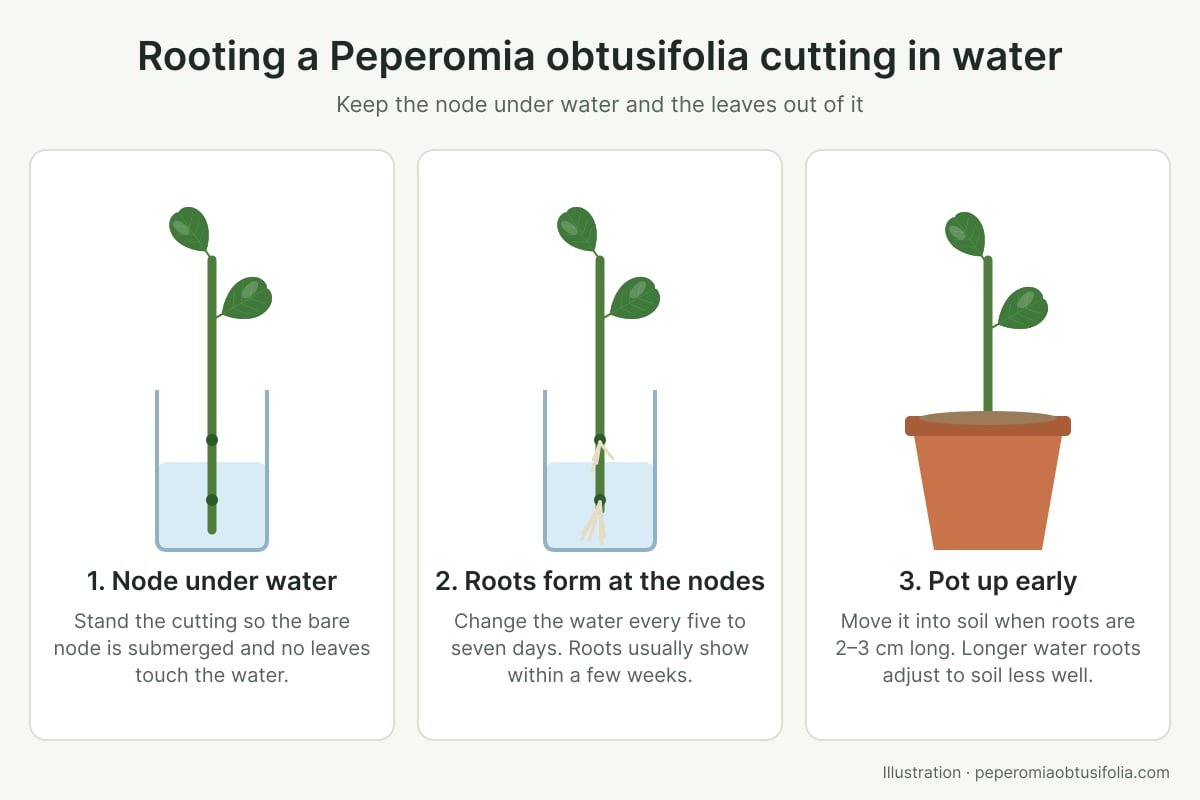
The most direct practical consequence is in propagation. Frequently lifting a rooting cutting out of water or substrate to "check for roots" also disturbs its orientation, and every reorientation forces the plant to resettle its gravity-sensing organelles and rebuild the auxin gradient before it can resume coordinated growth — a process that draws on the same limited energy reserves the cutting needs for root initiation. The practical fix is simple: check for roots by feeling for resistance when you tug gently, rather than lifting the cutting out to look, and see the stem cutting propagation guide for the rest of the method.
The second consequence is diagnostic rather than corrective: a stem that curves sharply after being knocked over or repositioned is not damaged tissue and does not need pruning on that basis alone. It is the plant correcting its orientation through exactly the mechanism described above, and the curve will typically straighten into new, correctly oriented growth above the bend rather than reversing the bent section itself.
Geotropism vs Phototropism: Why Stems Actually Lean
In an outdoor setting with even light from all directions, gravitropism alone would keep a stem growing straight upward. Indoors, it rarely works out that way, because a second directional signal — phototropism, bending toward the strongest nearby light source — is competing with it. A window on one side of a room means the light signal and the "straight up" gravity signal point in different directions, and phototropism generally wins that contest in a typical indoor position. This is the actual mechanism behind the characteristic sideways lean so many indoor P. obtusifolia develop over time: not a failure of gravity-sensing, but gravitropism losing a directional argument to a stronger, more consistent light cue. The leggy and leaning guide covers the phototropism side of this mechanism and the rotation-and-pruning fix in full; rotating the pot periodically is what keeps the light signal from permanently winning in one direction.
What This Does Not Prove
Understanding geotropism does not mean a leaning stem can be "cured" by correcting gravity somehow — gravity is not the thing that is wrong in the first place. It also does not mean a cutting placed upside down or sideways will fail; the entire point of the mechanism is that the plant corrects for this automatically, at an energy cost rather than a survival risk. And it is not evidence that the plant has any preference, awareness, or intent behind the response: amyloplast sedimentation and auxin redistribution are physical and chemical processes, not decisions, and describing them as such overstates what the mechanism actually shows.
Evidence Quality and Sources
The amyloplast-statolith model and the Cholodny-Went auxin model are both well-established in plant physiology, described in standard botanical references and supported by controlled experiments across multiple plant families, including foundational work traced back to Charles Darwin's own gravitropism experiments in the 19th century. Species-specific confirmation for P. obtusifolia is limited; the mechanism here is inferred from the broader literature rather than drawn from a Peperomia-specific study, and that gap is flagged rather than papered over. For the general growth framework this mechanism sits within, see the complete care guide.
Care FAQ
Why do Peperomia roots always grow downward?
Positive gravitropism. Root-cap cells contain dense, starch-filled organelles called amyloplasts that settle toward the lowest point of the cell under gravity. That settling triggers the plant to redistribute auxin so the upper side of the root elongates faster than the lower side, bending the root tip downward.
Why is my Peperomia leaning sideways instead of growing straight up?
Almost always phototropism overriding the plant's gravity response, not a gravity malfunction. Stems bend toward the strongest nearby light source, and in a single-aspect window that direction rarely matches straight up. See the leggy-and-leaning guide for the light-side of this mechanism and the rotation fix.
What are statoliths, and does Peperomia obtusifolia have them?
Statoliths are the dense, sedimenting organelles (amyloplasts, in most plants) that let a cell sense which way is down. This is documented general plant physiology, not a claim tested specifically in P. obtusifolia — the site treats it as a well-supported inference from the wider Piperaceae and flowering-plant literature rather than a species-specific finding.
Does flipping or disturbing a rooting cutting actually slow it down?
Yes, in mechanism if not in precisely measured degree for this species. Reorienting a cutting forces it to resediment its gravity-sensing organelles and rebuild its hormone gradient before directional growth can resume, which draws on the same energy reserves the cutting needs for root initiation. Frequent handling is a plausible, though not separately quantified, drag on rooting speed.