
Propagating Peperomia in Sphagnum Moss: Avoid Rot
Propagating Peperomia in sphagnum moss works because the moss holds substantial moisture within its fibrous structure while still leaving air pockets between strands — a balance that produces roots already adapted to navigating a physical medium. That matters most at the transplant stage: moss-grown roots handle the move to soil with less disruption than the thinner roots typical of water propagation.
When to Use This Method
Sphagnum moss suits a grower who has struggled with transplant shock after water propagation, or who wants a medium with genuine, documented antimicrobial properties for a cutting they're particularly keen not to lose. It works well for both stem and leaf cuttings, and its acidity gives it a natural edge against rot organisms that a neutral medium doesn't offer. It is less useful if visual monitoring matters to you — moss packed around a cutting in a cup hides root development far more than clear water propagation does. For multiplying an already mature, multi-stem specimen rather than rooting a single unrooted cutting, division skips the rooting wait entirely, since each division already carries its own roots.
Tools, Medium, and Cutting Selection
- Long-fibre sphagnum moss — avoid decorative or milled moss sold for craft use, which lacks the same structure and water-holding capacity.
- A clear or opaque cup or small pot, depending on whether visual monitoring matters to you.
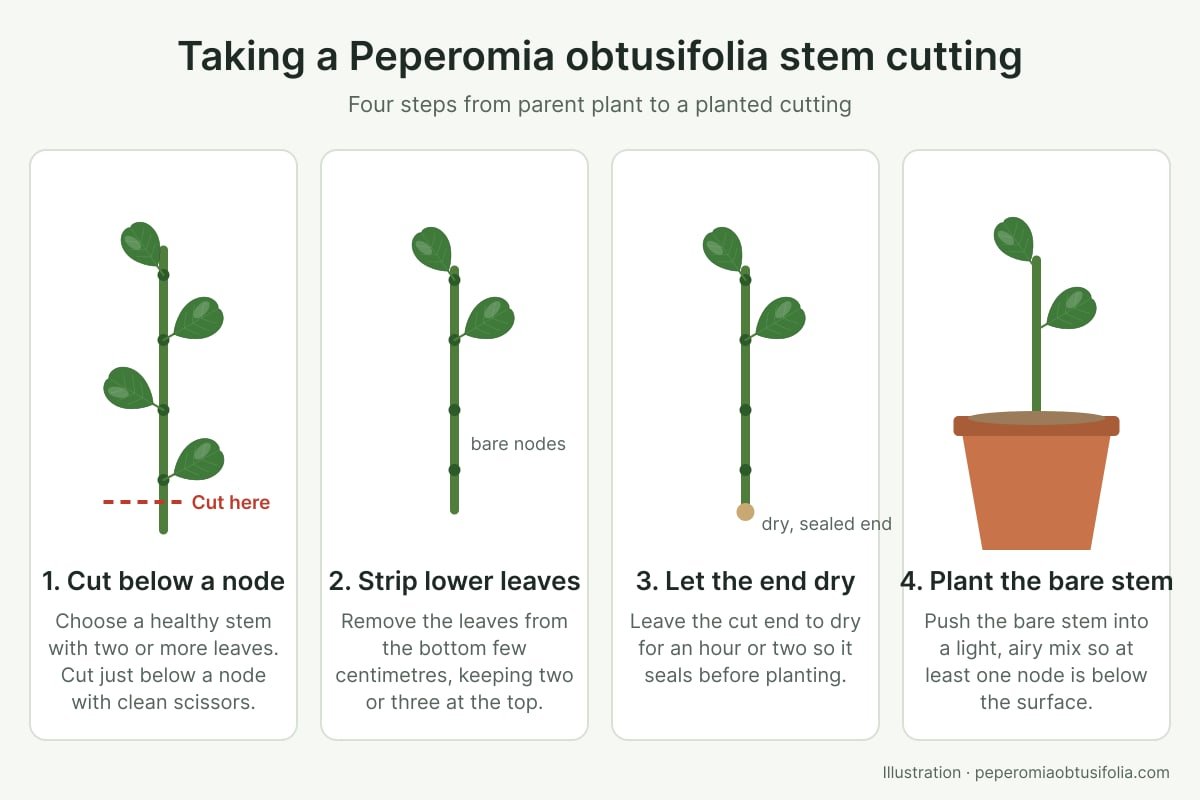
- A callused cutting with at least one node, prepared per the stem cutting guide and callus timing guide.
- A humidity tent or loosely sealed container, since moss dries out faster than standing water and needs more consistent ambient humidity to stay in its ideal damp range.
Step-by-Step Method
- Hydrate the dry moss by soaking it in warm water for around 15 minutes, then wring it out firmly by hand until it feels damp like a sponge rather than dripping wet — over-wet moss raises rot risk the same way waterlogged soil does.
- Fluff the wrung moss to loosen the fibres and restore the air pockets that got compressed during wringing.
- Fill the container roughly halfway with the fluffed moss.
- Insert the callused cutting, packing more moss firmly enough around the stem to hold it upright without compressing the fibres so tightly that the air pockets disappear.
- Place inside a humidity tent or a loosely closed clear container, since moss's faster drying rate needs a more consistent humidity environment than a jar of standing water does.
Rooting and New-Growth Signs
Through the sides of a clear container, roots typically become visible weaving through the moss fibres within two to four weeks, though moss's opacity when packed can make this harder to judge than in water. A gentle tug test after three to four weeks is a reliable alternative check — resistance means roots have anchored into the moss mass. Once roots reach roughly 5-8 cm with several visible branches, the cutting is ready to pot. Roots grown this way tend to look thicker and more branched than the thinner, single-strand roots typical of pure water propagation, since the moss fibres give developing roots something to grip and navigate around from the start.
Transition and Aftercare
Do not attempt to strip the moss from the roots before potting — roots grow tightly entwined with the fibres, and pulling them apart risks tearing fine root hairs that took weeks to develop. Plant the entire root-and-moss mass directly into a standard free-draining soil mix; the moss gradually breaks down and does not harm the plant as it settles into the new substrate. Hold off on fertiliser until a new leaf has fully expanded in the new pot, consistent with the standard aftercare for any freshly potted cutting.
Failure Diagnosis
| Symptom | Likely cause | Action |
|---|---|---|
| Cut end turns soft or discoloured | Moss was too wet, or cutting wasn't callused first | Wring moss firmer next time; see the cuttings rotting guide |
| Moss dries out completely between checks | Insufficient humidity control | Use a tighter humidity tent or check more frequently |
| No roots after 4-6 weeks | Room too cool, or moss packed too tightly | Confirm 18-24°C and loosen the moss around the stem |
| Leaves wilt but stem stays firm | Normal hydraulic deficit before roots establish | Raise humidity slightly, keep out of direct sun |
Comparison with Water Propagation
Moss and water propagation both work well for this species, and the choice is mostly about what you're optimising for. Water offers the clearest, easiest monitoring and needs no extra material; moss offers a gentler transition to soil and a naturally rot-resistant environment, at the cost of hiding root progress until you check by hand. Neither requires rooting hormone for a healthy, properly callused cutting. For the full comparison across every method this species tolerates, see the complete propagation guide, and if a cutting has already started rotting regardless of medium, the cuttings rotting guide covers rescue steps.
Care FAQ
Is sphagnum moss better than water for propagating Peperomia obtusifolia?
It offers one genuine advantage: roots grown in moss develop navigating a physical medium, easing the transition to soil compared with the thinner, more fragile roots typical of water propagation. Water offers easier visual monitoring in a clear container. Neither is required — both work.
Why is sphagnum moss less prone to rot than some other media?
Sphagnum moss is naturally acidic, which suppresses many of the bacteria and fungi responsible for cutting rot better than a neutral, stagnant medium would. This is a genuine advantage, though it does not eliminate rot risk if a cutting goes into moss before it has properly callused.
Should I remove the moss before potting a rooted cutting into soil?
No. Roots grow tightly entwined with moss fibres, and pulling them apart risks tearing fine roots. Plant the whole root-and-moss mass directly into the new pot — the moss breaks down gradually and does not harm the plant.
How wet should sphagnum moss be for propagation?
Damp like a wrung-out sponge, not dripping. Moss that is too saturated behaves like waterlogged soil and raises rot risk in exactly the way the method is meant to avoid.