Peperomia Aerial Roots: Why They Appear & What to Do
Peperomia aerial roots are normal adventitious / aerial roots on Peperomia obtusifolia, a facultative epiphyte that can live in leaf litter or on bark (NC State; Missouri Plant Finder; RHS). This is separate from the general watering and light baseline in the complete care guide — aerial roots are an anatomical response, not a care-error symptom.
The short answer: leave them, guide a long one into the mix, or snip flush with sterile tools. Use a node that already has an aerial root as a ready stem cutting. They are not a root-bound alarm and not a reason to install a Monstera-style moss pole by default (moss poles).
1. Why Peperomia Aerial Roots Exist
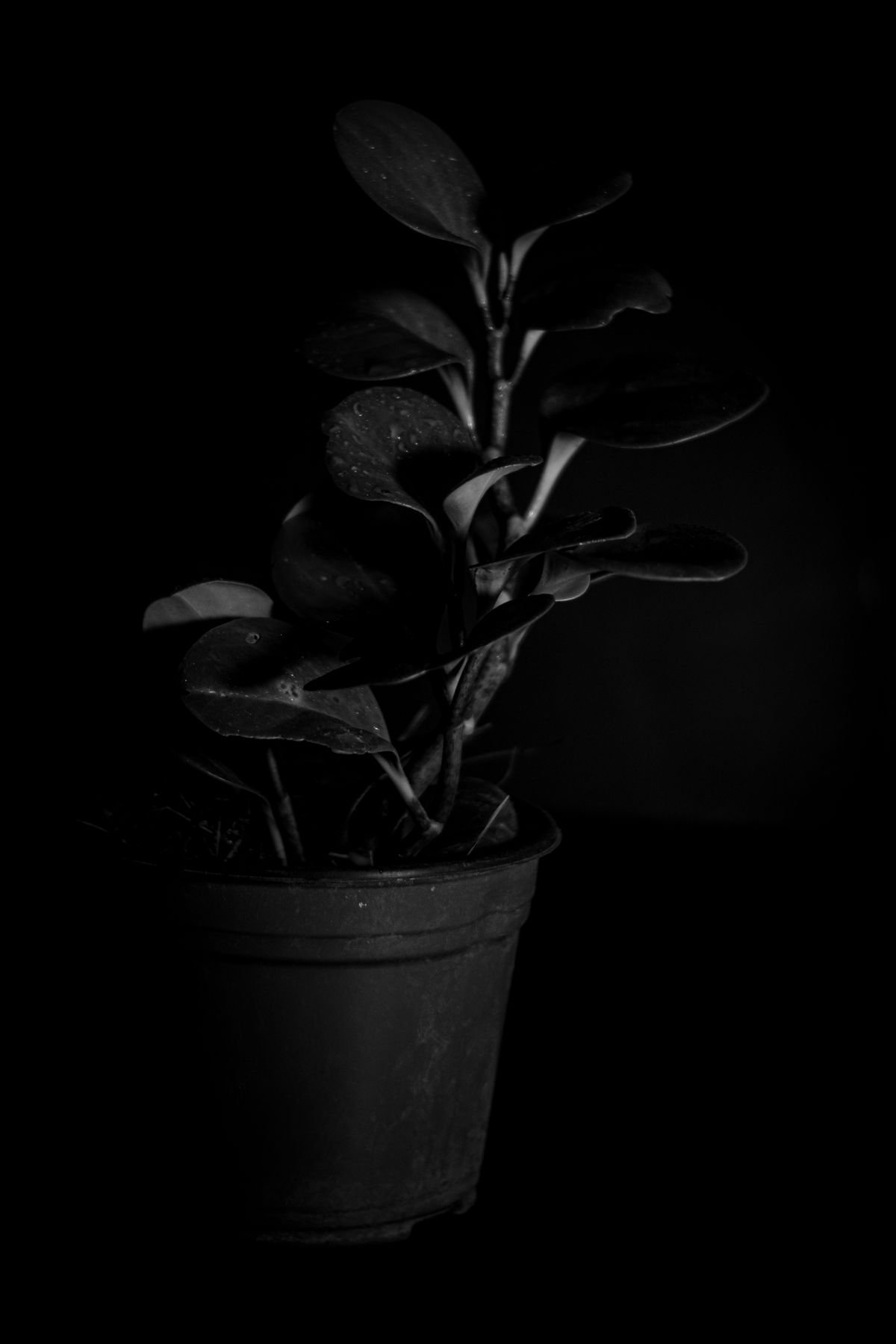
In neotropical understorey, stems may press against bark or rock. Aerial roots act as anchors so heavy, semi-succulent foliage does not peel away. They can also take up some surface moisture when air and contact surfaces are humid — secondary to the pot root system indoors, not a replacement for watering the mix (watering).
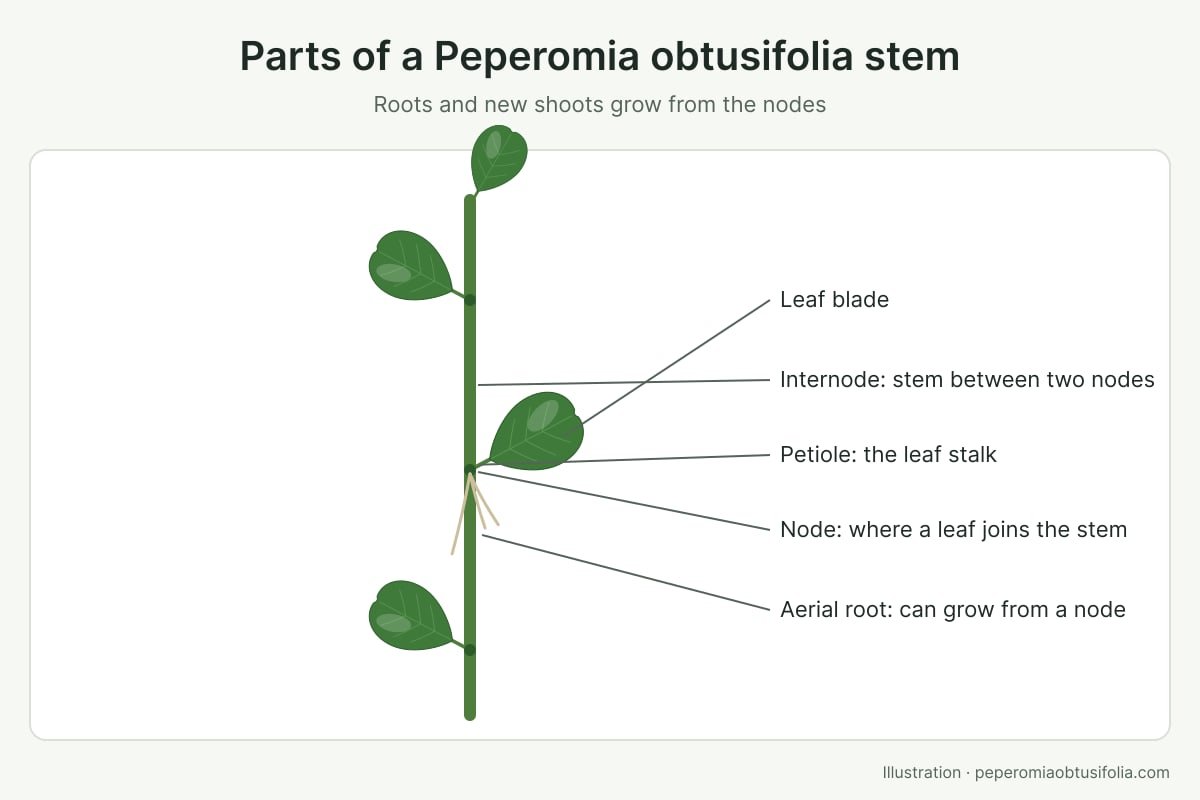
What they look like: firm white, cream, or tan pegs or short wiry tips at nodes, often on the underside of a leaning stem. Soft black tissue is not normal hardening — that is decay. Dry, woody stubs in arid rooms are unused roots that stopped elongating; they are cosmetic.
2. Three Triggers for Peperomia Aerial Roots Indoors
- Humidity / moist microclimate at the stem. RH in the species’ comfort band (40–60%) plus stagnant pockets at nodes can favour root initials. This alone is not a failure (humidity).
- Mechanical lean. Top-heavy stems under phototropism or soft stretch push props toward the pot or a surface. Support with a soft tie to a stake if the stem risks snapping; that is structure, not aroid climbing culture. If the lean is chronic, it is often worth reconsidering the plant's position altogether — the feng shui placement guide covers positioning a specimen so stems grow toward an even light source rather than reaching and leaning toward a single window.
- Severe substrate drought (less common cue). Thin, shrivelled aerial roots plus soft wilt and a bone-dry mix suggest the plant is scavenging moisture while pot roots are stressed — fix watering first, not the nubs.
Black, mushy aerial tissue can mean rot extending upward — check the subterranean roots (overwatering rescue).
Proliferation of firm aerial roots on an otherwise glossy, compact plant with a healthy pot is still within normal range. Judge stress by leaf turgor, internodes, and mix smell — not by counting nubs.
3. Three Options: Leave, Guide, or Prune
| Choice | When | How |
|---|---|---|
| Leave | Default | No action; unused roots may harden or dry back in arid rooms |
| Guide into mix | Long enough to reach | Pin gently into moist open mix (≥30% aeration) so it can become a soil root (soil recipe); a specimen already growing in LECA lets an aerial root reach straight into the pebble reservoir instead |
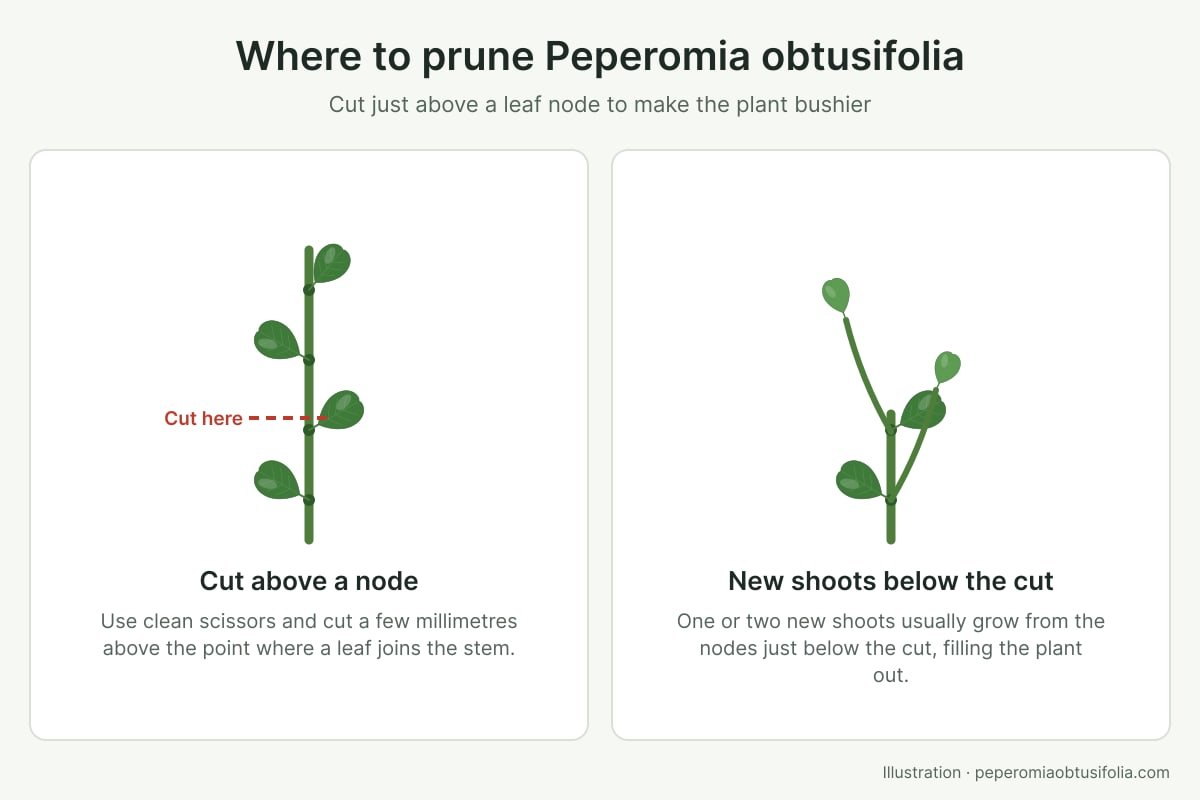
| Prune | Aesthetic only | Sterilise shears (70% isopropyl); cut flush; never rip — the same clean-cut technique used in the pruning guide for reshaping a stem |
4. Propagate From a Rooted Node
Sever just below a node that already bears an aerial root. Keep at least one leaf for photosynthate. Root in water or aerated mix at 18–24 °C; expect faster establishment than a bare node because organogenesis has already started. Do not bury the entire leafy stem in wet peat — only the basal node and aerial root need contact with the medium (propagation hub; stem cuttings).
Variegated cultivars still need a variegated stem node — an aerial root on a green leaf cutting will not preserve chimeric variegation.
5. Three Panic Myths About Peperomia Aerial Roots
Myth 1 — “Aerial roots mean repot now.” Pot-bound diagnosis uses drainage-hole roots and mix failure, not stem nubs (root-bound; repotting).
Myth 2 — “Tear them off by hand.” Peeling wounds the stem and invites stem rot.
Myth 3 — “It needs a moss pole like Monstera.” P. obtusifolia is not an aggressive hemiepiphytic climber. Poles are optional support props, not a requirement for aerial-root health.
Opinion: Treat peperomia aerial roots as facultative-epiphyte anatomy, not an emergency. The wrong fix is panic-repotting or stripping tissue; the right fix is leave, guide, clean snip, or propagate.
Conclusion
Peperomia aerial roots mark a facultative epiphyte doing what bark-dwellers do: anchoring and opportunistic moisture sensing. They are safe to leave, safe to snip flush, useful as pre-rooted cuttings, and useless as a root-bound or moss-pole mandate. Read the canopy and the pot roots for real stress; treat the aerial pegs as optional architecture.
Care FAQ
Are aerial roots on a Peperomia normal?
Yes. Peperomia obtusifolia is a facultative epiphyte: it can grow in litter or on bark. Peperomia aerial roots are adventitious organs that help anchor stems and respond to humidity and lean. They are not a parasite and not proof of disease.
Should I cut off aerial roots on my Peperomia?
Only for aesthetics. Use sterile shears and cut flush to the stem — do not tear. Tearing can strip epidermis and invite stem rot. Leaving them does not harm the plant.
Do Peperomia aerial roots mean the plant is root-bound?
No. Aerial roots and pot-bound subterranean roots are separate systems. Repot when drainage holes are packed with circling roots or the mix collapses — not merely because nodes sprout aerial nubs.
Can I propagate using peperomia aerial roots?
Yes. Cut just below a node that already bears an aerial root, then root in water or aerated mix. The existing root shortens the lag versus a bare node. Full cutting method: stem-cutting guide.
Does my Peperomia need a moss pole for aerial roots?
Not for health. Unlike vigorous aroid climbers, obtusifolia does not require a moist pole to thrive. A stake may support a top-heavy stem; moss-pole detail is optional and covered in the moss-pole guide.