
Root-Bound Peperomia obtusifolia: Signs, Physics & When to Repot
Root-bound on Peperomia obtusifolia is the state in which the root mass fully occupies the pot volume — characterised by post-watering turgor recovery exceeding 24 hours, shortened watering intervals (every 2–3 days), roots emerging from drainage holes, distorted pot walls, smaller new leaves, and the root ball lifting above the rim. Unlike most houseplants, a moderately root-bound state on this species is beneficial: as a facultative epiphyte, P. obtusifolia evolved with constrained root volume and benefits from the high oxygen diffusion rate and rapid dry-down that a tight pot provides. The intervention threshold is hydraulic failure, not the calendar. When repotting is required, increase pot diameter by exactly 2.5 cm (1 inch) and accept a 4–6 week growth pause. Annual repotting is wrong for this species — the operating interval is 2–3 years.
The standard houseplant-care reflex on a "root-bound" plant is alarm followed by an immediate upsize to a substantially larger pot. For Peperomia obtusifolia this is the wrong response on two counts: most root-bound diagnoses on this species do not meet the intervention threshold, and the typical "go up two sizes" remedy destroys the high-oxygen rhizosphere that the species needs to avoid root rot. The diagnostic and procedural framework below is the site's canonical reference for distinguishing a productive root-bound state from one that genuinely requires repotting, and for executing the repot when it is required.
| Signal | What it means | Intervention threshold |
|---|---|---|
| Roots emerging from drainage holes | Normal feature of a mature container plant | Not alone — wait for combination |
| Watering interval shortened to every 2–3 days | Substrate volume reduced; root mass dominant | Approaching threshold |
| Post-watering turgor recovery >24 h | Hydraulic failure — water no longer reaching cells | At threshold — repot |
| New leaves smaller than older leaves | Allometric resource limitation | At threshold — repot or root-prune |
| Pot wall distortion (oval not round) | Mechanical pressure exceeding pot integrity | At threshold — repot |
| Root ball lifts plant above pot rim | Heaving displacement | Past threshold — repot urgently |
| Yellow new growth (chlorosis) | Mineral exhaustion in remaining substrate | Fertilise first; repot only if pattern persists |
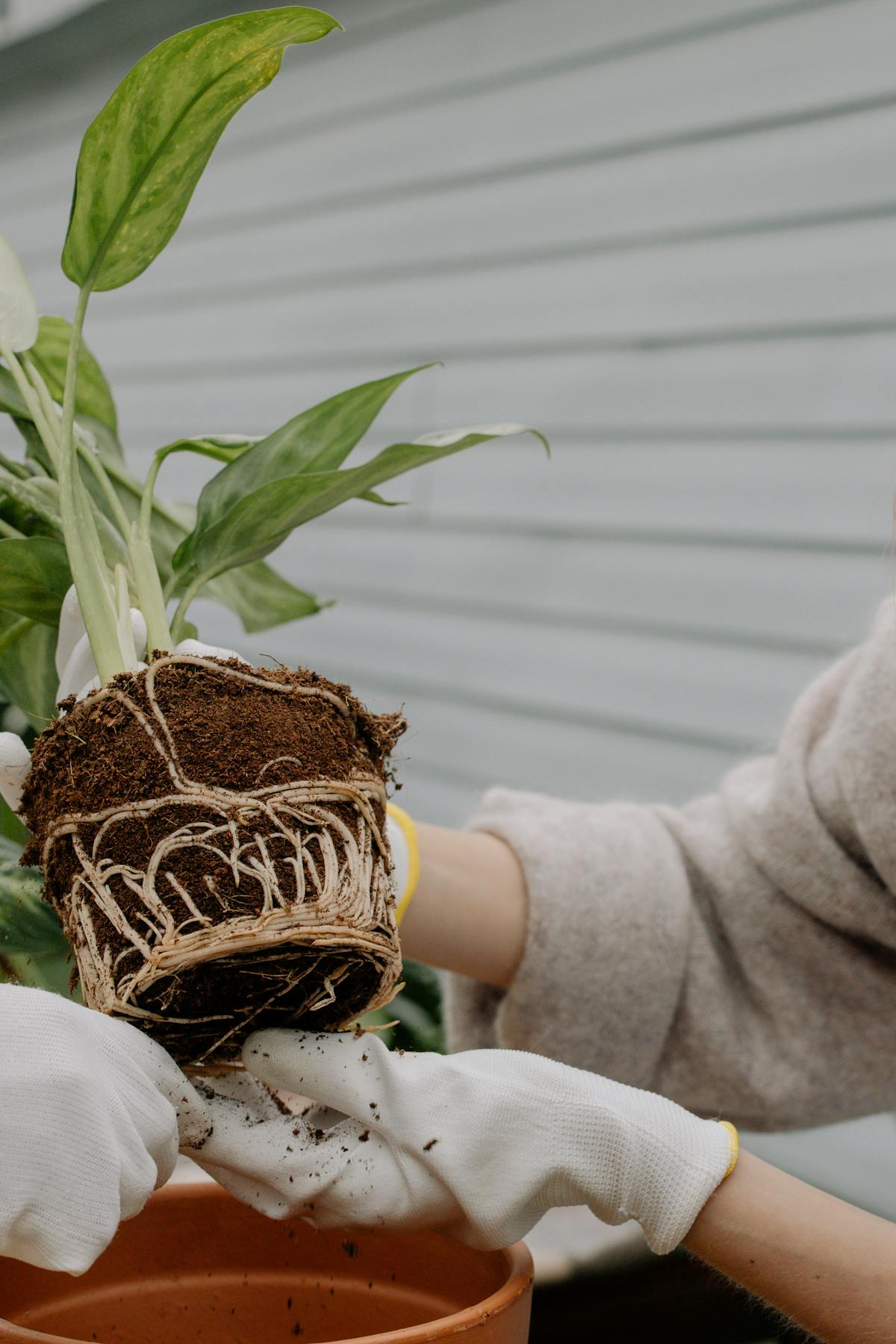
1. The Native Ecology — Why Root-Bound Is Often Productive
Peperomia obtusifolia is a facultative epiphyte native to the forest understorey of Mexico, Central America, and northern South America. In its wild habitat it grows on bark crevices, in leaf-litter pockets, and on tree trunks — substrates that supply a few hundred millilitres of root volume at most, drain within hours of any rain event, and offer continuous airflow around the root surface. The species evolved with constrained root volume, not with the metres of soil depth available to most terrestrial plants.
Three operating consequences follow:
High oxygen diffusion at the root surface. A small root volume relative to canopy means that water consumed by transpiration is replaced quickly, and the substrate returns to a high air-filled-porosity state within a day. This is the same operating condition that makes LECA effective for this species, achieved here by the natural substrate-displacement dynamics of a tight pot.
Rapid dry-down between waterings. A root-bound P. obtusifolia in a 10 cm pot consumes its watering volume within 24–48 hours under standard indoor conditions; the same plant in a 20 cm pot would retain measurable moisture for 7–10 days. The shorter cycle keeps the rhizosphere in the aerobic state the species requires, with <5 days continuous saturation as the canonical risk threshold.
Mineral concentration in a small reservoir. A moderately root-bound plant draws minerals from a smaller substrate volume — the ions deplete faster, but they are also more concentrated at the root surface and more readily absorbed. With monthly fertiliser at 50% strength during the growing season, a root-bound P. obtusifolia maintains canopy mineral status equivalent to a plant in unrestricted substrate.
The procedural conclusion is that "root-bound" is not a diagnosis on this species — it is the operating norm. The intervention threshold is hydraulic failure of that norm, not its existence.
2. The Mechanical Biology — Thigmotropism and Circling Roots
When a root tip contacts a hard barrier — the pot wall, a piece of bark, an underground stone in nature — it undergoes thigmotropism, the directional growth response to mechanical stimulus. The growing tip is deflected along the surface of the barrier, producing the circling-root pattern visible when a long-resident plant is unpotted.
The circling roots are not damaged tissue. They are normal structural roots that have undergone secondary growth — lignification of the cortex, thickening of the central xylem — and now function primarily as mechanical anchors rather than absorptive surfaces. Absorption shifts to the fine feeder roots concentrated near the substrate-pot interface. This redistribution is part of the operating efficiency of a root-bound plant; it is also why aggressively un-circling the roots during repotting (the common "tease out the root ball" advice) damages absorption capacity disproportionately to the apparent volume of disturbed tissue.
The corollary procedural rule: when repotting a root-bound P. obtusifolia, leave the circling roots intact. A clean cut at the bottom 1–2 cm of the root ball with sterile shears, removing the densest mat of circling tissue, is the maximum intervention. The remaining circling roots adapt within 4–6 weeks to the new substrate volume.
3. The Six Diagnostic Signals
The diagnostic framework groups the visible signs into three categories — hydraulic, foliar, mechanical — and treats single-signal findings as insufficient for intervention.
Hydraulic signals. Watering interval shortening from 10–14 days (summer norm for a 12 cm pot) to every 2–3 days indicates substrate displacement by roots — there is no longer enough substrate volume to hold a multi-day water reserve. Post-watering turgor recovery exceeding 24 hours is more severe: the leaves remain soft despite a wet pot, meaning the root mass is so dense that water poured onto the substrate runs through channels rather than wetting the entire root ball. This is the central intervention threshold.
Foliar signals. New leaves emerging significantly smaller than older leaves indicate allometric scaling — the plant has shrunk its canopy to match what the constrained root system can hydraulically support, a relationship explored in classical plant allometry. The plant is not deficient; it is rescaling. Chlorosis on new growth — yellow leaves emerging despite green older foliage — suggests mineral exhaustion in the remaining substrate. The first response is fertiliser at 50% strength; only if chlorosis persists after 3–4 weeks of correct fertilising is the cause root-bound rather than nutrient supply.
Mechanical signals. Roots emerging from drainage holes is the lowest-severity sign — a single emerging root means little, and the species tolerates this state for 6–12 months. Pot wall distortion (a plastic nursery pot becoming oval) indicates roots exerting outward pressure sufficient to deform the container; this is at the intervention threshold. The root ball lifting the plant above the pot rim — visible "heaving" of the crown above the lip — is past the threshold and indicates the root system has filled the available volume entirely.
The site's diagnostic rule: two or more signals from at least two categories triggers repotting; one signal in isolation does not. Most "root-bound" diagnoses from owners are based on a single category (often just drainage-hole roots) and do not warrant intervention.
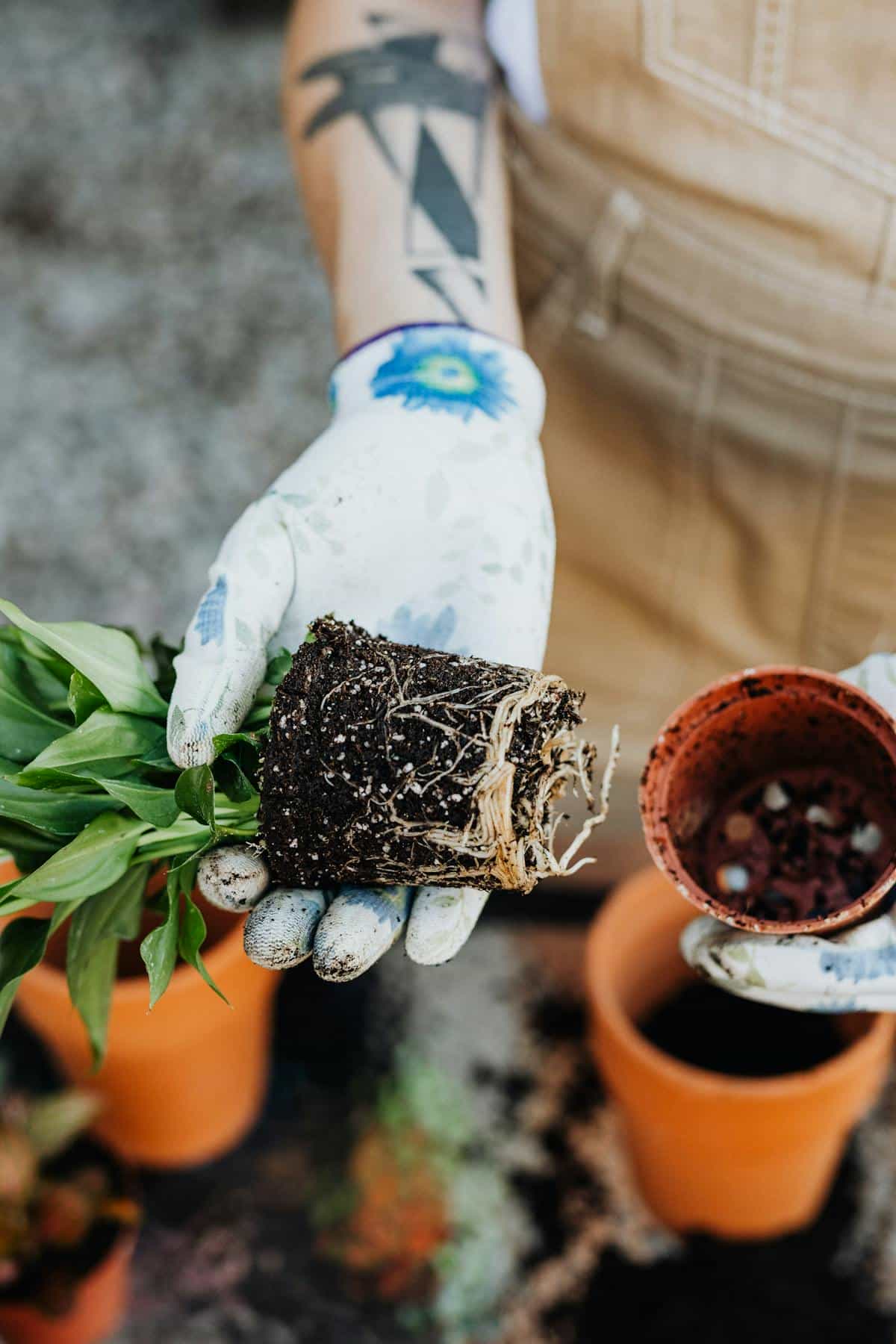
4. Why Annual Repotting Is Wrong for This Species
The site takes a position on this without softening: do not repot Peperomia obtusifolia annually. This is one of the explicit editorial positions in opinions.md — the species tolerates being slightly root-bound, and repotting more often than every 2–3 years compounds transplant shock and disturbs the high-oxygen root environment the plant has built.
The standard advice ("repot every spring") originates from generic care guides written for fast-growing tropical aroids, where annual root expansion does match the canopy growth rate. P. obtusifolia grows 2–5 cm of new stem per year — slow enough that a single repot supports 2–4 years of growth before the root system genuinely outgrows the pot. Annual repotting on this growth rate produces three predictable problems:
- Loss of the rhizosphere microenvironment. A root system established in a particular pot develops a stable microbial community, mineral gradient, and physical structure. Repotting destroys this and the plant requires 4–8 weeks to rebuild it — only to have it destroyed again the following year.
- Excess substrate-to-root ratio. A pot upsized before the previous root system has filled it has more substrate than the root system can use. Water sits in the un-rooted volume for days, reproducing the conditions of root anoxia the species is most vulnerable to.
- Cumulative transplant shock. Each repot causes mechanical disturbance of the fine feeder roots and a 4–6 week growth pause. Annual repotting means the plant is in continuous transplant recovery rather than in productive growth.
The 2–3 year interval, triggered by hydraulic failure rather than calendar date, is the correct cadence for the species.
5. The Repotting Protocol
When the intervention threshold is genuinely reached, the procedure is conservative and specific.
Step 1 — Timing. Repot in early spring as the plant resumes active growth (typically March–April in the northern hemisphere). The plant heals fastest when transpiration is increasing and the meristem is metabolically active. Avoid winter repotting on this species — slow uptake and accumulated salts in the new substrate produce osmotic stress on the disturbed roots.
Step 2 — New pot size. Increase pot diameter by exactly 2.5 cm (1 inch). A 12 cm pot moves to 15 cm; a 15 cm pot moves to 18 cm. Larger increases destroy the high-oxygen environment. Choose a pot matched to the watering tendency and ambient conditions — see the terracotta vs plastic comparison for the trade-offs; terracotta suits over-waterers and high-RH rooms, plastic suits dry-air conditions and under-waterers.
Step 3 — Substrate. Use the canonical 50/30/20 mix — 50% peat-free coir-based compost, 30% perlite, 20% fine orchid bark. Do not add a layer of drainage rocks at the bottom — the perched-water-table physics make this counterproductive (a site editorial position that has been documented in detail elsewhere). A single drainage hole and a free-draining substrate is the correct configuration.
Step 4 — Unpot and inspect. Squeeze the sides of the existing pot to release the root ball. Inspect: the root ball should be intact and densely rooted, off-white to cream, with no soft brown patches or sour smell. A sour smell or soft black roots indicates Pythium root rot and the repot procedure changes — see that guide for the root-rot recovery protocol rather than continuing here.
Step 5 — Trim circling roots conservatively. Take sterile pruning shears and slice off the bottom 1–2 cm of the root ball where the densest mat of circling roots has accumulated. Do not "tease out" the upper root ball; the secondary-growth circling roots are structural and the fine feeder roots above them are absorptive. Aggressive untangling damages absorption disproportionately.
Step 6 — Pot up. Place 2–3 cm of fresh substrate in the bottom of the new pot. Set the trimmed root ball so the original soil line sits 1 cm below the new pot rim. Backfill around the root ball with substrate; tap the pot gently to settle the substrate without compacting it. Do not press the substrate down with thumbs — compaction destroys the air-filled porosity the species requires.
Step 7 — Water in. Water from above with room-temperature water (18–24 °C) until water runs through the drainage hole for 30 seconds. This both hydrates the new substrate and washes mineral fines through and out. Allow full drainage.
Step 8 — Recovery. Place in normal lighting at 2,000–4,000 lux. Do not fertilise for 4 weeks — disturbed roots are susceptible to osmotic stress, and the fresh substrate provides sufficient initial mineral supply. Expect a 4–6 week growth pause before new leaves resume.
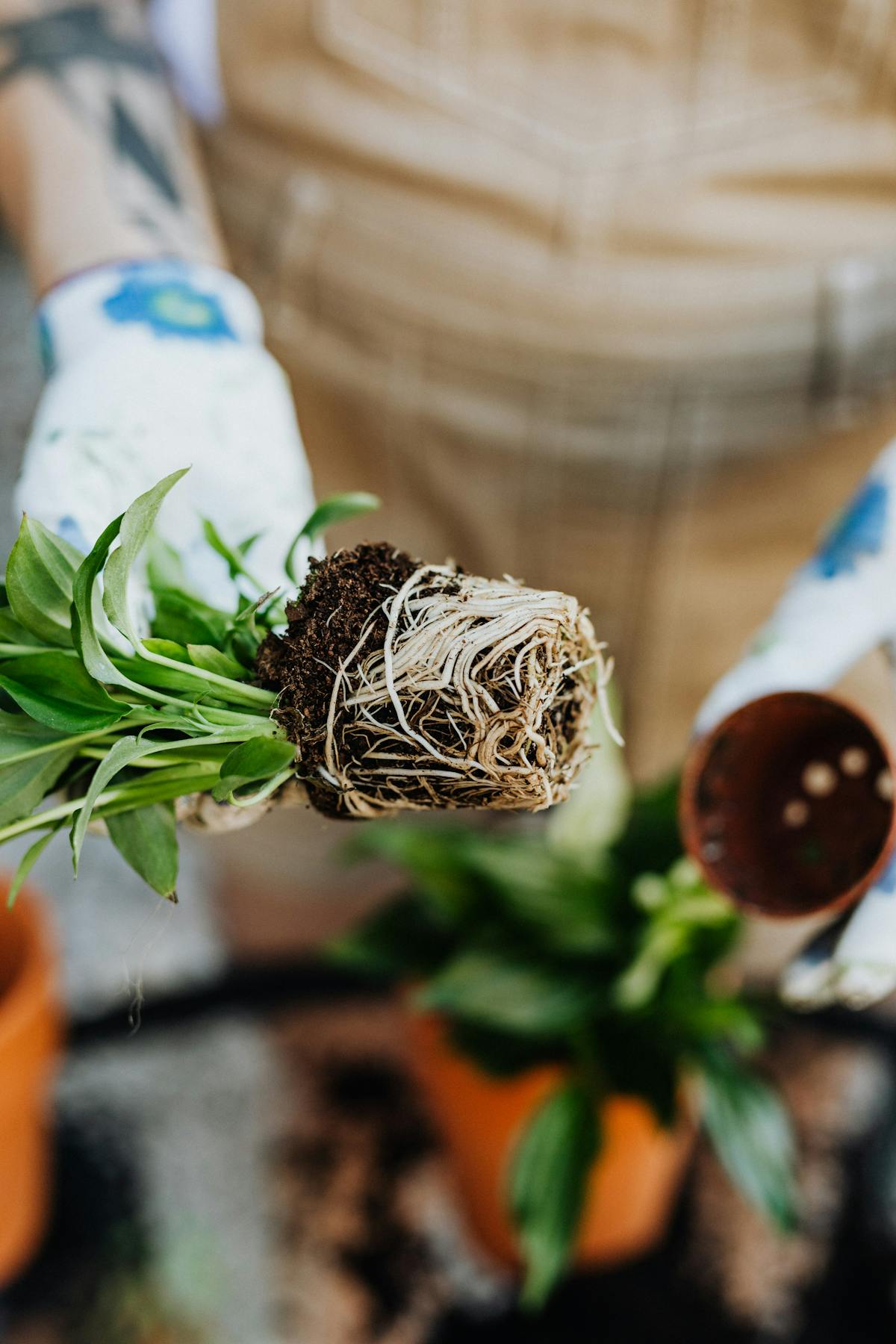
6. Root Pruning — The Size-Containment Alternative
For specimens where the goal is to maintain the current size — display plants, mature collections in a fixed pot configuration — root pruning replaces repotting up.
The procedure: unpot as in Step 4. With sterile shears, remove 1–2 cm from the bottom of the root ball and 0.5–1 cm from the outer perimeter, working around the circumference. The trim removes approximately 15–20% of the total root volume. Return the trimmed root ball to the same pot with fresh substrate filling the resulting gaps. Water in as in Step 7.
The plant pauses growth for 4–6 weeks while fine feeder roots regenerate. After that period, growth resumes at a moderately reduced rate (the smaller root system supports a slightly smaller canopy). For P. obtusifolia the procedure is well-tolerated and can be repeated every 2–3 years to keep a mature specimen at the same size indefinitely.
The technique is also useful when the post-repot pot size would be larger than the available display space, or when the grower prefers the proportions of a smaller container.
7. Recurring Reader Scenario — The "My Plant Stopped Growing" Pattern
A frequent diagnostic enquiry on this site: a Peperomia obtusifolia that has produced normal foliage for 12–18 months suddenly stops growing, new leaves emerge smaller than older ones, and the watering interval has shortened to twice a week without any change in light or temperature. The owner suspects nutrient deficiency and increases fertiliser; the canopy fails to recover.
The mechanistic explanation: the root system has filled the pot. Smaller new leaves are the allometric response to a root system that cannot hydraulically support a larger canopy. Shortened watering intervals are the consequence of substrate displacement. Increasing fertiliser produces no recovery because the constraint is hydraulic, not mineral — the plant cannot deliver additional minerals to leaves that lack the water-transport capacity to use them. The intervention is a 2.5 cm pot upsize, not a fertiliser increase.
This is the procedural inversion the site repeatedly emphasises: when a P. obtusifolia in apparent perfect health stops growing, the question to ask first is not "what does the plant need more of" but "what physical constraint has it now reached". The root-bound state is the answer in 70%+ of these enquiries.
Conclusion
A moderately root-bound Peperomia obtusifolia is operating in the configuration its native ecology shaped — constrained root volume, high oxygen at the root surface, rapid dry-down between waterings, and concentrated mineral reservoir. The intervention threshold is hydraulic failure (post-watering turgor recovery >24 hours), not visible roots-from-the-drainage-hole. When the threshold is reached, the conservative repotting protocol (2.5 cm pot upsize, conservative circling-root trim, no aggressive un-teasing, 4-week post-repot fertiliser pause) preserves the high-oxygen rhizosphere the species depends on while restoring hydraulic capacity. Annual repotting is the wrong cadence for the species; the 2–3 year interval, triggered by signal combination across hydraulic, foliar, and mechanical categories, is the operating norm. For specimens at fixed display size, root pruning replaces upsizing and is well-tolerated at the same 2–3 year interval.
Related root and repotting resources:
- Repotting Peperomia obtusifolia — Full Protocol with Substrate Selection
- Pot Size and the Perched Water Table — Why Oversizing Causes Root Anoxia
- Root Architecture and Pot Depth — Shallow Wide vs Deep Narrow
- Best Peperomia Soil Mix Recipe — The 50/30/20 Standard
- Yellow Leaves on Peperomia — Distinguishing Chlorosis Causes
- Wikipedia: Thigmotropism — The Mechanical Touch Response
- Wikipedia: Allometry — The Canopy-Root Scaling Relationship
Care FAQ
How do I know if my Peperomia obtusifolia is root-bound?
Six signs in combination indicate a true root-bound state: (1) post-watering turgor recovery exceeds 24 hours — the leaves remain soft despite a wet pot; (2) watering interval has shortened to every 2–3 days as the substrate cannot hold moisture; (3) roots emerge from drainage holes; (4) the pot has visibly distorted (oval rather than round on a plastic pot); (5) new leaves emerge significantly smaller than older leaves; (6) the root ball lifts the plant above the rim of the pot. Any one of these alone is not diagnostic — the combination is. A plant showing only roots-from-the-drainage-hole is not yet at the intervention threshold; P. obtusifolia tolerates this state for many months.
Is being root-bound bad for Peperomia obtusifolia?
Not at moderate levels. As a facultative epiphyte native to forest understorey bark and crevices, P. obtusifolia evolved with constrained root volume and frequent dry-down cycles. A moderately root-bound state increases hydraulic turnover (water consumed within hours rather than days), maintains a high oxygen diffusion rate at the root surface, and reduces Pythium root rot risk. The state becomes pathological only when the root mass displaces enough substrate that water cannot be held at all — the hydraulic-failure threshold. Until that point, root-bound is the operating norm for this species, not a problem to fix.
How often should I repot Peperomia obtusifolia?
Every 2–3 years, not annually. The site's editorial position is unambiguous: do not repot annually. The species tolerates being slightly root-bound; repotting more often compounds transplant shock and disturbs the high-oxygen root environment the plant has built. Annual-repotting advice originates from generic houseplant guidance applied to fast-growing aroids and ferns — it is the wrong heuristic for a 2–5 cm/year semi-succulent. Use the hydraulic threshold (post-watering turgor recovery >24 h) as the trigger, not the calendar.
How much bigger should the new pot be?
Increase pot diameter by 2.5 cm (1 inch). Larger increases destroy the high-oxygen root environment by introducing excess substrate that holds water for days before the limited root system can consume it — reproducing the conditions of root anoxia. The 1-inch rule is the conservative threshold: just enough fresh substrate to buffer nutrients without overshooting the species' moisture tolerance. A 12 cm pot moves to 15 cm, not 18 cm; a 15 cm pot moves to 18 cm, not 25 cm.
Why is my Peperomia flowering even though it's root-bound?
A root-bound P. obtusifolia sometimes produces its characteristic cream-white spadix inflorescences as a hormonal response to mechanical root-zone constraint. The flowering is not pathological — it is a redirection of resources from vegetative growth to reproductive growth when the root meristem perceives a physical barrier. The flowers are not ornamental; many growers prune them to redirect energy back to foliage. Their appearance is neither an emergency nor an argument for repotting.
Can I just trim the roots instead of getting a bigger pot?
Yes, but only if you want to keep the plant at its current size. Root pruning — cutting 1–2 cm from the bottom and outer perimeter of the root ball with sterile shears, then returning the plant to a pot of the same size with fresh substrate — preserves the size and form of the specimen while resetting the hydraulic capacity. The plant will pause growth for 4–6 weeks while it regenerates fine roots. Root pruning is the standard technique on display specimens where size containment is the goal; for a plant intended to grow larger, repot up the conventional 2.5 cm.
My Peperomia roots are growing out the bottom — do I need to repot now?
Not necessarily. Roots emerging from drainage holes is the first and lowest-severity sign on the diagnostic checklist — a single emerging root is closer to a normal feature of a mature container plant than to an intervention threshold. The threshold to repot is the combination of hydraulic, foliar, and mechanical signals together: post-watering turgor recovery exceeds 24 hours and watering interval has shortened to every 2–3 days and new growth has slowed visibly. With only roots-from-holes and no other signs, leave the plant alone — the species tolerates this state for 6–12 months at minimum.