
Peperomia Obtusifolia 'Pixie': Best Care & Density
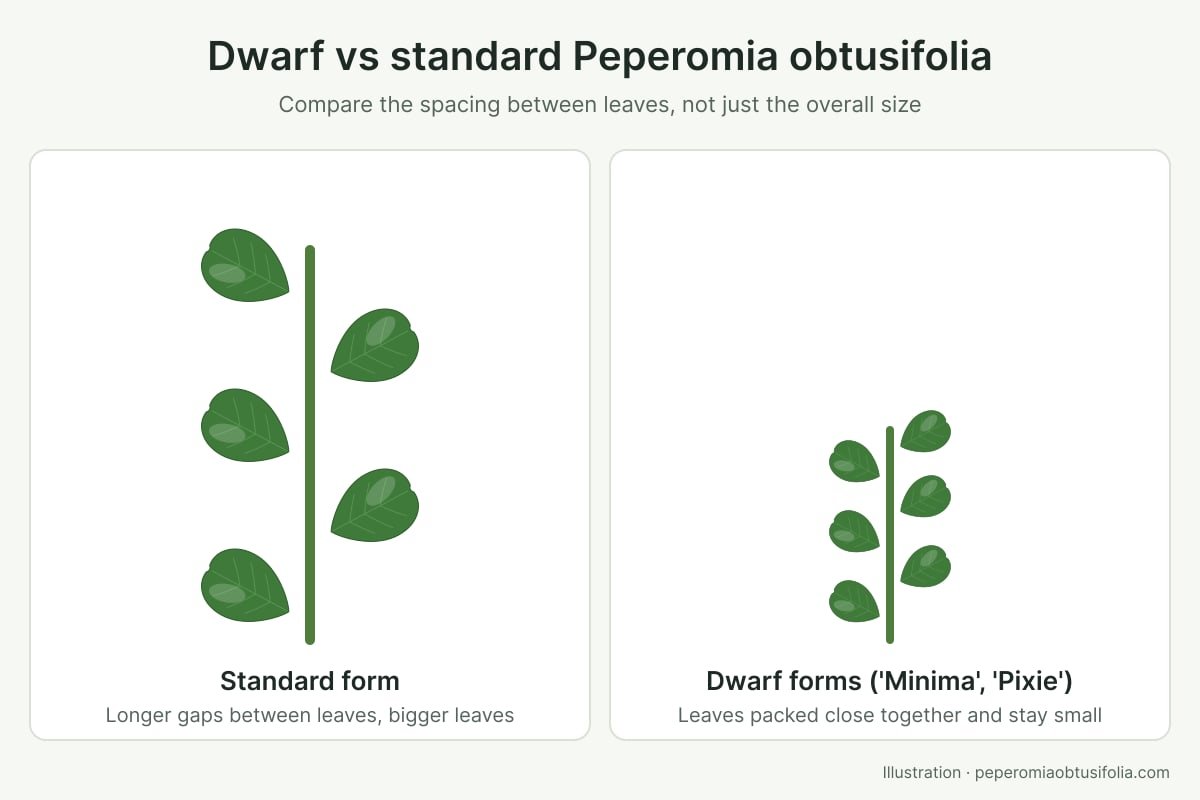
Peperomia obtusifolia 'Pixie' is identified by its naturally compact form and shorter internodes, not by any colour or variegation trait — a miniature growth habit rather than a distinct pattern. It needs the same light as any P. obtusifolia to stay dense and compact, and its tightly packed leaf structure makes bottom-watering a particularly good fit, since top-watering more readily traps standing moisture in its close-set rosette.
Is This Cultivar Name Verified?
'Pixie' is a recognised trade name in the P. obtusifolia cultivar trade describing a naturally compact growth form with shorter internodes and a denser overall silhouette than the species' typical habit, rather than any leaf colour or pattern difference. Since compactness alone is the defining trait, confirm a specimen sold as 'Pixie' genuinely maintains shorter internode spacing under adequate light before assuming the name is accurate — a stretched, leggy specimen under low light can superficially look like a different, less compact cultivar even if it's genetically the same one, simply under-lit.
Identification Traits
Leaves and overall leaf shape match the species baseline — obovate, glossy, solid green — but internode spacing (the distance between leaves along the stem) stays noticeably shorter than a standard specimen under the same light, giving the whole plant a denser, more tightly packed silhouette. Growth habit stays compact and mounding rather than trailing or leggy, provided light stays adequate.
Quick Care Table
| Factor | Requirement |
|---|---|
| Light | 2,000-4,000 lux, bright indirect — same as the species generally, despite the smaller size |
| Watering trigger | Top 2-3 cm of substrate dry; bottom-watering favoured for this cultivar specifically |
| Substrate | Free-draining mix, ~30% perlite or bark by volume |
| Pot size | Only 2-3cm larger than the current root ball — avoid over-potting a small root system |
| Temperature | 18-24°C day; avoid sustained exposure below 10°C |
| Fertiliser | Balanced feed at half strength, monthly, spring-summer only |
Light and Compactness
A common misconception is that a naturally small cultivar needs less light — it doesn't. The mechanism behind Pixie's compact internode spacing is the same light-dependent process behind etiolation in any P. obtusifolia: adequate light (2,000-4,000 lux) keeps internodes short, while sustained light below roughly 800 lux triggers elongation as the plant stretches toward available light, eroding the exact compact form that makes this cultivar distinct in the first place. Bright filtered light — an east-facing window, or a west/south exposure behind a sheer curtain — suits this cultivar well.
Watering, Soil, and Pot Choice
The standard top-2-3cm-dry trigger applies here too, but bottom-watering is a genuinely better default for this specific cultivar: its tightly packed leaf rosette makes it easier for water to collect and linger at the stem base when watered from above, and standing moisture in a low-airflow spot is the entry condition for crown and stem rot. Because Pixie's compact form also means a proportionally smaller root system, size any new pot only 2-3cm larger than the current root mass — the same rule that applies to the species generally, but easier to get wrong here since it's tempting to pot a small plant into a pot that looks proportionate to its leafy canopy rather than its actual, smaller root ball.
Reversion, Propagation, and Pruning
There is no variegation to revert in this cultivar, since it's a solid green growth-habit form rather than a chimeric pattern — the relevant risk is etiolation (loss of compactness under low light) rather than reversion. Because Pixie is naturally compact, it rarely needs structural pruning; removing occasional yellowed lower leaves to improve airflow to the centre of the rosette is usually all that's needed. Propagates the same way as the species generally, via stem cuttings — see the node propagation guide.
Common Problems and Lookalike Cultivars
A stretched, leggy Pixie under insufficient light can look enough like an ordinary green P. obtusifolia that buyers sometimes assume they were sold the wrong plant — in most cases, it's the same cultivar responding to light deficit, correctable by relocating it rather than a labelling error. Crown or stem softening at the centre of the rosette, distinct from ordinary etiolation, points to the water-trapping issue covered above; see the stem rot guide if this is the presentation.
Sourcing and Authenticity Checklist
Look for a specimen already showing tight internode spacing in listing photos, taken under good lighting, rather than one that already looks stretched — a Pixie grown under poor retail lighting may not show its defining trait clearly even if it's genuinely the correct cultivar, so judge more by internode density in the photo than by overall plant size alone.
Care FAQ
Why is my Pixie Peperomia stretching and losing its compact shape?
Insufficient light, the same mechanism as etiolation in any Peperomia obtusifolia. Despite its miniature growth habit, Pixie needs the same 2,000-4,000 lux the species generally requires — being small does not mean it needs less light, and below roughly 800 lux sustained, internodes elongate and the compact form is lost in the affected growth.
Does Pixie need special watering compared to other Peperomia obtusifolia?
The same top-2-3cm-dry trigger applies, but bottom-watering is a particularly good fit for this cultivar specifically, since its tightly packed rosette structure traps water more readily at the stem base when watered from above, raising the risk of crown rot in still, low-airflow conditions.
Does Pixie need a smaller pot than a standard Peperomia obtusifolia?
Yes, proportional to its smaller root system. Moving a compact specimen into a pot sized for a full-size plant leaves excess substrate around a small root mass, which stays wet far longer than the roots can use — size any new pot only 2-3cm larger than the current root ball, the same rule that applies to the species generally.