Peperomia Obtusifolia 'Red Edge': Best Light & Pigment
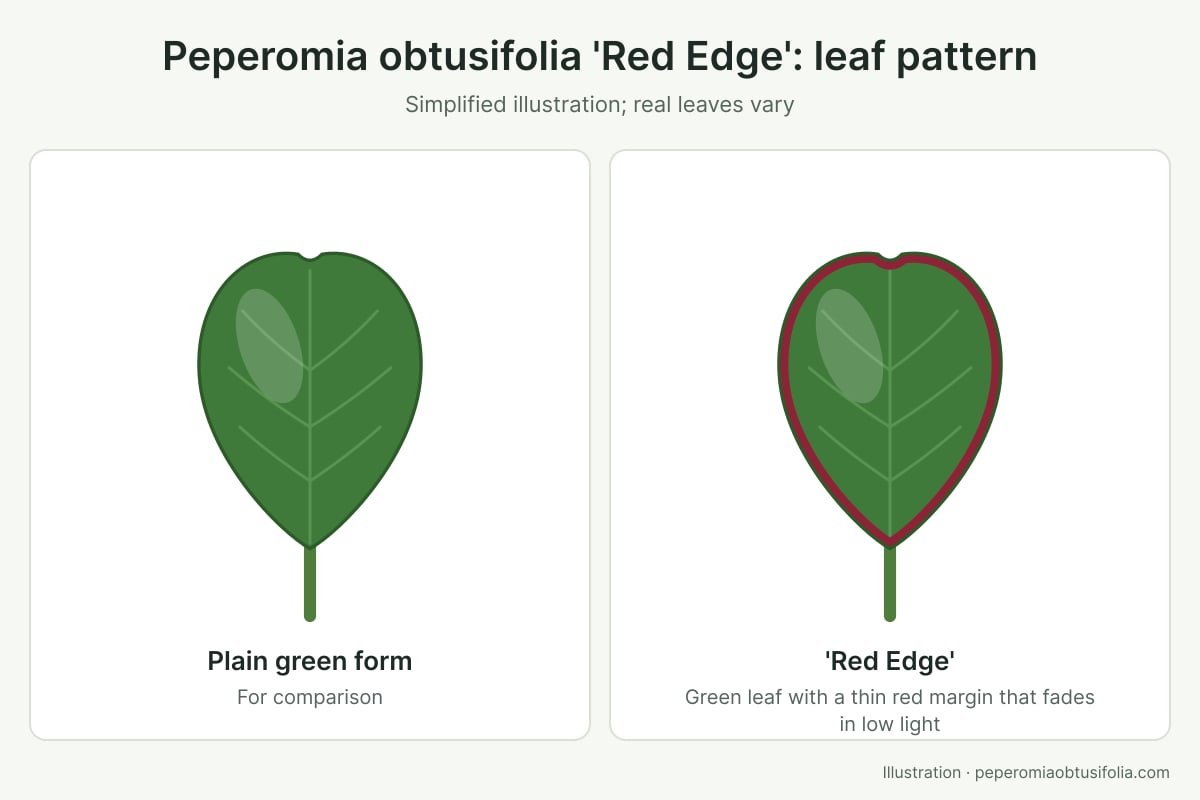
A Peperomia obtusifolia 'Red Edge' with fading margins almost always needs more light, not different watering or feeding. The red pigment is produced in direct response to light intensity, so a plant moved to a dimmer spot will gradually favour chlorophyll over anthocyanin in its new growth — check the light level first before assuming anything else is wrong.
Quick Diagnosis
| What you see | Likely cause | Confirming check | First action |
|---|---|---|---|
| Margins gradually fading toward plain green on new leaves | Light deficit | Lux reading below roughly 2,000 at leaf height | Relocate to brighter indirect light |
| Brown, dry, papery patches on the red margin | Sunburn from unfiltered direct sun | Damage on the side facing the window; occurred after a move into stronger light | Filter with a sheer curtain or move back from the glass |
| Margins more vividly red than usual, otherwise healthy | Cooler seasonal temperatures | Coincides with a temperature drop; no other symptoms | No action needed — this is a normal response |
| Fading combined with yellowing, wilting, or soft stems | A different, unrelated problem | Check for overwatering or root issues specifically | Address as a general care problem, not a pigment issue |
What a Healthy Red Edge Looks Like
A well-lit specimen shows a clear contrast between a deep jade-green centre and a defined maroon-to-red margin, concentrated most heavily at the leaf edge rather than spread evenly across the blade. This marginal concentration isn't decorative placement — the leaf edge is more exposed to light and loses water faster than the centre, so it is where the plant's light-protective pigment matters most. A specimen losing its colour shows this margin thinning and greening gradually, leaf by leaf, starting with the newest growth rather than affecting already-formed leaves.
Why the Red Colour Appears — and Fades
The red comes from anthocyanins, water-soluble pigments stored in the cell's central vacuole rather than in the chloroplasts that hold chlorophyll. Producing them costs the plant real energy, and that cost is why the response is conditional on light: anthocyanins absorb a portion of high-energy light and act as a mild antioxidant, buffering the photosynthetic machinery underneath from stress that bright light can otherwise cause. In good light, that trade-off is worthwhile and margins stay vividly red. In a dim spot, the calculation flips — every unit of energy is better spent on chlorophyll, which captures far more of the limited available light than a light-filtering pigment does, so new growth increasingly favours green over red. This is the same light-dependent reversion pattern documented in variegated cultivars generally, just expressed as colour intensity rather than a chimeric pattern.
Causes Ranked From Most to Least Likely
1. Insufficient light
By far the most common reason new growth comes in less red than older leaves. Confirm it: measure the actual light level rather than judging by eye — a spot that looks reasonably bright to a human eye can still read below the roughly 2,000-4,000 lux optimum this species needs generally.
2. Direct sun scorch on the margin
The pigment offers some protection but not full immunity to unfiltered direct sun, particularly through south- or west-facing glass in summer. Confirm it: damage is localised to the side of the plant facing the strongest light and appeared after a move into a brighter position.
3. Seasonal cold-related intensification
Cooler temperatures can slow the movement of sugars out of the leaf, and elevated sugar concentration is a documented trigger for increased anthocyanin production across many plant species. Confirm it: the change is toward more vivid colour, not less, and coincides with a seasonal temperature drop rather than any other symptom.
Step-by-Step Recovery Plan
If margins are fading: relocate the plant to a brighter spot delivering indirect light in the 2,000-4,000 lux range, confirmed with a meter or phone app rather than assumed by eye. If margins show scorch: filter the light with a sheer curtain or move the plant back from the glass, and treat it the same as general sunburn — the damaged tissue itself won't recover, but new growth under corrected light will be undamaged. What not to do: don't increase fertiliser or change the watering routine in response to fading colour alone, since neither addresses the actual light-dependent mechanism, and don't move a low-light specimen abruptly into strong direct sun to "fix" the fading, which risks scorch instead.
Recovery Signs and Realistic Timeline
Already-faded leaves do not regain their red margin — judge success by new growth instead, which should emerge with a visibly stronger red edge within a few weeks of correcting the light, continuing to intensify over the following months as the plant adjusts fully. Scorched tissue is similarly permanent in the affected leaf; new growth under filtered light should come in undamaged.
How to Prevent Recurrence
Light. Keep the plant in bright, indirect light — filtered south- or west-facing exposure, or an east-facing window — checked periodically with a meter rather than assumed, since a spot's actual light level can drift with furniture changes or the season. Watering. Water only when the top 2-3 cm of substrate is dry, the same as any other P. obtusifolia; waiting for the entire root ball to dry out risks the plant well past its comfortable range. Substrate. A standard free-draining mix — see the soil mix recipe — keeps the roots healthy enough to support the plant's normal pigment production. Cleaning. Wipe dust from the leaves periodically; a dusty leaf surface reduces the light actually reaching the plant's light-sensing tissue, which can compound a marginal light deficit that would otherwise be adequate.
Related Cultivar Guides
For the species' general light framework this cultivar's needs sit within, see the light requirements guide. For a comparison against other named forms, see the varieties guide, the Lemon Lime care guide, the rare varieties guide, and the Marble care guide.
Care FAQ
Why is my Peperomia obtusifolia Red Edge losing its red margins?
Almost always insufficient light. The red pigment (anthocyanin) is produced in direct response to light intensity, and in a dim spot the plant redirects resources toward chlorophyll production instead, since chlorophyll captures more of the limited available light than anthocyanin does. Moving the plant to brighter, indirect light restores the pigment in new growth.
What actually causes the red colour on Red Edge margins?
Anthocyanins — water-soluble pigments stored in the cell vacuole, distinct from the chlorophyll housed in chloroplasts. They are more concentrated at the leaf margins, which are more exposed to light and more prone to water loss than the leaf centre, and they help absorb excess light energy that would otherwise stress the photosynthetic tissue underneath.
Can the red margins get sunburned?
Yes. Anthocyanins provide some protection against excess light, but they are not full sun protection — unfiltered direct sun, particularly through south- or west-facing glass in summer, can still cause the same bleached, papery scorch patches this species shows generally above roughly 40,000 lux.
Does cold weather make the red edges more vivid?
Sometimes, and this is not a problem on its own. Cooler temperatures can slow sugar transport out of the leaf, and elevated sugar concentration is one of the documented triggers for increased anthocyanin production in many plants. A more vivid red edge during a cooler stretch is a normal seasonal response, not a symptom to correct.