Peperomia Minima Care: Best Dwarf Genetics & Watering
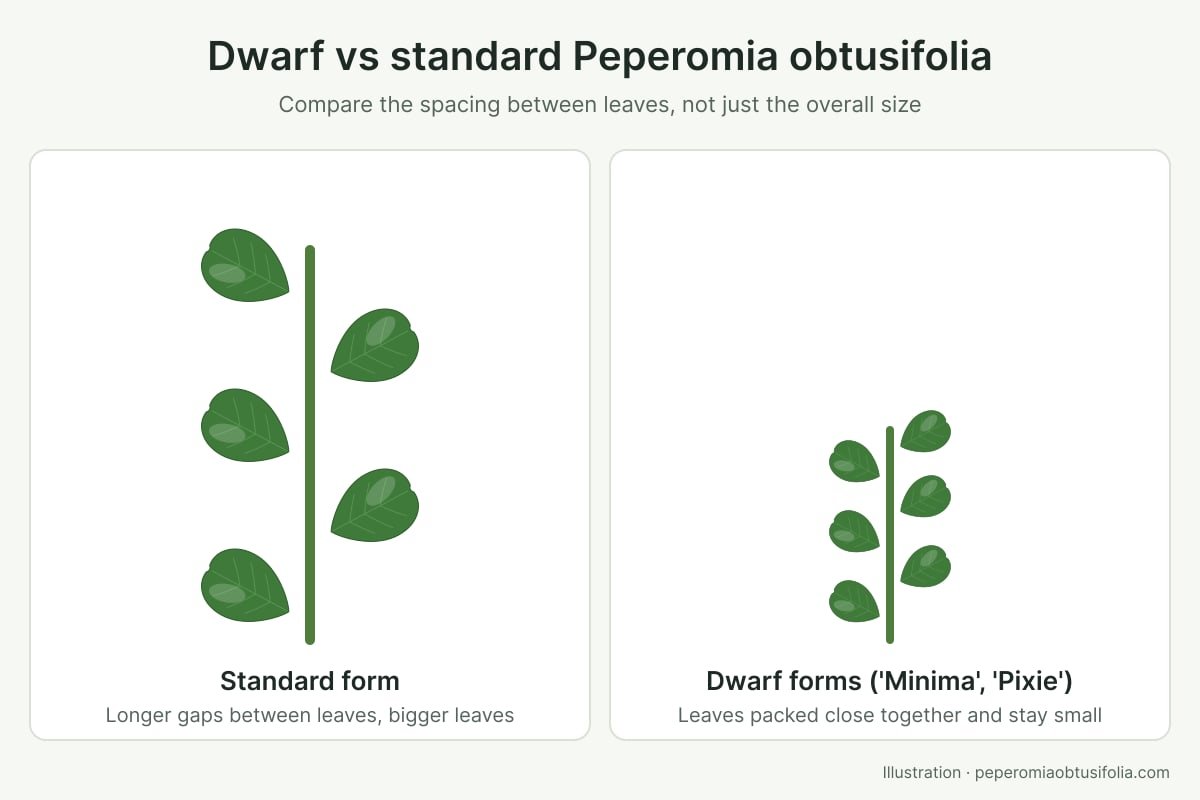
Peperomia obtusifolia 'Minima' is identified by its permanently compact growth habit — tightly compressed internodes and small leaves that stay small throughout the plant's life, not a young or stunted specimen of the standard form. The main practical challenge is proportional care: a dwarf canopy supports a dwarf root system, and treating this cultivar's pot size and watering volume the same as a standard specimen is the most common way to lose one.
Is This Cultivar Name Verified?
'Minima' is a recognised trade name in the P. obtusifolia cultivar trade for a genuine dwarf growth habit — permanently compressed internode spacing and proportionally smaller leaves, distinct from a young plant that simply hasn't grown to full size yet. The compact form persists throughout the plant's life under correct care rather than "growing out" of it. The likely underlying mechanism is reduced sensitivity to gibberellins, the plant hormones responsible for stem elongation, though this has not been specifically confirmed for this cultivar — treat it as a plausible explanation for the compression rather than a verified finding.
Identification Traits
Internode spacing — the distance between leaves along the stem — stays consistently tight throughout the plant's growth, producing a noticeably denser, more compact silhouette than the standard species even in good light. Leaves retain the species' typical blunt, glossy shape but at a proportionally smaller scale. This is a distinct cultivar from 'Pixie', which is also compact but differs in specific leaf shape and proportions — check nursery descriptions carefully if telling the two apart matters for your purposes.
Quick Care Table
| Factor | Requirement |
|---|---|
| Light | 2,000-4,000 lux, bright indirect — same as the species generally |
| Watering trigger | Top of the substrate dry, checked more frequently given the small pot volume |
| Pot size | No more than 2-3cm wider than the current root ball — a small canopy means a genuinely small root system |
| Substrate | Free-draining mix, ~30% perlite or bark by volume |
| Temperature | 18-24°C day; avoid sustained exposure below 10°C |
| Fertiliser | Balanced feed at quarter-to-half strength (proportional to pot size), monthly, spring-summer only |
Light and Compactness
Like any P. obtusifolia, Minima needs adequate light to maintain its form — being naturally compact doesn't reduce its light requirement. Under insufficient light, the plant will still attempt some degree of stretching in response, producing a "leggy dwarf" that combines small leaves with unusually elongated stems for the cultivar — a visibly different, less appealing look than a properly compact specimen. Keep this cultivar in the same 2,000-4,000 lux range as the species generally.
Watering, Soil, and Pot Choice
This is where Minima genuinely differs in practice from a standard-size specimen, though the underlying principle — match pot volume to root mass — is the same rule that applies to the whole species. A small root system in a pot sized for a full-grown plant leaves a large volume of substrate the roots can't draw down between waterings, and that excess substrate stays wet far longer than the plant tolerates, raising root anoxia risk substantially. Size any pot no more than 2-3cm wider than the current root ball — for most of this cultivar's life, that means a genuinely small nursery pot, not a "starter size" to be sized up as it grows. Check top-substrate dryness more frequently than with a larger plant, simply because a small volume of substrate dries faster in absolute terms.
Reversion, Propagation, and Pruning
There is no variegation in this cultivar to revert, since Minima is a solid-green growth-habit form rather than a chimeric pattern — the relevant risk is etiolation (loss of compactness), covered above, not reversion. It rarely needs structural pruning given its naturally compact habit; removing occasional yellowed lower leaves for airflow is usually sufficient. Propagates the same way as the species generally via stem or node cuttings, scaled to the plant's smaller size.
Common Problems and Lookalike Cultivars
Root rot following a repot into an oversized pot is the most common failure mode specific to this cultivar — see the overwatering rescue guide if this has already happened. In a closed or lightly ventilated terrarium, the tightly packed leaves can trap small pockets of still, humid air more readily than an open-growing specimen, raising fungal risk — ensure at least periodic ventilation if growing this cultivar in an enclosed setup, and see the terrarium guide for the general ventilation principles that apply even more strictly here.
Sourcing and Authenticity Checklist
Confirm the specimen shows genuinely compressed internode spacing in listing photos taken under adequate light, rather than a small plant that might simply be young or under-lit — a true Minima should look proportionally denser than a standard P. obtusifolia seedling of similar overall size, not just smaller in scale.
Care FAQ
Will my Minima grow into a full-size Peperomia obtusifolia eventually?
No. Minima is a genuine dwarf cultivar with a permanently compact growth habit, not a young or stunted specimen of the standard form. Its compressed internode spacing stays consistent throughout its life under correct care.
Is Minima the same as Pixie?
No. Both are compact cultivars, but they are separate — Pixie has a somewhat different leaf shape and growth pattern, while Minima is closer to a true miniature of the standard species' proportions at a smaller overall scale. Check specific leaf shape and size against nursery descriptions if the distinction matters for your purposes.
Why did my Minima rot after I repotted it into a bigger pot?
A small canopy generally supports a small root system, and a pot sized for a standard specimen holds far more substrate volume than Minima's roots can draw down between waterings. The excess substrate stays wet long past the point the small root system can use it, raising root anoxia risk substantially. Keep pot sizing closely matched to the actual root ball.
Can Minima be grown in a closed terrarium?
Yes, with attention to airflow. Its tightly packed leaves create small pockets of still, humid air between them more readily than an open-growing specimen, raising fungal risk in a fully sealed enclosure. Some ventilation, even periodic, reduces this risk considerably.